

More news on this day
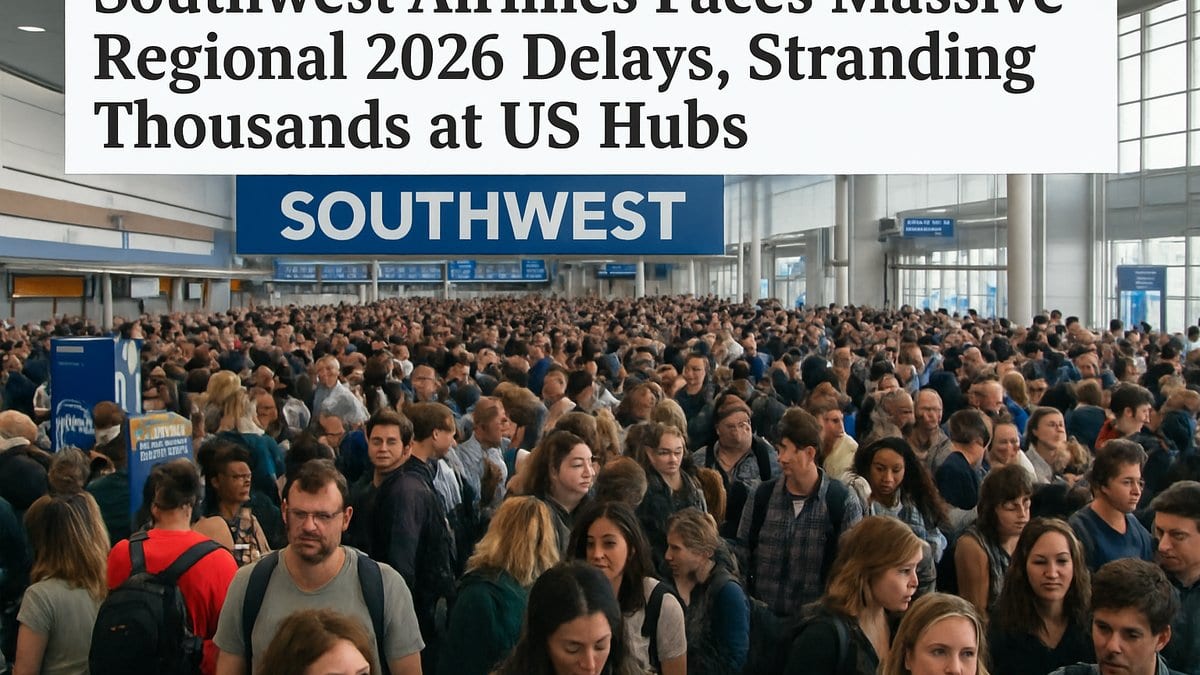
Thousands of Southwest Airlines passengers are facing rolling delays and disrupted connections across major United States hubs in early April 2026, as storms, staffing pressure and a tightly wound point-to-point network combine to create another large-scale operational crunch for the carrier.
Get the latest news straight to your inbox!
Storm Systems and Network Strain Collide
Published coverage of nationwide flight operations in late March and early April 2026 shows Southwest among the most heavily affected airlines as severe thunderstorms, high winds and flooding rain sweep across core Midwestern and Texas air corridors. Flight-tracking data cited in multiple reports indicates that Southwest has logged hundreds of delayed departures on peak days, particularly at busy transfer points such as Chicago Midway, Denver and Dallas Love Field.
One recent national roundup of March 31 and April 1 disruptions describes a systemwide pattern of gridlock centered on Chicago O’Hare and surrounding regional airports, with the same storm complex rippling into Chicago Midway and Denver. In that analysis, Southwest accounted for several hundred delays in a single day, with operations in Denver and Chicago singled out as particularly hard hit as aircraft and crews fell out of position across the network.
Separate reporting focused on Texas airports highlights similar stress on Southwest’s schedule, with double-digit delay rates in Dallas and other key gateways. The airline’s high-frequency, short-haul schedules across the state left it especially vulnerable to rolling delays as storms repeatedly interrupted departures and arrivals, compounding congestion across the region over the course of the day.
These weather patterns are unfolding against a backdrop of already elevated spring storm risk. Seasonal outlooks for April 2026 warn of intensified severe weather across the central United States, including the same corridors that underpin many of Southwest’s busiest routes. Aviation analysts note that even short-lived ground stops and flow-control measures at a few choke-point airports can now cascade through the broader system more quickly than before.
Passengers Stranded at Southwest Focus Cities
The immediate impact for travelers is being felt at airports where Southwest carries a large share of traffic and where many passengers use the airline for same-day connections, despite its point-to-point business model. Chicago Midway, Denver, Dallas Love Field, Houston Hobby, Phoenix, Las Vegas and Baltimore are all cited in recent disruption summaries as experiencing surges in delayed departures, crowded gate areas and long lines at customer service counters.
Reports from nationwide delay tallies this week describe thousands of travelers left in limbo at these hubs as late-arriving aircraft miss their next departure windows and tightly scheduled turnarounds slip behind. At times when regional storm cells repeatedly disrupt departures, some Southwest focus cities have seen rolling holds stretch into multiple hours, forcing last-minute rebookings and overnight stays for passengers.
Regional snapshots, including coverage of multi-airport slowdowns in Texas, underscore how quickly localized weather can strand large numbers of Southwest passengers. When Dallas, Houston and nearby fields all encounter route restrictions or ground delays, aircraft that normally rotate among these cities are unable to complete scheduled sequences. As a result, travelers booked on later legs, including those departing from secondary airports, find themselves without available aircraft or crews even after skies have cleared locally.
Travel industry commentators also note that the disruption is not limited to one-off cancellations. Instead, prolonged operational slippage is increasingly visible as a series of rolling, hour-by-hour delays that leave passengers uncertain whether flights will depart on schedule, be pushed back repeatedly, or ultimately cancel late in the day.
Legacy Vulnerabilities Resurface for Southwest
The current wave of delays is reviving questions about Southwest’s structural resilience that first reached a wider audience during its high-profile scheduling crisis in December 2022. Publicly available postmortems from that event highlighted how the airline’s distinctive point-to-point network, combined with older crew-scheduling tools, made it more difficult for Southwest to recover quickly when large portions of its map were disrupted by winter storms.
While Southwest has since pledged technology upgrades and process changes, analysts observing the 2026 disruptions point out that several of the same pressure points remain in play. A dense web of short-haul flights, reliance on quick aircraft turnarounds and complex crew rotations across multiple cities can amplify the effect of weather-related interruptions far from a given flight’s origin.
Regulatory filings and investor communications in recent years have also acknowledged that Southwest’s operational performance can be disproportionately affected when storms, staffing shortages or air traffic control constraints hit particular regions. The airline has repeatedly cited the complexity of modern aviation networks, describing how simultaneous weather events and infrastructure bottlenecks can slow recovery across an entire schedule.
In the current environment, the airline is navigating those structural challenges while also facing broader industry headwinds, including high demand for pilots and ground staff, congested airspace around key metropolitan areas, and a spring severe-weather season that appears more active than average. Together, these factors have increased the risk that routine disruptions grow into larger regional slowdowns before schedules can be fully stabilized.
Staffing Cuts and Station Changes Add Friction
The turbulence in Southwest’s 2026 operations is unfolding alongside a network and staffing reshuffle that labor groups have been tracking closely. A recent update from a union representing Southwest workers describes station closures and a reduction in force across certain locations as the carrier trims capacity and reallocates resources following the pandemic recovery period and the 2022 meltdown.
Although the announced cuts are targeted rather than systemwide, aviation observers say they may reduce Southwest’s margin for error at affected airports. When ground staff and customer service teams operate with leaner headcounts, periods of intense disruption can quickly overwhelm available personnel, lengthening queues, slowing rebookings and complicating efforts to locate hotel rooms and alternative flights for stranded passengers.
Network planning changes are also reshaping how delays propagate. As Southwest shifts some flying toward stronger markets and new destinations, including additional routes launched in early 2026, its operational pattern is evolving. In practice, this means aircraft and crews are sometimes scheduled over longer chains of flights spanning multiple regions, making it easier for a storm in one area to affect passengers far away hours later.
Industry analysts caution that these changes do not inherently cause delays, but they can magnify the operational impact when irregular operations occur. In combination with staffing adjustments, they contribute to the perception among some travelers that Southwest is operating closer to its limits, with less slack available to absorb shocks during peak disruption days.
What Travelers Can Expect Through Spring 2026
Looking ahead into the remainder of April and the broader spring travel season, aviation weather outlooks and historical delay patterns suggest that Southwest and its customers may continue to face elevated disruption risk across certain regions. Central and southern states served intensively by the airline sit within forecast zones for repeated severe storms, while upper Midwestern corridors can still see late-season snow and ice events that slow traffic at major hubs.
Travel specialists reviewing recent data recommend that passengers planning itineraries on Southwest in the coming weeks treat published schedules as more fluid than usual, especially when relying on tight connections or last-flight-of-the-day departures at key hubs. Longer connection times, early departures and flexible hotel plans are being framed as prudent hedges against cascading delays.
Publicly available delay statistics from recent nationwide events also reinforce a broader lesson for travelers: disruptions are increasingly network-wide rather than confined to a single airport or carrier. When storms, ground stops and staffing pressures converge, they tend to affect multiple airlines at once, though Southwest’s concentration in certain regions and its operational model can make the impact more visible on particular days.
For now, the combination of volatile spring weather, evolving staffing levels and lingering structural vulnerabilities in Southwest’s operation appears set to keep pressure on the carrier’s on-time performance. Passengers moving through its key hubs should be prepared for continued waves of regional delays that, at least periodically, strand thousands and test the airline’s ability to restore its schedules quickly.