

More news on this day
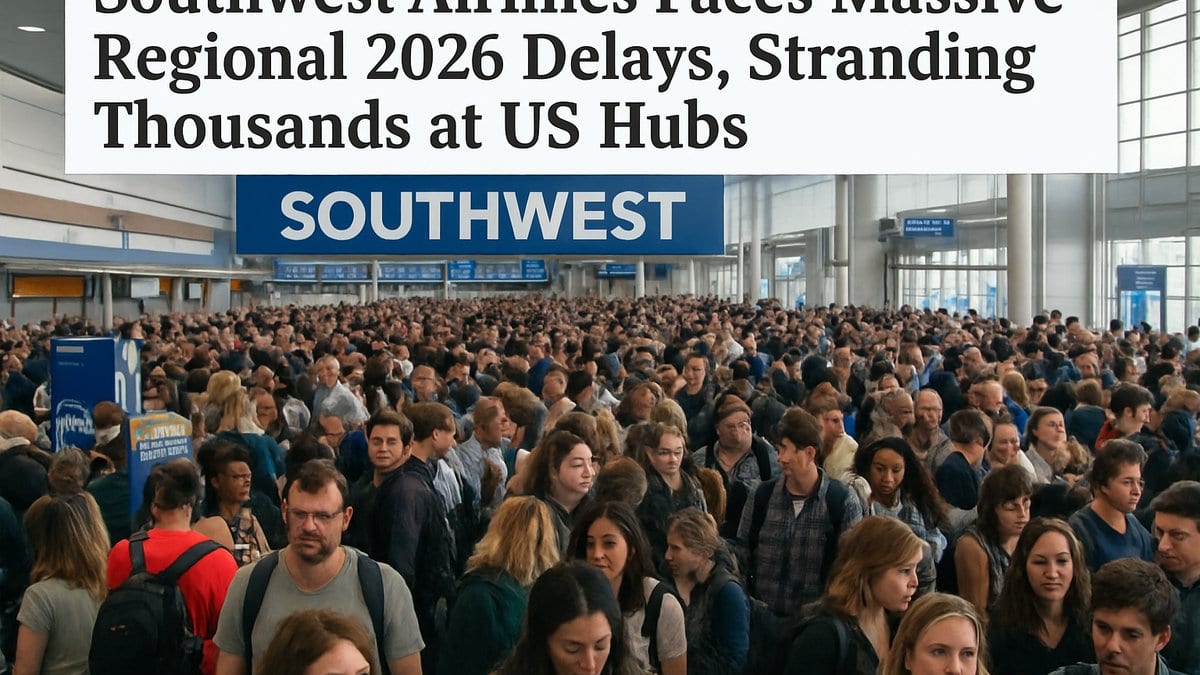
Rolling flight delays across the Southwest Airlines network in early 2026 are stranding thousands of passengers at major US airports, as repeated weather shocks and a tightly wound schedule expose vulnerabilities in one of the country’s most important carriers.
Get the latest news straight to your inbox!
Wave of Delays Builds Through Winter and Early Spring
Publicly available flight-tracking tallies and news coverage indicate that Southwest has faced repeated disruption pulses since late January 2026, coinciding with a series of major winter storms and operational bottlenecks across the United States. Winter weather systems in late January, February, and mid March produced heavy snow, ice, and high winds across broad swaths of the country, repeatedly constraining capacity at busy airports.
Reports on national aviation performance show that during these episodes, overall US delays surged into the thousands per day, with Southwest frequently appearing among the hardest hit airlines by delay counts. While cancellations for the carrier have in many cases remained lower than during its 2022 meltdown, the volume of late departures and missed connections has translated into crowded concourses and long customer service lines at Southwest locations.
Coverage of early April disruption patterns points to a particularly intense peak around April 3, when industry summaries describe nearly 1,000 Southwest delays at key airports and at least a modest number of outright cancellations. That created a backlog of passengers seeking rebooking at airports from Chicago to Los Angeles, compounding strain that had been building for weeks.
For many travelers, the practical impact has been multi hour waits at departure gates, missed family events and business meetings, and in some cases overnight stays at or near airports while they wait for the next available Southwest seat.
Key Southwest Hubs and Focus Cities Under Pressure
Southwest does not organize flights around a traditional hub and spoke system, but its point to point network still relies heavily on a set of large bases and focus cities that function like de facto hubs. Data on scheduled destinations and airline operations shows dense activity at locations including Chicago Midway, Dallas Love Field, Denver, Phoenix, Las Vegas, Baltimore, Houston Hobby, and several busy Florida airports.
Recent reporting on airport performance in 2026 highlights some of these same airports as flashpoints for delays. Articles tracking national disruption patterns have pointed to Chicago Midway and Los Angeles International as sites of heavy Southwest delay counts in early April, while separate coverage has documented crowding and missed connections at Phoenix Sky Harbor, where Southwest operates a large base alongside another major carrier.
In Texas, passenger-rights resources describe nearly 400 delays across Dallas, Houston, and San Antonio on a single early April day, with knock on effects rippling into regional airports served by Southwest and other carriers. When such disruption coincides with strong spring leisure demand, the number of available empty seats for rebooking quickly shrinks, increasing the likelihood that travelers will be stranded overnight at these de facto hubs.
Because these airports connect many smaller cities to the rest of the Southwest network, any ground stop or prolonged delay at one station can propagate across the system, affecting travelers who may never pass through the original problem airport.
Network Design Makes Recovery Slower When Things Go Wrong
Analyses published by aviation and consumer outlets repeatedly note that Southwest’s point to point model behaves differently from the hub based networks used by many large competitors. Instead of concentrating traffic through a handful of central hubs with extensive spare capacity, Southwest spreads aircraft and crews across a wide web of routes, often with rapid turns and limited slack in the schedule.
In practice, this means that a weather ground stop, runway constraint, or air traffic control slowdown at one busy station can quickly cascade, as delayed aircraft and crew fail to reach their next assignments on time. Industry commentary comparing recent performance has emphasized that even modest disruptions can take 24 to 72 hours to fully unwind when aircraft and crews are scattered around the system.
Flight-status dashboards and airport statistics for early 2026 show this pattern in action. A storm system or staffing shortage at a single region can trigger waves of late departures at airports hundreds or thousands of miles away that rely on inbound Southwest aircraft. When the disruption coincides with peak spring-break or holiday demand, there may be few or no open seats on later flights, leaving passengers with limited rebooking options.
This structure does not inherently guarantee poor performance, but the recent string of severe weather events and infrastructure constraints has exposed how thin margins can be when schedules are tightly optimized. The result is a visible buildup of stranded passengers in multiple regions whenever conditions deteriorate.
Passengers Report Long Lines, Limited Options at US Hubs
Accounts collected by travel and consumer publications in recent weeks describe scenes of packed gate areas and customer-service queues at several major US airports. Images published alongside these reports show departure boards filled with delay notices, particularly at airports where Southwest operates a large share of departures.
Commentary from online traveler communities has echoed these descriptions, with multiple posts in March and early April referencing hundreds or even thousands of passengers waiting overnight in terminal seating after flights were delayed beyond crew duty limits or canceled late in the evening. Some passengers report being advised to arrange and pay for their own hotel stays while awaiting rebooking, particularly when weather is cited as the underlying cause of the disruption.
At airports such as Phoenix, Chicago Midway, and various Texas and West Coast stations, reports indicate that concession areas and airport hotels have been stretched by waves of stranded travelers. In some cases, passengers describe waiting until the early morning hours to speak with an agent or secure a confirmed seat for a flight departing one or two days later.
For travelers whose journeys rely on multiple Southwest legs, such as those connecting from a smaller regional field through a larger base en route to a vacation destination, the combination of long lines and limited alternative routings can significantly extend total trip times.
What Travelers Can Expect as 2026 Peak Seasons Approach
Industry observers note that the recent disruption pattern has emerged before the busiest stretches of the 2026 travel calendar, including late spring, summer, and the November and December holiday periods. Public analysis of the broader aviation system points to a mix of strong leisure demand, lingering staffing challenges in some operational roles, and exposure to increasingly volatile weather as key risk factors.
Travel guidance articles responding to the latest delays suggest that passengers flying on Southwest in the coming months may want to build additional buffer time into their plans, particularly when traveling through historically delay prone airports or connecting to cruises, tours, or international flights operated by other carriers. Recommendations commonly include booking earlier departures, monitoring weather forecasts along the route, and making active use of airline apps to track rebooking options.
Passenger advocates emphasize in public materials that US regulations do not guarantee compensation for weather related delays or cancellations, and that each airline’s voluntary commitments vary. Because of this, travelers affected by the recent Southwest disruptions have in many cases had to rely on credit-card protections, travel insurance, or personal funds to cover hotel stays and meals when stranded.
For the broader US travel landscape, the strain on Southwest’s regional operations serves as a test of how the carrier and airports will handle further shocks in 2026. If the current pattern of strong demand, tight schedules, and frequent severe weather persists, similar waves of delay and passenger stranding may continue to surface at US hubs throughout the year.