

More news on this day
Hundreds of Southwest Airlines passengers were left stranded or facing hours-long waits at airports across the United States after the carrier delayed 1,139 flights and canceled 34 more, snarling operations at key hubs in Denver, Chicago, Phoenix, Las Vegas and Dallas and rippling across the national route network.
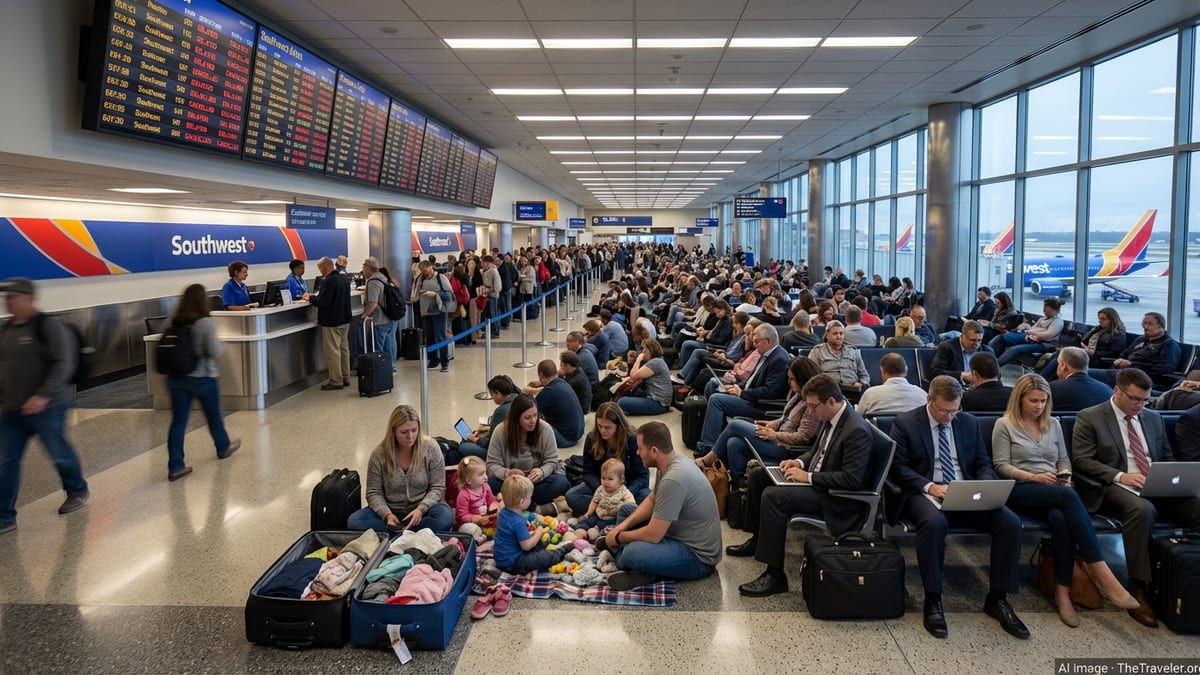
Major Disruptions Across the Southwest Route Network
The latest wave of disruption hit some of Southwest’s largest bases and focus cities, triggering crowded gate areas, snaking customer-service lines and mounting frustration among travelers who had expected routine domestic journeys. Flight-tracking data showed 1,139 Southwest-operated flights delayed and 34 canceled over the course of the day, a volume that put the Dallas-based carrier among the most affected airlines in the country by midafternoon.
At Denver International Airport, where Southwest is the largest carrier by number of departures, departures boards filled with yellow and red status changes as delays cascaded through the schedule. Similar scenes unfolded at Chicago Midway, Las Vegas Harry Reid International, Phoenix Sky Harbor and Dallas Love Field, all of them key nodes in the airline’s point-to-point network. Travelers reported being held on the tarmac awaiting available gates, while inbound aircraft arriving late further compressed already tight turnaround times.
The problems quickly radiated across the rest of Southwest’s system. Because the airline relies heavily on through-flights and aircraft that make multiple hops in a single day rather than feeding traffic through one or two big hubs, delays at a few major airports can easily magnify into widespread operational strain. By late day, disruptions were being felt on routes far from the initial chokepoints, including secondary and leisure-focused airports that depend heavily on Southwest for service.
While the precise breakdown of causes varied from airport to airport, the combined effect for customers was similar: heavily crowded terminals, long waits for rebooking and missed onward connections at the height of the busy travel period. For many, the latest episode revived memories of past mass disruption events at the carrier, even as Southwest has insisted it has invested in technology and staffing to avoid a repeat of those breakdowns.
Scenes of Frustration at Denver, Chicago and Phoenix
At Denver International Airport, long lines formed early as Southwest passengers tried to speak with gate agents, customer-service staff and baggage representatives. Travelers arriving to find their departures delayed by multiple hours described sitting on the floor near power outlets, watching their boarding times repeatedly slip. Families with young children clustered around gate areas while business travelers attempted to rebook using airline apps and third-party tools, often finding remaining seats either scarce or significantly more expensive.
Chicago Midway, another crucial Southwest stronghold, saw its own share of disruption as a large share of the carrier’s schedule through the airport ran late. The compact terminal layout, which on busy days already strains to accommodate heavy passenger flows, became noticeably congested. Baggage carousels loaded with late-arriving luggage added to the sense of disorder, and customer-service desks saw multi-hour queues as travelers attempted to salvage same-day connections to destinations across the Midwest and East Coast.
In Phoenix, where Southwest is a dominant player on intra-Western routes, staffing pressures intersected with the day’s operational hiccups to create lengthy delays. Passengers reported pushback times repeatedly revised in 30- and 60-minute increments and boarding processes paused while crews or aircraft were repositioned. With Sky Harbor serving as a key connecting point between California, the Mountain West and the Southwest, the disruption there complicated plans for travelers heading to or from smaller regional markets that typically have limited alternative options.
For many affected customers, the most immediate pain point was uncertainty. Status boards and mobile apps sometimes lagged behind reality, reflecting outdated departure times or showing flights as “on time” even as boarding remained halted. That information gap left travelers refreshing screens, listening for gate announcements and trading updates with one another in an effort to piece together what was happening to their flights.
Las Vegas and Dallas Love Field Face Ripple Effects
Las Vegas Harry Reid International Airport, a major leisure destination and Southwest stronghold, experienced heavy knock-on effects as delayed aircraft arrived late from other parts of the network. Passengers on early-morning flights saw relatively modest wait times, but as the day wore on delays began to stack, with some departures from Las Vegas pushed back by several hours. The airport’s already bustling concourses filled with stranded vacationers and convention attendees seeking out food, power outlets and quiet corners to wait out the disruption.
Dallas Love Field, Southwest’s home base and corporate headquarters airport, was similarly strained. With a dense schedule of short-haul flights throughout Texas and to neighboring states, even minor timing issues can cascade quickly. On this day, delayed aircraft arriving from Denver, Chicago and Phoenix triggered further slippage for flights leaving Dallas, squeezing turn times and forcing some aircraft to depart without all connecting passengers who were still making their way across the airfield.
The point-to-point structure of Southwest’s network means that delays are not easily contained in one region. Many planes flying out of Dallas and Las Vegas had earlier originated in cities like Denver or Chicago, where issues were already in motion. When those aircraft ran behind schedule, the impact propagated almost automatically to subsequent flights, frustrating even those travelers whose trips did not pass through the hardest-hit airports.
For airport operations teams, the knock-on nature of the disruptions complicated gate assignments, ground-handling staffing and baggage logistics. Bags meant to be transferred briskly from one aircraft to another frequently missed connections, leading to piles of unclaimed luggage in some claim areas and forcing additional manual sorting and delivery runs once flights finally departed.
Passengers Confront Missed Events and Added Costs
Behind the statistics on delays and cancellations were thousands of individual itineraries upended, from weekend getaways to milestone events. Travelers at several affected airports described missing weddings, family reunions, job interviews and international connections because of the cascading schedule changes. In some cases, even relatively short delays of 90 minutes or two hours were enough to cause missed onward flights on other carriers, especially at coastal gateway airports.
Many stranded passengers faced immediate out-of-pocket costs. With same-day seats limited on alternative airlines, available tickets were often priced far above what travelers had originally paid. Hotel rooms near major airports quickly filled as evening approached, forcing some customers to stay downtown or in outlying areas and rely on ride-hailing services or taxis. Food expenses mounted as what had been envisioned as a two- or three-hour airport transit turned into a full day spent in the terminal.
Parents traveling with children and elderly passengers were particularly vulnerable to the disruption. For families, juggling meals, naps and entertainment in crowded concourses added to the stress of uncertainty about when or whether they would depart. Older travelers and those with mobility limitations reported difficulty accessing timely assistance, especially when gate agents were inundated with long lines of customers seeking rebooking or answers.
Social media platforms filled with posts from passengers documenting their experiences, sharing photos of crowded terminals and lengthy lines, and trading advice on how to navigate the disruption. While some praised individual frontline employees for their efforts, many comments reflected broader frustration with what customers perceived as limited communication and an airline system that still feels fragile after several years of high-profile breakdowns.
Southwest Response and Ongoing Regulatory Scrutiny
Southwest Airlines said it was working to stabilize its operation, reposition aircraft and crews and get customers on their way as quickly as possible. The carrier typically points to a combination of factors behind days with significant delays, including weather, air traffic control constraints, staffing and maintenance issues. On this occasion, officials acknowledged that the scale of delays was well above normal but emphasized that the majority of flights were still operating.
The airline remains under heightened scrutiny from federal regulators after its December 2022 holiday meltdown, when winter storms and internal scheduling failures led to more than 16,000 canceled flights and millions of stranded passengers. That event prompted a record enforcement action from the Department of Transportation and commitments by Southwest to upgrade its crew-scheduling technology, bolster staffing and build more resilience into its operations.
Consumer advocates say that continued large-scale disruptions, even on days with far fewer outright cancellations, demonstrate how sensitive modern airline networks remain to strain. They argue that carriers, including Southwest, continue to operate with tightly wound schedules and limited slack in aircraft and crew availability, leaving little margin for recovery when weather, traffic control constraints or technical issues arise. Regulators have signaled they will continue to monitor whether airlines are scheduling more flights than they can reliably operate.
For Southwest, each new round of high-visibility disruption risks further erosion of the goodwill it has long enjoyed among many travelers for its low fares, free checked bags and flexible policies. The company has emphasized that the 2022 holiday crisis was an outlier and has highlighted subsequent operational improvements, but days like this one serve as a test of whether those investments have translated into a more resilient day-to-day operation.
What Passengers Can Do When Flights Are Delayed
For travelers caught in the latest wave of Southwest delays, the immediate priority is getting to their destination as efficiently as possible. Aviation analysts advise affected passengers to simultaneously use multiple channels for rebooking, including the airline’s mobile app, website and telephone agents, rather than relying solely on airport counters that can quickly become overwhelmed. In some cases, re-routing through less congested airports or accepting connections on later flights can improve odds of same-day arrival.
Passengers whose flights are significantly delayed or canceled may be entitled to refunds or travel credits depending on the circumstances. While U.S. regulations do not require compensation for delays in the same way that European rules do, airlines are required to provide refunds if a flight is canceled and the passenger chooses not to travel. Following its 2022 holiday debacle, Southwest also agreed to offer vouchers in certain cases where delays or cancellations are within the airline’s control, such as staffing or maintenance issues.
Experts recommend that travelers maintain detailed records of their disruption, including screenshots of flight status updates, receipts for meals and lodging, and any written communication from the airline. These can be useful if customers later seek reimbursement or file complaints with the Department of Transportation. Travel insurance, when purchased, may cover some incidental costs, although coverage terms vary widely among policies and providers.
Looking ahead, frequent travelers say they increasingly factor an airline’s recent operational performance into their booking decisions, particularly for trips tied to important events. While Southwest continues to carry more domestic passengers than any other U.S. airline, repeated high-disruption days could prompt some customers to split their loyalty, spreading risk by booking across multiple carriers or choosing early-morning departures that historically face fewer knock-on delays.
Broader Strains on the US Air Travel System
The Southwest disruptions unfolded against a backdrop of broader tension in the U.S. air travel system, where demand has rebounded strongly while infrastructure and staffing have struggled to keep pace. Air traffic control centers in several regions continue to grapple with personnel shortages, and major hub airports are operating near or at capacity during peak periods. In that environment, any operational hiccup at a large carrier can reverberate quickly across shared runways and airspace.
Weather remains a central wild card, with convective storms in summer and snow and ice in winter regularly triggering ground stops, de-icing delays and reroutes. When combined with tight airline schedules and limited reserve crews, even localized bad weather can cause large numbers of delays that then propagate nationwide. For point-to-point carriers like Southwest, which depend on aircraft cycling through many cities per day, that sensitivity can be especially pronounced.
Industry observers note that while airlines and regulators have launched initiatives aimed at improving resilience, such as investments in modernized air traffic control technology and updated crew-management systems, these changes take years to implement and fully realize. In the meantime, passengers are likely to continue experiencing periodic days of severe disruption, particularly at congested hubs and during peak travel seasons.
For now, the hundreds of Southwest customers stranded or heavily delayed across Denver, Chicago, Phoenix, Las Vegas and Dallas serve as a stark reminder that the post-pandemic air travel recovery remains a work in progress. Even as overall cancellation rates have fallen compared with some previous years, the experience on any given travel day can still hinge on the fragile choreography of planes, people and technology that keeps the system aloft.