

More news on this day
Southwest Airlines Flight 2094 from Nashville to Fort Lauderdale made an unscheduled landing at Hartsfield-Jackson Atlanta International Airport on Friday night after the crew reported a possible security matter involving a passenger, prompting a rapid diversion and hours-long disruption for travelers.
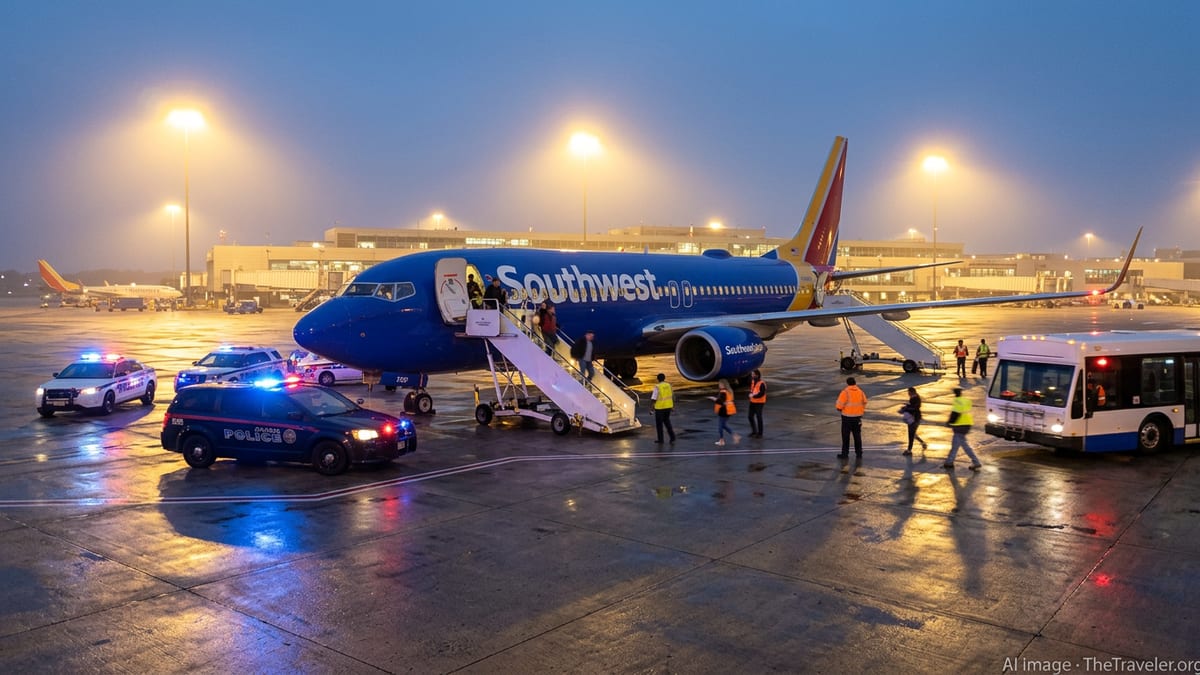
Unscheduled Landing Follows Mid-Air Security Concern
The Boeing 737 operating Flight 2094 departed Nashville International Airport at approximately 7:15 p.m. Central time on March 6, bound for Fort Lauderdale-Hollywood International Airport with a full load of evening travelers heading to South Florida. Midway through the flight, the crew notified air traffic control of a security-related incident on board and requested an immediate diversion to Atlanta, one of the Southeast’s primary aviation hubs.
The aircraft landed safely at Hartsfield-Jackson Atlanta International Airport just after 9 p.m. local time, according to flight-tracking data and airline statements issued Saturday. Atlanta officers, working alongside federal partners, met the aircraft on arrival as it taxied to a remote stand away from the main terminal operations.
Southwest Airlines described the situation as a “possible security matter” and said the decision to divert was made out of an abundance of caution. The airline emphasized that safety protocols were followed and that the landing in Atlanta was uneventful from an operational standpoint.
Passenger Removed, No Credible Threat Found
Law enforcement officers boarded the aircraft after it reached its designated parking position and removed one passenger from the flight. The individual was detained on site as agents and officers conducted interviews and initial checks, while the rest of the passengers remained on board or in a secure area of the airfield.
By Saturday morning, federal authorities in Atlanta confirmed that an investigation into the incident had determined there was no credible ongoing threat. No explosives or weapons were reported found, and officials said no criminal charges were filed against the passenger who was initially detained in connection with the disturbance.
Atlanta Police Department officials said their officers assisted federal partners in handling the response at Hartsfield-Jackson, which has detailed protocols for dealing with in-flight security reports. While specific details of what prompted the concern were not released, multiple local outlets reported that the crew had cited a passenger disturbance and possible threatening remarks.
The lack of charges underscores how seriously crews are trained to treat any perceived security risk, even when an incident ultimately proves not to involve an active threat. Aviation security specialists say that in the post-9/11 environment, erring on the side of caution has become standard operating procedure for carriers and flight crews.
Hours-Long Delay and Rebooking for Stranded Travelers
Once authorities cleared the aircraft in Atlanta, Southwest made the decision to transfer customers to another plane rather than continue the journey on the diverted jet. Passengers on Flight 2094 were rebooked onto a different aircraft later in the night, with some spending several hours in secure areas as the airline and airport worked through the logistics.
The replacement aircraft departed Atlanta in the early hours of Saturday, and travelers finally arrived in Fort Lauderdale just before 3:30 a.m. local time, according to statements from the airline and passenger accounts. What was scheduled as a relatively short evening hop from Tennessee to South Florida turned into a lengthy overnight ordeal for many on board.
Southwest said it contacted all affected customers to apologize for the disruption and significant delay. The carrier indicated that standard customer service policies would apply, which can include vouchers or other gestures of goodwill in cases of major irregular operations, although specific compensation packages were not publicly detailed.
Despite the inconvenience, many travelers indicated to local media and on social platforms that they were relieved the crew had taken the report seriously and that the incident ended without injuries. The safe completion of the journey, albeit hours behind schedule, was widely viewed as a positive outcome given the initial nature of the concern.
Security Protocols and Airline Response Under Scrutiny
The diversion of Flight 2094 highlights how airlines rely on layered security measures and close coordination with law enforcement to respond to potential in-flight threats. Cabin crew members are trained to identify concerning behavior, de-escalate conflicts when possible, and quickly notify the cockpit and ground authorities if they suspect a safety or security issue may be developing.
Once a flight reports a possible security matter, air traffic control and the airline’s operations center begin working through established checklists. That can include redirecting the aircraft to the nearest suitable airport with robust law enforcement and emergency services, arranging for remote parking stands, and coordinating boarding by officers upon arrival.
Southwest praised the professionalism of its crew in public statements following the diversion, reiterating that “nothing is more important than the safety of its customers and employees.” The airline noted that while such incidents are rare relative to the number of flights operating daily across its network, crews train repeatedly for a range of scenarios, from medical emergencies and disruptive passengers to suspected security threats.
Aviation analysts say that the handling of Flight 2094 will likely be reviewed internally by both Southwest and federal agencies, as is standard after any security-related diversion. Those reviews typically examine communication timelines, coordination among agencies, and passenger handling to determine whether established protocols worked as intended or need refinement.
Impacts on Operations and Traveler Confidence
Friday’s diversion added to an already busy evening for Atlanta’s vast airfield, where thunderstorms and routine congestion often test the resilience of airline schedules. While the incident involved only a single flight, unscheduled arrivals can ripple through operations as ground crews, gates, and law enforcement resources are reassigned to handle an unexpected aircraft.
For travelers connecting onward from Fort Lauderdale to Caribbean and South American destinations on Saturday morning, the late-night arrival of Flight 2094 may have forced last-minute changes to hotel plans, cruise embarkations, and early departures. Travel advisors note that the event is a reminder of why flexible booking options and robust travel insurance can be valuable when irregular operations arise from security or safety concerns.
At the same time, experts point out that the swift response and eventual determination of no credible threat can bolster confidence in the system among frequent flyers. Diversions like this are visible evidence that crews and authorities are empowered to act decisively whenever there is a question about safety, even on relatively short domestic routes.
As of Saturday afternoon, Southwest reported that its Nashville and Fort Lauderdale operations were running close to normal, with Flight 2094’s disruption largely confined to the group of passengers on board. For those travelers, the experience was an unwelcome reminder that even routine point-to-point domestic journeys can change course quickly when security concerns arise in the skies.