

More news on this day
Southwest Airlines flight attendants are heading into a critical vote on union dues and internal rules, a high-stakes decision that will test member unity less than two years after securing a landmark pay deal and following multiple failed attempts to update their local’s financial structure.
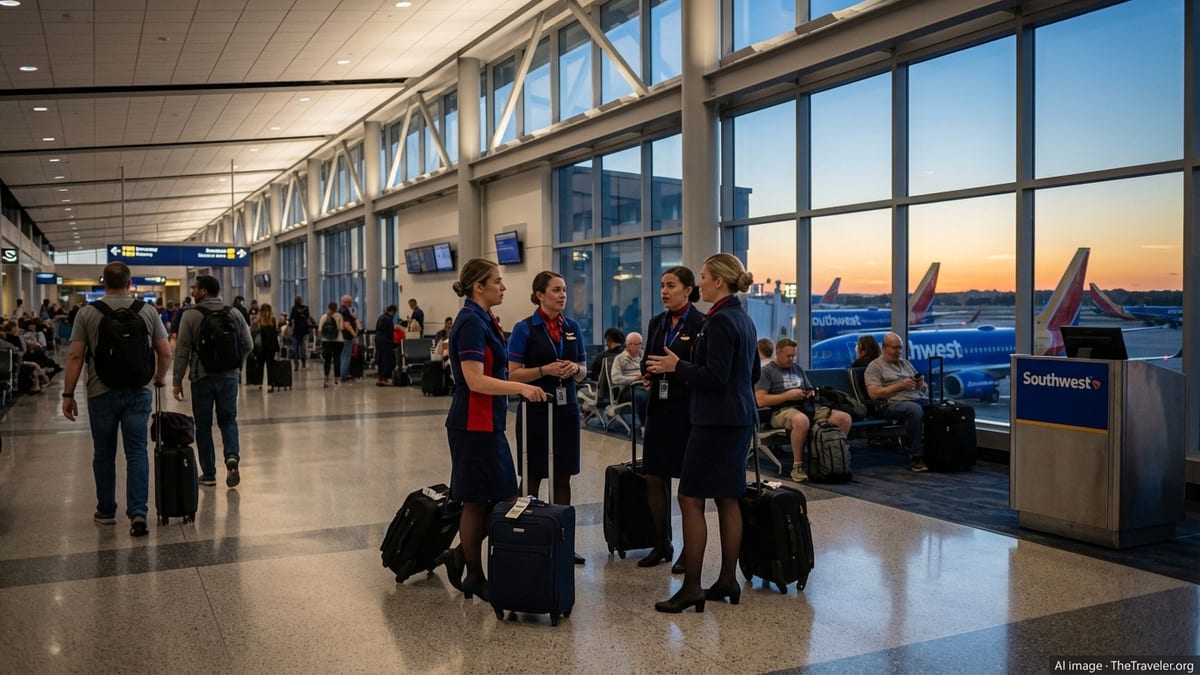
A New Flashpoint After a Hard-Won Contract
The upcoming dues and bylaws vote for Southwest Airlines flight attendants comes at a delicate moment for Transport Workers Union Local 556, which represents more than 20,000 cabin crew members across the United States. In April 2024, members overwhelmingly ratified a contract that delivered some of the biggest wage gains in the carrier’s history, including an immediate raise of more than 22 percent and annual increases through 2028, following an earlier tentative agreement that had been rejected by a wide margin.
That contract, valued in industry reports at roughly $6.3 billion over four years, also included substantial retroactive pay, quality-of-life improvements and company-paid maternity and parental leave. It was heralded by labor advocates as a new standard for flight attendants, positioning Southwest’s crews near the top of the industry in both hourly pay and work rules. Yet even as the pay dispute with management was resolved, long-simmering internal questions about how the union funds its operations and represents an expanded workforce remained unresolved.
Those questions have now converged in a fourth attempt to revise Local 556’s dues structure and internal governance rules. Three previous proposals reportedly failed to win enough support from members, reflecting a deep divide over how much rank-and-file flight attendants should pay, how those funds are managed and what level of resources the union needs to respond to an airline still reshaping its network, bases and staffing model.
For a profession defined by constant movement and unpredictable schedules, the outcome of this vote could help determine how effectively flight attendants can mobilize in the next round of bargaining when their new contract becomes amendable in 2028.
Why the Dues Question Has Become So Contentious
Union dues are often a technical subject, but at Southwest the issue has taken on symbolic weight after years of tense talks, operational disruptions and shifting expectations for cabin crews. Local 556 has ballooned to more than 21,000 members as the airline expanded its network, adding complexity to grievance handling, scheduling disputes and safety issues. Union leaders argue that rising legal, communications and organizing costs require a modernized dues structure if they are to keep pace with an increasingly sophisticated management and a rapidly changing airline industry.
Many flight attendants, however, view dues through the lens of the long contract fight that preceded the 2024 agreement. A tentative contract that would have delivered cumulative wage gains of around 36 percent over five years was decisively rejected by 64 percent of voting members in December 2023 after leaders initially urged ratification. That episode fueled skepticism among some rank-and-file members about how the union evaluates deals and communicates risks, and it sharpened scrutiny of how dues dollars are being spent on bargaining and outreach.
The union’s leadership has responded by emphasizing the scale of recent wins and the cost of achieving them, pointing to industry-leading raises and improved scheduling protections in the ratified contract. They have also highlighted the need for robust strike preparedness and legal resources under the strict rules of the U.S. Railway Labor Act, which governs airline labor relations and makes it difficult for workers to strike without a lengthy federal mediation process. For officers and activists pushing for a revised dues model, the vote is being framed as an investment in the union’s long-term leverage.
Opponents counter that any increase in financial burden must be weighed against continuing economic uncertainty for many crew members, who often contend with inconsistent hours, volatile trip pairings and high out-of-pocket costs tied to layovers and commuting. They argue that better transparency and cost controls within the local could deliver many of the same benefits without raising dues, and they worry that higher assessments could disenfranchise newer or lower-paid members.
Three Failed Attempts and a Fourth Try
Local 556 has already brought three versions of a revamped dues and bylaws package to its membership, only to see each one fail under intense internal debate. While specific language has varied, proposals have generally sought to adjust the formula used to calculate dues, refine how reserve funds are managed and clarify governance procedures for elections and disciplinary processes. In each round, critics have zeroed in on perceived shortcomings, from concerns about centralized authority to questions about how much discretion the Executive Board should have over spending.
The latest proposal, now heading toward a vote, reflects lessons learned from those earlier defeats. Union officials have held membership meetings across the network and increased digital communications, attempting to explain the financial realities of representing a workforce spread over multiple crew bases and satellite stations. They have also stressed the potential risks of going into the next contract cycle without a more stable funding model, particularly as other unions across the industry step up their own organizing and bargaining campaigns.
Still, the history of failed votes looms large. Some flight attendants say repeated referendums on dues have caused frustration and a sense of “vote until you get it right,” echoing complaints that surfaced after the union briefly pursued a revote on the rejected 2023 contract. Others welcome the persistence, arguing that high-stakes structural changes deserve multiple attempts and robust debate before they are locked in.
What is clear is that the fourth vote will carry more than just accounting consequences. After years in which contract negotiations with Southwest dominated union life, the dues question has become a proxy for deeper disagreements over leadership style, communication and how much centralization is necessary to represent a sprawling, highly mobile membership.
Operational Shifts Put More Pressure on Crews
The internal union vote comes as Southwest continues to recalibrate its network and crew strategy following the December 2022 holiday meltdown and a softer revenue environment. The airline has taken public steps to curb costs and streamline operations, including the closure of satellite flight attendant bases in Fort Lauderdale and Austin as part of a broader efficiency push. Those moves have forced hundreds of flight attendants to weigh whether to relocate, change base assignments or endure longer commutes, adding another layer of stress to an already demanding job.
At the same time, Southwest is pursuing growth opportunities in key markets such as Austin, where local officials have approved economic incentives to support an expanded presence and potential new training facilities. That juxtaposition of base closures and growth investments has not been lost on flight attendants, who say it underscores the need for a strong union capable of ensuring that cost-cutting does not erode the work-life balance gains secured in the 2024 contract.
For travelers, the internal reshuffling of crew bases can translate into subtle changes in service patterns, reliability and staffing on certain routes. While the airline has pledged that customers will continue to see the same level of care and hospitality, union leaders warn that a mismatch between staffing realities and corporate ambitions could once again strain the operation, especially during peak travel periods.
In that context, the dues vote is not just about spreadsheets. It is about whether Local 556 will have the financial capacity to contest scheduling changes, challenge disciplinary actions and engage with regulators on issues like rest requirements and cabin safety protocols that can directly affect the passenger experience.
Industry Context: Flight Attendant Unrest Nationwide
Southwest’s internal struggle over dues and governance is unfolding against a broader wave of activism among U.S. flight attendants. At United and American, unions are still locked in contract talks or moving toward new tentative agreements after years without significant raises. At regional carriers, cabin crews have pursued joint contracts and midterm improvements as mergers and fleet transitions reshape their workplaces.
In recent years, major pilot unions at Delta, American, United and Southwest have secured contracts that delivered pay increases of roughly a third or more over several years, along with improved retirement and scheduling provisions. Flight attendants, who work under different unions and contracts at each airline, have been determined not to be left behind, organizing informational pickets, social media campaigns and high-profile demonstrations at airports across the country.
Southwest’s 2024 contract ratification was widely seen as a turning point in that campaign, both because it delivered substantial raises and because it included industry-first paid maternity and parental leave provisions for cabin crew. Labor organizers say that success has raised expectations for what is possible at other airlines but has also increased pressure on Southwest flight attendants to defend and build on their gains when negotiations reopen in a few years.
The dues debate, then, is not happening in isolation. It is intertwined with a broader industry conversation about how flight attendants can maintain bargaining power in a sector marked by volatile demand, high capital costs and intense investor scrutiny. Many union activists argue that well-funded locals are essential to meeting that challenge, while skeptics remain wary of any measures that feel like they are asking members to shoulder a disproportionate share of the burden.
Member Sentiment: Solidarity Tested on the Line
On layovers and in crew lounges, the impending vote is a frequent topic of conversation among Southwest flight attendants. Some say they are inclined to support the new dues structure out of a belief that a stronger union is the best insurance against future concessions. They point to the experience of 2023 and early 2024, when intense member mobilization and a willingness to reject an initial tentative agreement helped secure a better contract at the bargaining table.
Others are more cautious, expressing concern that repeatedly revisiting union finances distracts from day-to-day workplace issues that still need attention, from hotel quality and transportation to fatigue management and enforcement of scheduling rules. They question whether the local has done enough to demonstrate how previous dues revenue has been deployed and to provide clear line-of-sight into budgets, reserves and officer expenses.
Local 556 has tried to bridge that divide by circulating financial summaries and hosting question-and-answer sessions, while also encouraging members to participate in membership meetings and committee work. Whether those efforts are enough to rebuild trust among skeptics is likely to be one of the key factors in the outcome.
For many rank-and-file flight attendants, the dilemma is personal as well as political. Union dues are deducted from paychecks that must also cover housing in high-cost base cities, commuting expenses, family obligations and, for some, student loans or caregiving responsibilities. The vote forces a calculation about how much they are willing or able to invest in collective infrastructure today in the hope of greater security tomorrow.
What the Vote Means for Future Bargaining
Regardless of how the membership decides, the dues and bylaws referendum is likely to shape Local 556’s approach to the next round of bargaining when its current contract becomes amendable in 2028. If the proposal passes, union leaders will have a mandate to pursue a more expansive strategy that could include increased staff support, more comprehensive communications and stronger research capabilities to counter management proposals.
A rejection, particularly after three earlier failed attempts, would send a different message. It could be interpreted as a call for greater internal reform, more direct democracy or even leadership change before members are willing to approve any new financial commitments. It might also prompt fresh discussions about alternative funding mechanisms, such as targeted assessments tied to major bargaining campaigns or legal actions, rather than permanent increases in base dues.
For Southwest itself, the vote will be closely watched as a barometer of labor relations. A more unified and well-resourced union could mean tougher, more sophisticated negotiations next time around. On the other hand, visible internal divisions might embolden management to push harder on productivity, scheduling flexibility and other priorities, betting that a fragmented membership will struggle to mount a sustained response.
Travelers, too, have a stake in the outcome, even if they never see the inside of a union hall. Contract disputes and labor unrest can filter down to the airport gate in the form of pickets, informational campaigns or, in extreme cases, service disruptions during peak travel seasons. While U.S. law makes strikes rare and heavily regulated in commercial aviation, the level of trust and collaboration between flight attendants and management can have a profound effect on the overall travel experience.
A Pivotal Moment for Southwest’s Labor Identity
For more than five decades, Southwest has cultivated an image as a uniquely employee-friendly airline, proud of the fact that it went more than half a century without mass layoffs and touting a culture rooted in humor, informality and frontline empowerment. That identity has been tested in recent years by the pandemic, the 2022 operational meltdown and a shifting competitive landscape that has forced the carrier to balance cost discipline with growth ambitions.
The flight attendants’ dues vote will not, on its own, determine whether Southwest maintains that reputation. But it is a revealing moment in which the values the company espouses and the expectations of its workers intersect. If the union emerges from the process with a clearer, more widely accepted financial framework, it could strengthen the collaborative side of that relationship, giving both parties a more stable foundation for future talks.
If the vote deepens internal rifts or leads to further rounds of contentious debate, it may signal that the scars of recent negotiations and operational challenges run deeper than the pay raises and bonuses of 2024 can heal. In that scenario, the airline could face a more fragmented workforce at precisely the time it needs cohesive crews to navigate growth plans, competitive pressures and an increasingly demanding travel public.
As ballots are cast, Southwest’s flight attendants once again find themselves at the center of a story that extends far beyond any single contract clause or dues formula. The outcome will help define not just the internal workings of their union, but also the broader trajectory of labor power in one of America’s most closely watched airlines.