

More news on this day
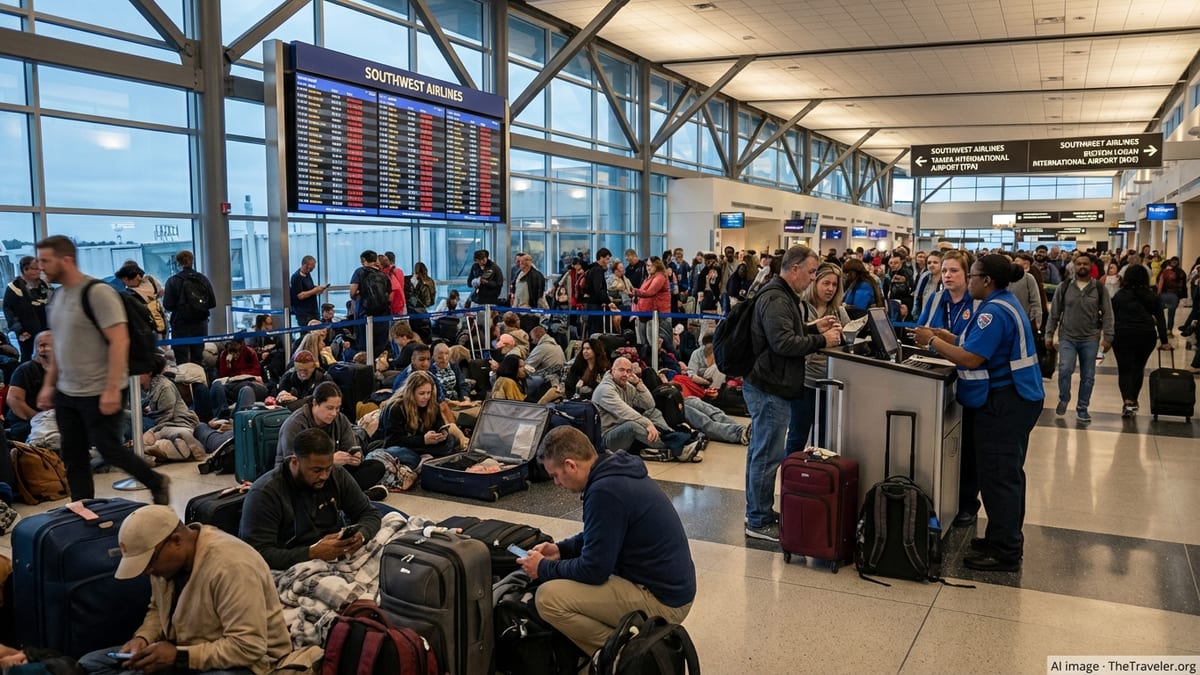
Thousands of Southwest Airlines passengers were stranded at airports across the United States on Sunday after the carrier suspended 335 flights and delayed more than 500 others, snarling travel through major gateways including Tampa, Fort Lauderdale, San Juan, Louisville and Boston and triggering a fresh wave of frustration for travelers who had counted on the airline’s promise of a more reliable operation.
Wide-Ranging Disruptions Hit Key Southwest Cities
The latest disruption unfolded across a broad swath of Southwest’s domestic network, with early morning departures among the first to be scrubbed. Tampa International, Fort Lauderdale-Hollywood International, San Juan’s Luis Muñoz Marín International, Louisville Muhammad Ali International and Boston Logan International all reported clusters of canceled and heavily delayed Southwest flights, leaving concourses crowded with passengers tracking departure boards that shifted by the minute.
Data compiled from flight-tracking services showed that the 335 suspensions represented a sizable portion of Southwest’s planned schedule for the day, while more than 500 additional flights were delayed, often by several hours. The pattern pointed to a systemic disruption rather than isolated weather issues, as aircraft and crews fell out of position and delays rippled outward across the network.
Southwest, the nation’s largest domestic carrier by passenger numbers, relies on a point-to-point system that can make it efficient in normal times but vulnerable when a disruption hits a key node. With multiple early morning departures from cities like Tampa, Fort Lauderdale and San Juan into Baltimore/Washington International and other large bases scrubbed, the carrier quickly found itself short of aircraft and crews for onward flights.
The result for travelers was an all-too-familiar scene: crowded gate areas, snaking customer-service lines and passengers recharging phones on terminal floors as they tried to rebook trips via apps and call centers. For many, the latest turmoil revived memories of previous high-profile disruptions in the U.S. airline industry and raised questions about whether carriers have done enough to build resilience into their operations.
Early-Morning Wave of Cancellations Centered on Baltimore Routes
A closer look at the day’s schedule showed a heavy concentration of cancellations on routes feeding into Baltimore/Washington International, one of Southwest’s busiest hubs. Flights from Tampa, Fort Lauderdale, Indianapolis, San Juan, Detroit, Louisville, Cleveland, Boston, Columbus, Miami, Rochester, Sarasota-Bradenton and Raleigh-Durham to Baltimore were all wiped from the schedule, according to detailed airport-level data.
Among the suspended services were a Tampa to Baltimore flight scheduled for just after 5 a.m. Eastern time, a Fort Lauderdale to Baltimore departure blocked at the same time, and a San Juan to Baltimore service that had been set to depart shortly before dawn in the Caribbean. Additional cancellations from cities including Louisville, Detroit and Boston underscored how quickly the disruption spread across multiple states and time zones.
Passengers on those routes found themselves especially exposed. Many had booked early flights to make tight connections onward to other cities or to arrive in time for cruises, work commitments or family events. When the initial wave of suspensions hit, alternative options dwindled rapidly as later Southwest flights filled and other carriers operating similar routes saw a surge in last-minute demand.
The heavy focus on Baltimore routes also created knock-on effects throughout Southwest’s system. Aircraft and crew rotations designed to feed later services from the Maryland hub were thrown off balance, contributing to an expanding roster of delays that affected travelers far from the original trouble spots, including in the Midwest and on the West Coast.
Scenes of Frustration and Fatigue at Affected Airports
At Tampa International, travelers arriving before dawn expecting a routine departure instead encountered growing lines at Southwest counters as gate agents announced that early flights to the Northeast and Mid-Atlantic would not operate. Families heading to connecting flights, snowbirds returning north and leisure travelers bound for weekend getaways all faced the same question: how to reach their destinations before the end of the day.
In Fort Lauderdale, a key gateway for Caribbean and Latin American travel as well as domestic routes, the mood in Terminal 1 turned tense as departure boards flickered with red cancellation notices. Passengers on suspended flights to Baltimore, and those connecting onward to cities throughout the Midwest, scrambled to secure remaining seats on later departures or considered making the hour-long drive to Miami in search of alternatives.
San Juan’s Luis Muñoz Marín International, a crucial link between Puerto Rico and the U.S. mainland, also saw travelers stranded after an early Baltimore-bound flight was grounded. For some, the cancellation meant missing medical appointments or work shifts on the mainland. Others worried about hotel bills and the cost of last-minute rebooking on competing carriers that were already heavily booked due to robust winter travel demand.
In Louisville and Boston, business travelers and students returning to campus described wandering between gates and customer-service desks as agents attempted to rebuild itineraries on the fly. Some accepted reroutes through secondary hubs or agreed to overnight stays, while others opted for road trips of eight hours or more after deciding that driving would get them to their destinations sooner than waiting on spare seats.
Southwest Faces Fresh Scrutiny Over Operational Resilience
The disruption comes at a sensitive time for Southwest, which has spent the past two years working to repair its reputation after earlier operational crises and pledging to invest heavily in technology and staffing upgrades. The airline has publicly highlighted improvements to its network operations center and touted stronger on-time performance in recent months, positioning itself as more resilient during periods of strain.
Industry analysts say that while a single day of 335 cancellations and more than 500 delays does not approach the scale of some past nationwide meltdowns, it nonetheless raises renewed questions about how major carriers manage risk in an era of tight staffing, congested airspace and packed schedules. With U.S. airlines operating at or near record capacity on many routes, the margin for error has shrunk, making cascading disruptions more likely when things go wrong.
Consumer advocates note that travelers’ patience with large-scale disruptions has thinned after repeated episodes in recent years involving several U.S. and international airlines. Passengers caught in the latest Southwest turmoil reported difficulties accessing real-time information on the status of their flights, as well as lag times in customer-service response as call centers and chat lines were overwhelmed during the morning rush.
For regulators and policymakers, the incident provides another data point in ongoing debates over airline accountability and passenger rights. While the precise causes of the latest wave of cancellations were not immediately clear, federal officials have previously emphasized that carriers are expected to adhere to customer-service commitments, provide prompt refunds when flights are canceled and ensure that passengers receive timely, accurate information during major disruptions.
Ripple Effects Across the National Air Travel System
Although Southwest accounted for the bulk of the cancellations highlighted in Sunday’s data, the disruption reverberated throughout the broader U.S. aviation system. Major airports from Florida to New England reported elevated levels of congestion at security checkpoints, boarding gates and baggage-claim carousels as delayed flights arrived late and multiple departures sought to push back simultaneously once ground holds were lifted.
At Boston Logan, one of the hardest-hit airports in the Northeast on busy travel days, Southwest’s schedule hiccups added to a day already marked by elevated delays across several carriers. The result was a complex operational puzzle as gate space, runway slots and ground-handling resources were stretched, occasionally forcing arriving aircraft to wait for available gates and compounding delays for connecting passengers.
In Tampa and Fort Lauderdale, where several airlines were already managing robust winter demand, Southwest’s cancellations strained rental car fleets and nearby hotels as stranded travelers sought backup plans. Airport officials reported steady but manageable pressure on customer-assistance desks and urged travelers to monitor flight-status tools and arrive early, even for rebooked flights, to account for longer lines.
The issues also highlighted the interconnectedness of the national aviation network. When a carrier like Southwest experiences concentrated disruption at a handful of key airports, the impacts can quickly ripple to smaller markets that depend on those hubs for connections. Travelers in mid-sized cities, from the Midwest to the Southeast, reported finding their flights delayed or crew-short because aircraft coming from places like Baltimore, Boston or Florida had never departed.
Passengers Scramble for Alternatives and Assistance
As the day wore on, many Southwest customers turned to a mix of digital tools and old-fashioned persistence to salvage their travel plans. Some travelers reported modest success using the airline’s mobile app and website to self-rebook onto later flights, though limited inventory on popular routes meant that many options were already fully booked by mid-morning.
Others chose to pivot to competing carriers, especially in large markets served by multiple airlines. In Boston, Miami and Tampa, passengers queued at ticket counters for alternative airlines or used online fare-search tools in hopes of finding reasonably priced last-minute seats. Several travelers said they faced steep one-way fares as demand surged, forcing difficult choices between absorbing the extra cost or postponing trips.
For those who could not secure same-day flights, ground transportation became the fallback. Rental car agencies in Tampa, Fort Lauderdale and Louisville reported brisk business, with some locations nearing capacity. Groups of stranded passengers arranged shared drives to cities within a manageable radius, such as road trips from Louisville to Chicago or from Tampa to Atlanta, calculating that hours on the highway might be more predictable than waiting out airport delays.
At the same time, questions swirled about compensation and support. Passengers sought clarity on whether they were entitled to hotel vouchers, meal credits or refunds depending on the circumstances of their cancellations and delays. Many turned to federal consumer resources and media coverage to better understand their rights, underscoring the growing role of transparency in how travelers navigate airline disruptions.
Airports and Crews Work to Restore Normal Operations
Behind the scenes, airport operations teams and Southwest ground staff spent the day working to untangle the network. Repositioning aircraft and crews became the top priority, as schedulers attempted to rebuild sequences that would allow the airline to operate as much of its later schedule as possible while honoring mandatory crew rest rules that limit how long pilots and flight attendants can be on duty.
At major airports such as Tampa, Fort Lauderdale and Boston, Southwest agents repeatedly updated passengers about shifting departure times, gate changes and aircraft assignments. While some travelers expressed appreciation for the front-line staff doing what they could with limited options, others voiced frustration that concrete answers about departure times remained elusive well into the afternoon.
Airport officials in several affected cities emphasized that coordination with the airline and federal air traffic managers remained constant throughout the disruption. Efforts focused on smoothing peak periods at security checkpoints and boarding gates, making space on tarmacs and gate areas for aircraft that were able to operate, and ensuring that baggage-handling systems kept up with the churn of rebooked passengers and rerouted luggage.
By late in the day, operational data suggested that Southwest was beginning to stabilize parts of its schedule, though residual delays were expected to persist into the evening and potentially into the following day for some routes. Industry observers noted that the speed and effectiveness of the recovery would be closely watched by travelers and regulators alike as a measure of how much progress the airline has made in strengthening its resilience.
What Travelers Can Do If Their Flight Is Affected
For passengers caught up in Sunday’s disruptions, travel experts advised a combination of preparation, persistence and documentation. Checking flight status frequently through both the airline’s official channels and independent tracking services can provide early warning of potential problems, allowing travelers to request rebooking before flights are formally canceled and options disappear.
Experts also urged passengers to understand their rights when a flight is canceled or significantly delayed. In many cases, travelers whose flights are canceled by the airline are eligible for refunds if they choose not to travel, even for nonrefundable fares. Those who opt to continue their journeys may request rebooking at no additional cost, and some carriers offer meal or hotel assistance in certain circumstances, particularly when disruptions are within the airline’s control.
When airport lines are long and call centers are overloaded, experienced travelers recommend using multiple channels at once: standing in line at the gate or ticket counter while simultaneously reaching out through apps, websites or social-media messaging. In some cases, alternate airports within driving distance, such as Miami instead of Fort Lauderdale or Providence instead of Boston, may offer more flexible options for rebooking.
Finally, travel planners say that building buffers into itineraries, especially when connecting to cruises, international flights or important events, can provide a measure of protection in an era when airline systems remain vulnerable to weather, staffing and technical shocks. While no strategy can fully insulate travelers from a day of widespread cancellations like the one Southwest experienced, thoughtful planning and quick action can make the difference between a ruined trip and an inconvenient delay.