

More news on this day
Southwest Airlines is grappling with a convergence of operational and labor pressures as cramped overhead bins, delayed turnarounds and simmering contract disputes fuel growing frustration among crews and customers across the United States.
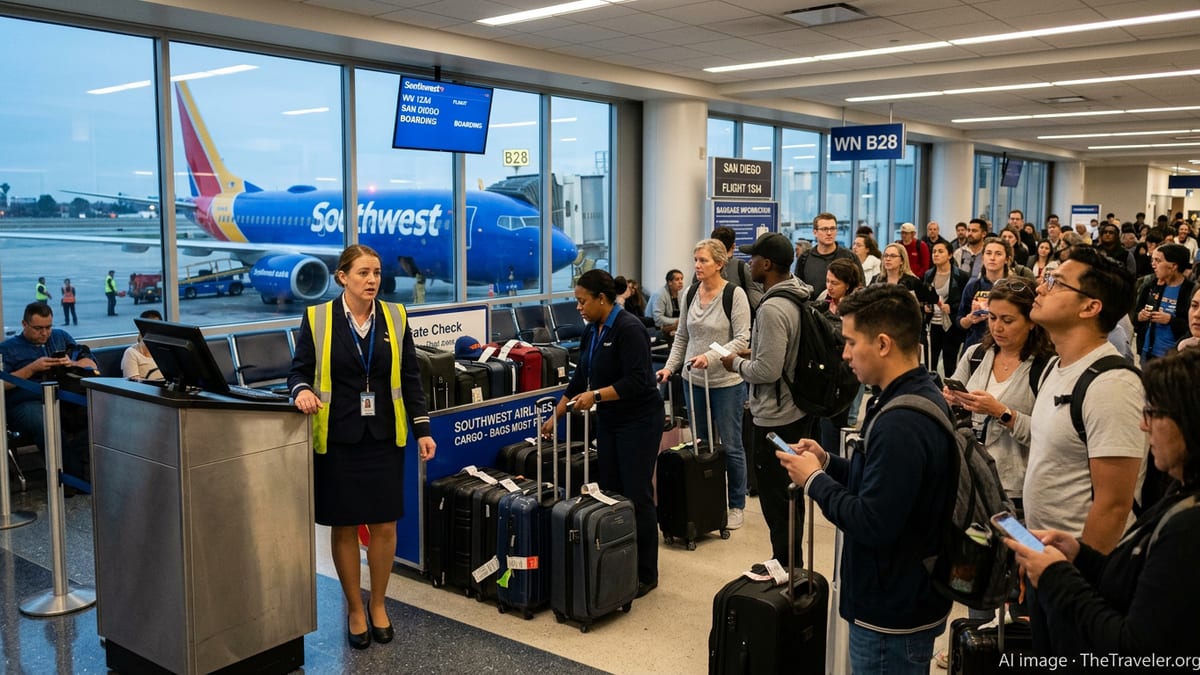
Overhead Bin Squeeze Adds New Strain to Cabin Operations
As domestic air travel rebounds, Southwest’s Boeing 737 fleet is struggling to keep pace with demand for carry on space. Passengers boarding full flights routinely encounter already packed overhead bins, prompting hurried reshuffling in the aisle and forcing late gate checks that slow every stage of the boarding process.
Flight attendants and gate agents say the lack of consistent space has become a flashpoint on busy routes, particularly at hubs such as Dallas Love Field, Denver and Chicago Midway. Crews report more frequent disputes over bag size, confusion about what must be checked and rising tempers as travelers watch precious minutes tick by before departure.
The bin crunch is especially acute on aircraft that have not yet been fitted with roomier pivot bins that several competitors now advertise as standard. While Southwest has invested in cabin refreshes in recent years, uneven retrofit schedules and strong load factors mean many customers still board to find limited storage and little guidance on how space will be managed.
For front line staff, that uncertainty translates into more emotional labor at the very start of a flight. Workers say they are increasingly forced to mediate between anxious passengers and a rigid departure clock, often without clear, enforceable policies that match real world demand for overhead space.
Turnaround Times Slip as Boarding and Ground Delays Mount
Southwest built its reputation on quick, efficient turnarounds that kept aircraft in the air and fares relatively low. In recent seasons, however, the squeeze in the aisle and at the bins has begun to erode that advantage. Longer boarding times, more last minute gate checks and frequent reseating to balance weight and accommodate families are stretching once brisk ground operations.
According to union leaders, the airline’s tightly packed schedules leave little margin when boarding stalls, leading to late departures that ripple through the day. Crews describe days when a single delayed flight due to congestion in the cabin or a slow deplaning process can cascade into missed connections and unexpected duty time extensions.
The Department of Transportation has already targeted Southwest over what regulators call unrealistic scheduling, focusing on flights that have been chronically late and raising questions about whether the carrier has properly aligned staffing and aircraft utilization with current conditions. Those concerns intersect directly with the realities of today’s crowded cabins, where any disruption multiplies if there is no spare capacity built into the schedule.
Passengers, meanwhile, are increasingly vocal on social media and at the gate, questioning why the airline has not moved faster to modernize bin design, tighten enforcement of carry on limits or adjust its famously fast boarding routine to reflect a more complex operational environment.
Labor Groups Decry Staffing, Pay and "Unrealistic" Schedules
Behind the scenes, Southwest’s unions have framed the overhead bin crunch and delayed turnarounds as symptoms of deeper labor issues. Leaders of the Transport Workers Union, which represents flight attendants and ramp agents, have criticized the company for what they describe as chronic understaffing and an overreliance on tightly packed schedules that leave workers little room to recover from disruption.
Union officials argue that when boarding bogs down because of limited bin space or crowded jet bridges, the pressure falls squarely on crew members who must absorb customer frustration while also trying to protect safety and on time performance metrics that factor into their evaluations. They say the erosion of buffer time on the ground has left crews regularly working to the limits of their duty days.
Recent federal action has bolstered those concerns. The Transport Workers Union has applauded a Department of Transportation lawsuit accusing Southwest of chronically delaying certain routes as a result of unrealistic scheduling, calling it a validation of workers’ long standing complaints about being asked to execute flight plans that do not reflect real world operating conditions.
For many employees, the clash over scheduling and staffing has become inseparable from disputes about pay and benefits. Workers argue that if management expects them to shoulder the burden of operational fragility, compensation and protections must keep pace.
Contract Tensions Persist Despite High Profile Deal
Southwest’s relationship with its labor groups has been under the microscope since the airline’s 2022 holiday meltdown, and the current operational strains have only sharpened that focus. In 2024, flight attendants represented by Transport Workers Union Local 556 secured a new contract after years of contentious bargaining, winning significant wage increases and new quality of life measures.
The deal positioned Southwest flight attendants among the best compensated in the industry and included first of its kind provisions for paid parental leave and revised reserve rules. Union leaders hailed it as a hard fought milestone after members had worked for years under an amendable agreement while navigating operational chaos and a global pandemic.
Yet the ink on that contract has not erased underlying tensions. Local leaders continue to warn that compensation improvements alone cannot offset the stress of operating in cabins where overhead space and time are persistently short. They contend that without structural changes to scheduling, staffing levels and aircraft utilization, workers will keep bearing the brunt of delays that damage both morale and the brand.
Other workgroups, including ramp and operations agents, have raised similar concerns, arguing that pressure to turn planes quickly in the face of systemic constraints is contributing to burnout and attrition at a time when airlines can ill afford to lose experienced staff.
Customer Experience and Brand Promise on the Line
The combined effect of labor friction, overhead bin shortages and slipping turnarounds reaches far beyond crew rooms and corporate boardrooms. Southwest, long marketed as a friendly, no nonsense carrier that makes flying simple, now faces a test of whether it can maintain that identity under intensifying operational strain.
Travelers increasingly share stories of boarding queues that barely move, overhead bins that fill by the midway point of the cabin and arguments sparked when late arriving passengers find no space for their bags. For families and business travelers alike, those moments can overshadow the airline’s hallmark perks such as no change fees and free checked bags.
Analysts note that Southwest is not alone in facing these pressures, as carriers across the industry confront crowded flights, evolving bag policies and labor groups emboldened by a tight job market. But because Southwest’s model depends so heavily on rapid turnarounds and high aircraft utilization, any sustained friction in boarding or baggage handling may have an outsized impact on its performance.
For now, the carrier is under growing pressure from workers, regulators and passengers to address the overlapping challenges in its cabins and on its ramps. How swiftly and decisively it responds could help determine whether Southwest can navigate the current turbulence without compromising the reliability and customer friendly service that have defined its brand for decades.