

More news on this day
Travelers flying through Dallas and Houston on Southwest Airlines are getting a first look at the carrier’s most sweeping boarding overhaul in its history, a strategy designed to tame crowded aisles and overflowing overhead bins on some of the nation’s busiest domestic routes.
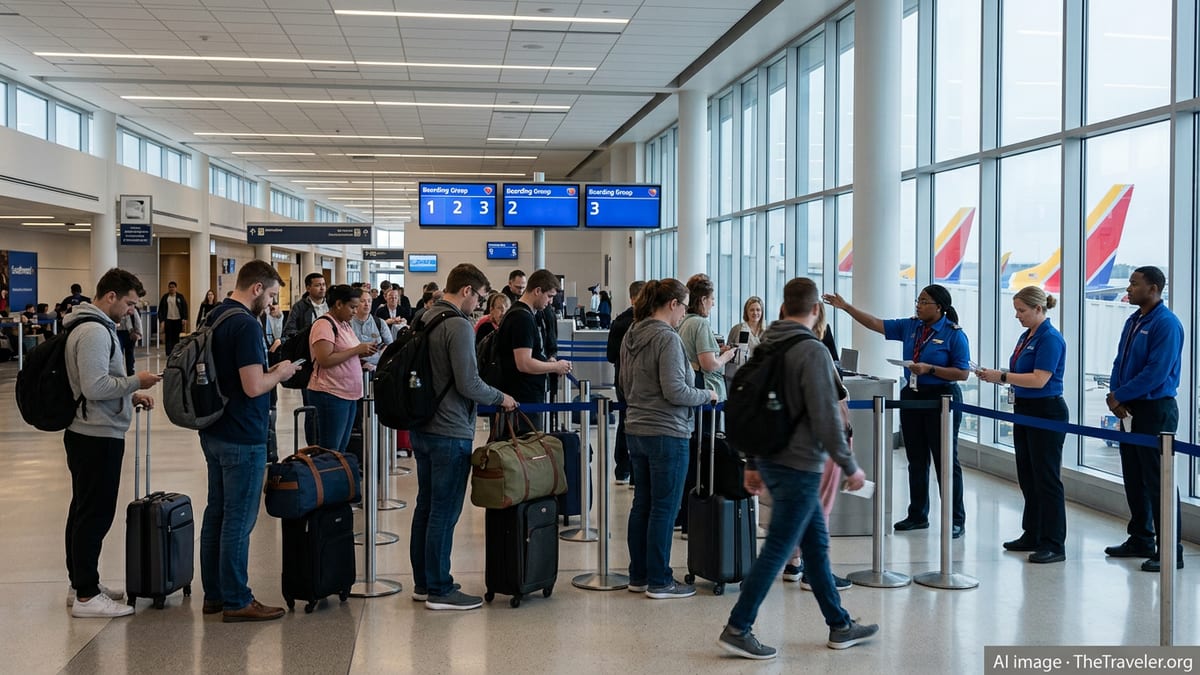
New Boarding Groups Replace A–B–C System
Southwest’s new boarding strategy, now rolling out on flights from Dallas Love Field and Houston’s Hobby Airport, replaces the familiar A, B and C groups with eight numbered boarding groups tied to assigned seats. The change, effective for flights operating with assigned seating from January 27, 2026, represents a sharp departure from the long-standing open seating model that let customers choose any available seat after boarding.
Under the new design, every traveler is allocated a specific seat in one of three cabin zones: Extra Legroom toward the front and exit rows, Preferred in the forward and mid-cabin, and Standard toward the rear. Boarding priority is linked to both seat type and fare bundle, with higher-priced Choice Extra and frequent flyers boarding earlier, followed by Preferred and then Standard seats in later groups.
For passengers used to jockeying for position in the boarding lane to secure overhead bin space, Southwest is betting that clear boarding tiers and defined seat locations will ultimately cut confusion and speed up the process. At Love Field and Hobby, gate agents have been retrained to call groups by number rather than letter-and-position combinations, and the familiar stanchions that once sorted passengers into columns have been removed.
The airline frames the shift as an evolution rather than a break with its past, pointing to internal surveys suggesting most customers now prefer having an assigned seat before reaching the gate. The new groups, Southwest says, are intended to reflect customer value and seat location while maintaining the quick turnarounds that underpin its short-haul network in Texas and beyond.
WILMA Boarding Takes Aim at Overhead Bin Bottlenecks
Central to Southwest’s attempt to solve what executives call a “cabin crunch” is the adoption of a WILMA boarding pattern, in which travelers with window seats board first, followed by those in middle seats and finally those in aisle seats. By filling the cabin from the windows inward, the airline hopes to reduce the number of people stepping into and out of the aisle to reach their row, a frequent cause of delays and congestion.
In theory, WILMA should coordinate better with assigned seating than the legacy open system ever could, particularly on heavily booked flights from Houston and Dallas where business travelers, families and connecting passengers all compete for limited bin space. With passengers seated by specific row and seat, and window-seat customers settling in first, bin use is meant to spread more evenly throughout the cabin.
Early reports from operations managers, however, indicate that carry-on behavior remains a major stress point. Southwest’s decision in 2025 to start charging for checked bags pushed more luggage into the cabin, and the airline’s aircraft, optimized for a previous era of free checked bags, have comparatively limited overhead capacity. On full flights from Texas hubs, that has led to late-stage gate checks and last-minute shuffling of bags, undercutting some of the intended gains of the new boarding model.
To keep aisles moving, flight crews on Houston and Dallas routes have been instructed to intervene more quickly when nearby bins fill up, directing customers to open space farther back and urging travelers to stow smaller items under the seat in front of them. The airline is also prioritizing upcoming cabin refreshes that will retrofit newer, larger overhead bins across more of its Boeing 737 fleet.
Fine-Tuning Extra Legroom and Early Boarding Perks
One of the earliest flashpoints in the new boarding system has come from Extra Legroom customers, particularly those departing Dallas Love Field. Initially grouped to board at the very front of the process, these passengers found themselves clustering in the forward aisle as they settled into front-cabin seats, while other travelers tried to squeeze past to reach rows farther back.
In response, Southwest has already adjusted the boarding hierarchy. Only passengers assigned to the first few rows and exit rows now board in the first group, while those in other Extra Legroom seats follow just behind in Group 2. The airline is pitching the move as a way to balance the promise of early access to bin space with the need to keep the jet bridge and forward aisle fluid rather than jammed with rollaboards.
The change is being felt acutely on short intra-Texas hops, where many business travelers have opted to pay for Extra Legroom primarily to secure a fast exit and guaranteed overhead space. Some now find themselves re-evaluating which specific row to select out of Dallas and Houston, aiming for the limited seats that still qualify for the earliest boarding.
Southwest has signaled that more tweaks are likely as it studies boarding times, customer feedback and on-time performance through the spring and summer travel peaks. For now, gate screens in Houston and Dallas explicitly flag boarding groups and seat zones, and agents have been briefed to explain the new boarding order to travelers who assumed any premium seat would automatically board first.
What Travelers From Houston and Dallas Should Expect
For regular Southwest customers in North Texas and along the Gulf Coast, the most immediate difference is psychological. The days of camping out near the podium at Love Field or Hobby with a low A-group boarding position are over; the critical choice now happens at booking, when customers select a fare bundle and, in many cases, a specific seat.
Travelers on the busy Dallas–Houston shuttle, a cornerstone of the carrier’s Texas network, may find that the new structure rewards planning ahead. Securing a seat closer to the front, or in a row under a spacious bin, now depends more on how early a ticket is purchased and which bundle is chosen than on when a boarding pass is printed. Families are being auto-grouped into the same boarding zone, and agents have been instructed to prioritize keeping children seated next to at least one adult.
Because luggage is at the heart of the cabin crunch, frequent flyers are also reassessing how much they bring on board. Some travelers in Houston and Dallas are experimenting with checking a bag again on less time-sensitive trips, calculating that reduced hassle at the gate and in the aisle may outweigh the new fees. Others are opting for smaller, softer carry-ons that are easier to maneuver into tight bin spaces or under seats.
Airport operations teams at both Texas airports are tracking metrics closely, from average boarding time per flight to the number of bags that must be gate-checked. Southwest says those data points will drive additional refinements to boarding group sizes, gate staffing and announcements as the system matures.
Implications for Southwest’s Identity and the Texas Market
The boarding overhaul is part of a broader transformation at Southwest that stretches well beyond the gate area. Assigned seating, bag fees, extra-legroom seats and new fare bundles are all aimed at boosting revenue and aligning the carrier more closely with legacy rivals, even as it seeks to keep a value-focused reputation among Texas travelers.
Dallas and Houston, long-time strongholds for the airline, are at the center of this redefinition. Business customers who once embraced Southwest for its simplicity now face a more stratified cabin, with clearer distinctions between premium and standard experiences. Leisure travelers from the two cities, meanwhile, are assessing whether the combination of assigned seats and evolving boarding rules still delivers the informal, community feel that distinguished Southwest in the Texas market for decades.
Aviation analysts note that while the open-seating system was a hallmark of the airline’s brand, it also limited revenue opportunities and complicated efforts to respond to changing traveler expectations. The new boarding and seating regime, they argue, gives Southwest more levers to pull as it competes for corporate accounts linked to Dallas and Houston and responds to pressure from investors seeking higher returns.
Whether the latest tweaks to WILMA groups and seat-based boarding can truly solve the cabin crunch on full flights remains an open question. For now, Southwest’s message to passengers in Houston and Dallas is to arrive informed, choose seats strategically and expect the airline to keep adjusting the system as it learns, in real time, how Texans actually board.