

More news on this day
Southwest Airlines is set to scale back some of its hallmark connections from Phoenix Sky Harbor International Airport in 2026, trimming flights that link the desert hub with Chicago and the Washington area as the carrier recalibrates its domestic network.
Get the latest news straight to your inbox!
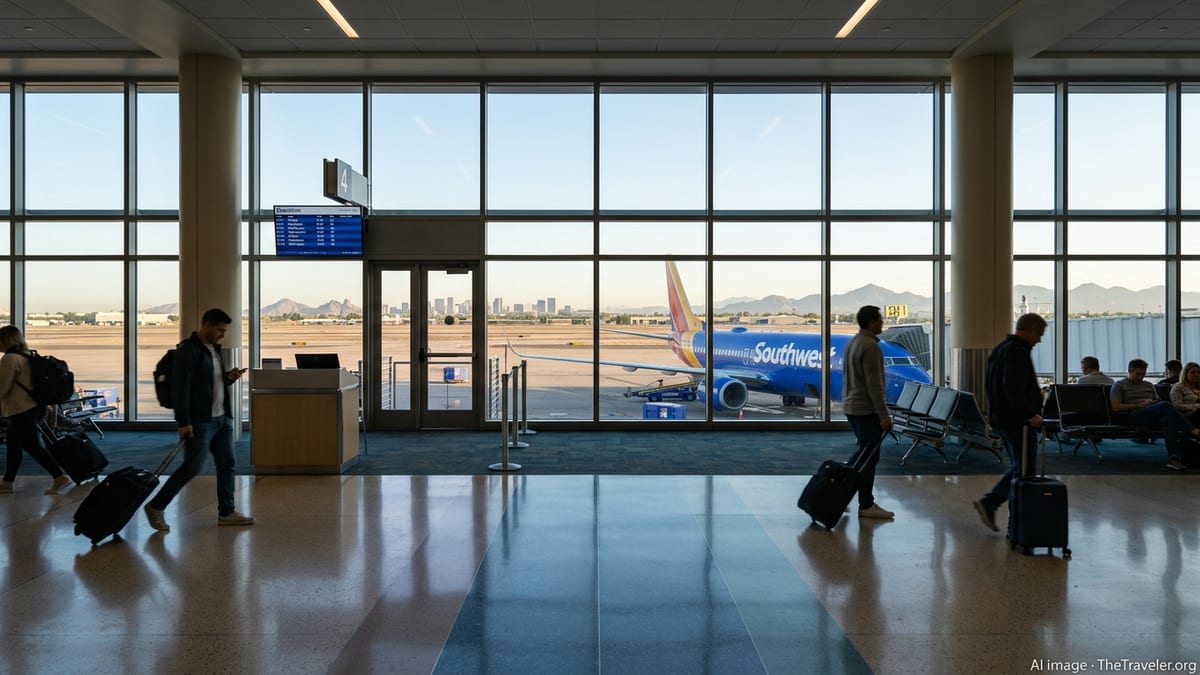
Chicago Service From Phoenix Faces Reduced Options
The most visible impact for Arizona travelers will be on flights between Phoenix and Chicago, a corridor long popular with both business and leisure passengers. Schedule filings for spring and summer 2026 show fewer nonstop options linking Phoenix Sky Harbor and Chicago’s Midway International Airport compared with prior years, along with tightened frequencies on peak days.
While Southwest is keeping Phoenix to Midway as its primary Chicago access point, the airline is concentrating more of its Midwestern capacity on shorter, high-density routes and new connections that feed other focus cities. That leaves Phoenix-based travelers with a slimmer selection of departure times, especially on shoulder days outside of traditional weekend peaks and holidays.
For Chicago-bound fliers, the changes mean less flexibility for day trips and tighter choices for onward connections through Midway. Travelers booking spring and early summer 2026 itineraries are already seeing formerly standard morning and late-afternoon Phoenix departures replaced with a narrower band of mid-day and early evening options.
Aviation analysts note that Chicago remains a critical market for Southwest, but the airline is now more willing to trim what it sees as marginal frequencies in favor of building out other hubs and new routes that promise stronger returns.
Washington-Area Links from Phoenix Pulled Back
Southwest’s reshuffle also reaches across the country to the Washington region, where service patterns from Phoenix are shifting. Although Phoenix-based travelers once had a broader mix of options into the capital area, 2026 schedules highlight a leaner footprint, particularly on nonstop flying.
Seats between Phoenix and Washington Reagan National are more limited in the 2026 timetable, reflecting a pullback that leaves some days with fewer direct choices than in previous seasons. The airline is also using its Baltimore/Washington flights and connections through other cities to funnel some Phoenix traffic into the region rather than maintaining as many point-to-point nonstop offerings.
For Arizona travelers who rely on Washington for government, defense and advocacy work, the reduced nonstop selection may translate into longer total journey times and less schedule control. It also pushes some flyers toward competitors that still offer a wider range of nonstop options into the capital’s trio of major airports.
Industry observers say the Washington cuts underscore how tightly Southwest must manage scarce slots and crowded airspace in the Northeast, forcing the carrier to prioritize routes that consistently fill aircraft at profitable fares.
Strategic Pivot as Southwest Rebuilds Its Network
The reductions in Phoenix-to-Chicago and Phoenix-to-Washington flying do not occur in isolation. They form part of a broader strategy in which Southwest is refocusing growth on a handful of core airports while pruning routes that no longer align with its financial and operational goals.
In 2026 the airline is leaning into network moves that strengthen certain connecting hubs, add new cities and boost leisure-heavy destinations, even as it trims in others. Phoenix, Chicago Midway and key West Coast and Sun Belt airports remain central to the plan, but the mix of city pairs is changing as Southwest shifts from a pure point-to-point model toward more connecting flows.
Rising costs, evolving travel demand and ongoing air traffic management constraints are all pushing carriers to be choosier about where each aircraft is deployed. Southwest’s Phoenix cuts, particularly on longer-haul routes into slot-controlled or congested markets like Washington, show how the airline is prioritizing routes where it can sustain both strong load factors and resilient yields.
Network planners also have to account for federal capacity directives at major airports and the ripple effects of congestion. Those pressures can make longer spokes from a city like Phoenix more vulnerable when the airline looks for flying to redeploy.
What Phoenix Travelers Should Expect in 2026
For travelers in metro Phoenix, the 2026 schedule will feel different even if Southwest remains one of Sky Harbor’s dominant players. The airline is still expected to offer a robust roster of flights to major Western, Texan and leisure markets, but long-haul business staples such as Chicago and Washington will be somewhat less plentiful from a nonstop perspective.
Passengers who favor Southwest for its fare structure and loyalty program may increasingly have to accept one-stop itineraries through other focus cities to reach the Midwest and Mid-Atlantic at preferred times. That could mean additional travel time but also new routing choices through airports such as Dallas, Denver or Nashville, depending on the final timetable.
Travel advisers recommend that Phoenix-based customers who depend on nonstop access to Chicago or Washington for regular work trips monitor schedules closely throughout 2025 and 2026. Booking further in advance, being flexible on travel days and comparing options across multiple Washington-area or Chicago-area airports will become more important as the network shifts settle in.
Even with the cuts, industry experts expect competition to remain relatively healthy on Phoenix’s long-haul corridors. Rival carriers continue to invest in Arizona service, and any reduction in capacity from one airline can quickly attract attention from competitors looking to capture displaced demand.