

More news on this day
Southwest Airlines is preparing to end flights between Chicago O’Hare International Airport and Washington Dulles International Airport in early June 2026, as part of a broader restructuring that will see the low-cost carrier withdraw entirely from both airports and consolidate operations at its longstanding bases in Chicago Midway and the Baltimore–Washington region.
Get the latest news straight to your inbox!
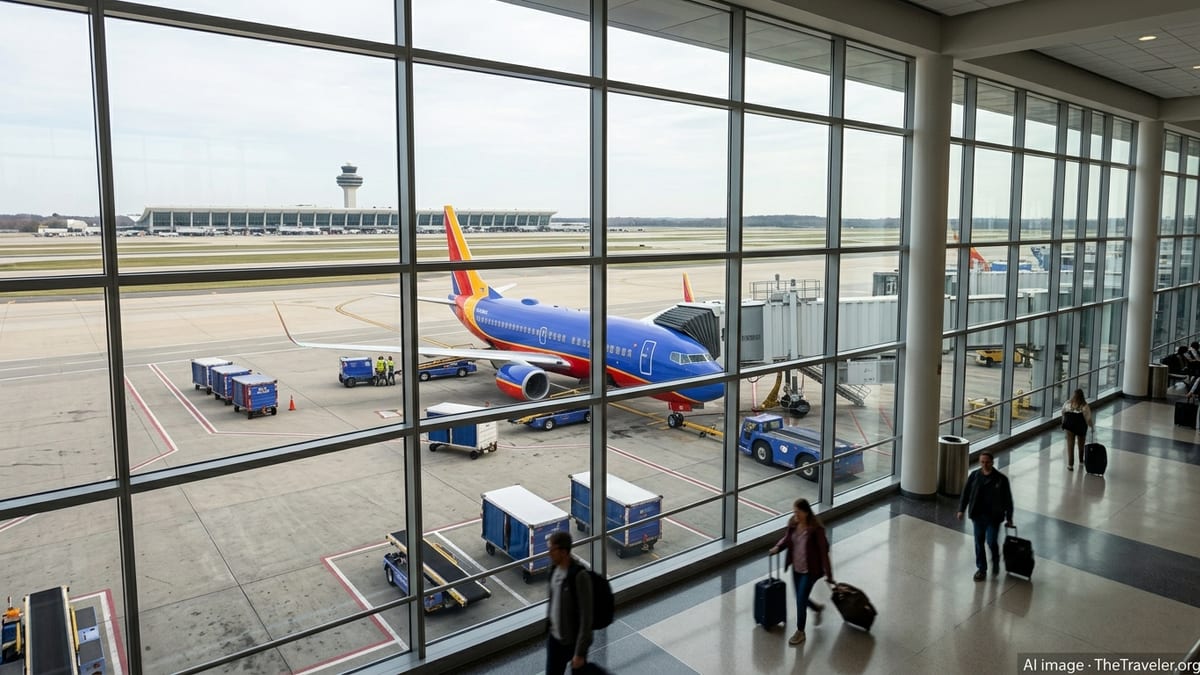
O’Hare and Dulles Exit Targets Underperforming Capacity
Publicly available schedule data and recent reporting indicate that Southwest plans to cease service at Chicago O’Hare (ORD) and Washington Dulles (IAD) around June 4, 2026, ending a relatively short-lived experiment at two of the country’s largest hub airports. The move comes as the airline continues to refine its point-to-point network and shift aircraft toward markets where demand and profitability are stronger.
Industry coverage of the carrier’s 2025 and 2026 schedule extensions has highlighted a pattern of trimming service in higher-cost, congested airports in favor of adding flights at core bases and growth cities such as Nashville, San Diego, and Sacramento. Reports indicate that O’Hare and Dulles fall into the group of stations where load factors and yields have not consistently matched the airline’s targets, especially when competing head-to-head with entrenched hub carriers.
Southwest previously signaled that it would significantly reduce capacity at Chicago O’Hare as part of a network realignment prompted by aircraft delivery delays and a sharper focus on financial performance. The decision to fully exit both O’Hare and Dulles suggests that incremental cuts were not sufficient to deliver the returns the airline is seeking from its constrained fleet and staffing resources.
The specific Chicago O’Hare–Washington Dulles pairing is a relatively small piece of the carrier’s national schedule, but its removal underscores the broader strategy shift away from duplicating service in multi-airport metropolitan areas and toward concentrating operations at a single, more cost-efficient field.
Shift Back to Midway and Core Washington-Area Airports
For travelers in Chicago and the Washington region, Southwest’s withdrawal from O’Hare and Dulles does not mean the airline is leaving either metro area. Instead, it is consolidating operations at Chicago Midway International Airport and its existing Washington-area gateways, primarily Baltimore/Washington International and Ronald Reagan Washington National, which align more closely with the carrier’s traditional network and cost structure.
Chicago Midway has long been Southwest’s primary base in the region, hosting the bulk of its flights and providing extensive connections across the United States. Aviation industry analyses show that, in recent years, the airline has steadily rebuilt and expanded its Midway schedule, using the airport as a central node in its point-to-point system while maintaining only a limited presence at O’Hare.
In the Washington market, Southwest has historically relied on Baltimore/Washington as its main East Coast hub, complemented by a smaller but strategically important footprint at Reagan National. The decision to discontinue Dulles operations returns the airline to a structure more consistent with its pre-expansion pattern, emphasizing connectivity through Baltimore and carefully managed access to the highly slot-controlled Reagan airport.
By dropping the O’Hare–Dulles link and other related flying, Southwest can free aircraft time and crews for routes that better feed its core bases. Analysts following the carrier note that similar decisions at other airports have allowed Southwest to boost frequencies and add new nonstop options in markets where it already commands stronger customer loyalty and higher flight utilization.
Implications for Business and Connecting Travelers
The discontinuation of Southwest’s O’Hare–Dulles service is expected to be felt most acutely by travelers who relied on the route for point-to-point business trips and for one-stop connections using both airports as stepping stones to other destinations. While the carrier’s overall presence in both metro areas will remain significant, passengers who favored the specific O’Hare–Dulles combination will need to adjust their travel plans.
For Chicago-based travelers, the change effectively removes Southwest as a nonstop option between O’Hare and the Dulles side of the Washington region. Competing hub carriers at both airports are likely to continue operating a variety of services that can absorb some of this demand, though schedules and fares may differ from the low-cost model Southwest typically offers.
On the Washington side, customers who previously connected through Dulles on Southwest to reach O’Hare will be redirected toward Baltimore/Washington or Reagan National, potentially adding ground travel or requiring different airport choices for the same city pair. Travel industry observers suggest that some passengers may find comparable or better connectivity through Midway and Baltimore, particularly for trips involving multiple segments within Southwest’s domestic network.
The decision also has implications for travelers who valued the ability to align Southwest itineraries with long-haul international flights departing from O’Hare or Dulles. With the airline stepping back from those global hubs, such itineraries will depend more heavily on other carriers for the international legs, or on alternative domestic routings that start or end at different airports within the same metropolitan areas.
Part of a Broader 2025–2026 Network Realignment
The end of service between Chicago O’Hare and Washington Dulles sits within a broader series of network adjustments that Southwest is implementing through 2025 and 2026. Public filings and schedule announcements over the past year describe a systematic review of underperforming routes, with the airline cutting some point-to-point links while introducing new nonstops from growing focus cities.
Recent schedule updates show Southwest adding routes such as Nashville to Dulles and Nashville to El Paso, alongside new and restored services in other medium-size markets. At the same time, the airline has confirmed reductions or exits in places where competitive pressure, airport costs, or limited local demand have constrained profitability, including select routes from Baltimore, Atlanta, and other large hubs.
Analysts note that the strategy reflects a balance between retrenchment and targeted expansion. The carrier is shedding routes and airports that do not align with its preferred operating model while investing in markets where it can sustain high aircraft utilization and rapid turn times. Exiting O’Hare and Dulles is consistent with that approach, reducing exposure to delays and congestion that can ripple across the network.
For travelers, the reshaping of Southwest’s schedule means that some long-familiar options, such as the O’Hare–Dulles pairing, will disappear even as new nonstop opportunities emerge elsewhere. The airline’s focus on realigning capacity suggests that further adjustments are possible as it responds to evolving demand patterns, competitive moves, and the timing of aircraft deliveries in the years ahead.