

More news on this day
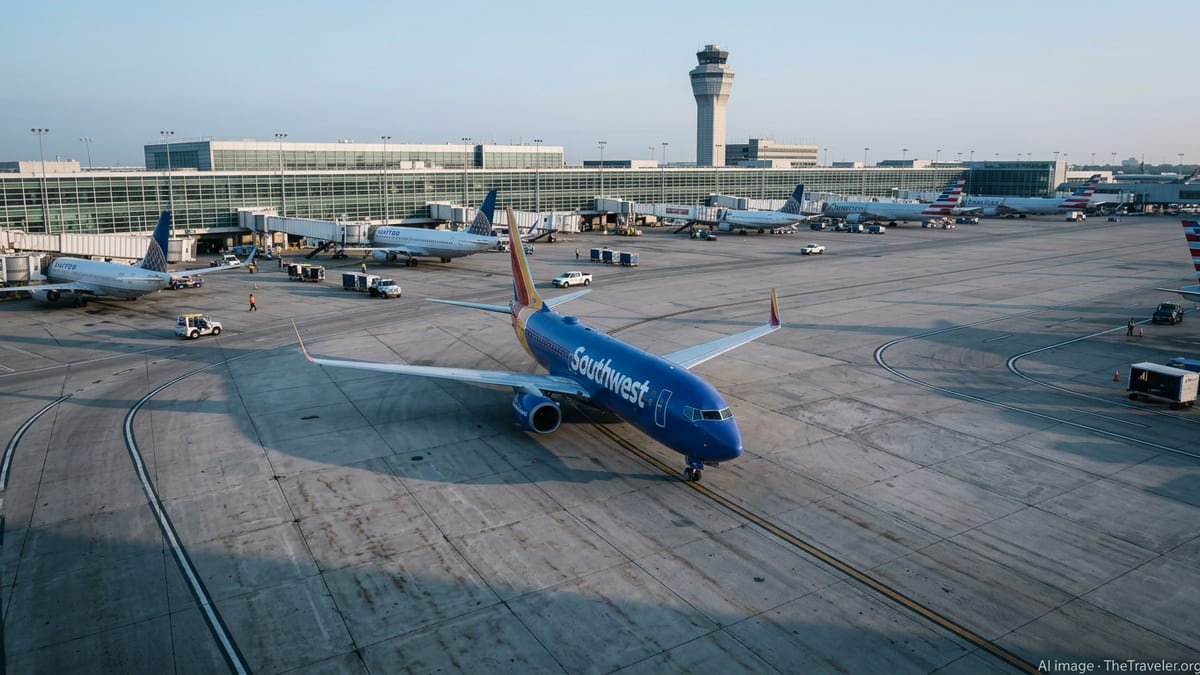
Southwest Airlines is preparing to discontinue service at Chicago O’Hare International Airport and Washington Dulles International Airport in 2026, as the carrier continues reshaping its network around core hubs and higher-performing routes.
Get the latest news straight to your inbox!
Strategic Shift Away From Secondary Hubs
Publicly available schedule data and industry analysis indicate that Southwest intends to wind down its relatively small operations at both Chicago O’Hare and Washington Dulles during 2026. The move would mark a retreat from two competitive airports where legacy carriers dominate capacity and where Southwest has never approached the scale it maintains at its traditional strongholds.
Southwest has already signaled in recent filings and network updates that it is reallocating aircraft from underperforming stations and concentrating more flying at airports such as Chicago Midway, Denver, Nashville and St. Louis. The planned exits at O’Hare and Dulles align with that pattern, shifting attention back to airports where the airline controls significant share and can operate dense, high-frequency schedules.
Reports also show that the airline has been trimming select routes touching O’Hare in stages, initially reducing frequencies and seasonal flying before removing some city pairs entirely. At Dulles, Southwest’s presence remains modest compared with its larger operations at nearby Baltimore/Washington International and Washington Reagan National, making the airport a logical candidate for consolidation.
Industry observers note that Southwest’s evolving strategy reflects a broader reassessment of how it deploys capacity in a market still adjusting to post-pandemic travel patterns, with a particular focus on maximizing returns from leisure traffic and strong-origin markets rather than maintaining thin outposts in crowded hub airports.
What the Exit Means for Chicago Travelers
For Chicago-area travelers, Southwest’s departure from O’Hare would further solidify the split between the region’s two major airports. O’Hare is dominated by hub operations from United Airlines and American Airlines, while Midway has long served as Southwest’s fortress in the city, with hundreds of daily departures and extensive domestic coverage.
Passengers who have favored Southwest at O’Hare for its point-to-point routes and fare structure are likely to be funneled to Midway instead. While this may introduce additional travel time for some suburban and northern Illinois residents who find O’Hare more convenient, Midway’s larger Southwest schedule is expected to preserve access to many of the same destinations, often with more frequency.
Air service reports from Chicago aviation authorities already highlight Southwest’s focus on expanding Midway with new domestic and international routes, underlining the carrier’s view of that airport as its primary Chicago gateway. As O’Hare operations wind down, the contrast between the two airports’ roles may become even sharper, with O’Hare leaning into global connecting traffic and Midway functioning as a high-volume, domestic-oriented point-to-point base.
Other airlines at O’Hare, particularly United and American, may see opportunities to attract former Southwest customers on overlapping routes. However, because Southwest’s O’Hare footprint is relatively small, the broader market impact on capacity and fares is expected to be limited and centered on specific leisure routes.
Impact on Washington-Area Connectivity
In the Washington region, Southwest’s decision to discontinue Dulles service would narrow options at an airport already heavily centered on United Airlines operations and long-haul international routes. For Southwest, Dulles has functioned as a niche station, secondary to its larger presence at Baltimore/Washington International and incremental growth at Reagan National.
Travel patterns in the capital region suggest that many price-sensitive leisure passengers have long gravitated toward Baltimore, where Southwest maintains a dense schedule and extensive domestic network. As operations at Dulles are phased out, those customers are expected to be directed even more firmly toward Baltimore, or to Reagan National where slot and perimeter constraints limit expansion.
The discontinuation of Dulles flights may create an opening for other low-cost or hybrid carriers to adjust capacity on select domestic routes, but analysts generally view Southwest’s Dulles presence as too modest to trigger large-scale shifts. For most travelers, the effect will be felt most acutely in reduced non-stop options on specific point-to-point routes where Southwest competed directly.
Regional transportation dynamics will also play a role. Travelers in Northern Virginia who have used Dulles for Southwest flights may face longer surface trips if they choose to follow the carrier to Baltimore, while those closer to central Washington could pivot more easily between Dulles and Reagan National depending on schedule and fare.
Network Optimization and Financial Pressures
Southwest’s consolidation at stronger stations is unfolding against a backdrop of heightened cost pressures and a multiyear effort to restore margins. Public financial disclosures and industry coverage describe a carrier facing higher labor and fuel expenses while also investing in technology and operational resilience upgrades after several high-profile disruptions.
In this environment, maintaining small-scale operations at highly competitive hub airports can be difficult to justify, particularly when those stations do not support a broad portfolio of connecting itineraries or sustained business travel demand. Redeploying aircraft to markets where Southwest can run higher load factors and leverage its brand strength is seen as a way to improve unit revenues without aggressive capacity growth.
Analysts also point to evolving competitive dynamics. At O’Hare and Dulles, Southwest contends with major carriers that can feed large connecting banks of passengers into domestic routes, allowing them to sustain frequencies and fare structures that are challenging for a point-to-point oriented airline to match. By contrast, in cities where Southwest acts as the primary carrier, it exerts more control over pricing and schedule design.
The 2026 changes at O’Hare and Dulles fit into a wider sequence of network adjustments stretching back through 2025, when Southwest began cutting select underperforming routes while simultaneously adding capacity in markets demonstrating strong leisure demand and resilient yields. Observers expect that pattern of incremental pruning and redeployment to continue as the airline refines its post-pandemic footprint.
What Passengers Should Watch in 2026
For travelers, the most immediate concern will be how the timing of Southwest’s exits affects existing bookings and future planning. Based on typical industry practice, schedules are usually adjusted several months in advance, with customers offered reaccommodation options, refunds or alternative routings when affected flights are removed.
Passengers who rely on Southwest from O’Hare or Dulles will want to monitor schedule changes closely throughout 2026, especially around traditional peak periods such as spring break, summer holidays and year-end travel. Travel advisors and online booking tools can help identify comparable itineraries from Midway, Baltimore or Reagan National where Southwest will continue to operate.
Travelers with flexibility may find that shifting to Southwest’s larger hubs opens up more timing options and, in some cases, competitive fares compared with the smaller portfolios previously available from O’Hare and Dulles. However, those benefits must be weighed against additional ground travel time, parking costs and potential connectivity considerations for anyone pairing air and rail or intercity bus segments.
As Southwest completes the transition, the broader U.S. domestic market is likely to see relatively modest structural change from these two station exits alone. Yet the decisions at Chicago O’Hare and Washington Dulles underscore how even the largest low-cost carriers are rethinking their maps, favoring depth over breadth as they navigate a more challenging cost and demand landscape.