

More news on this day
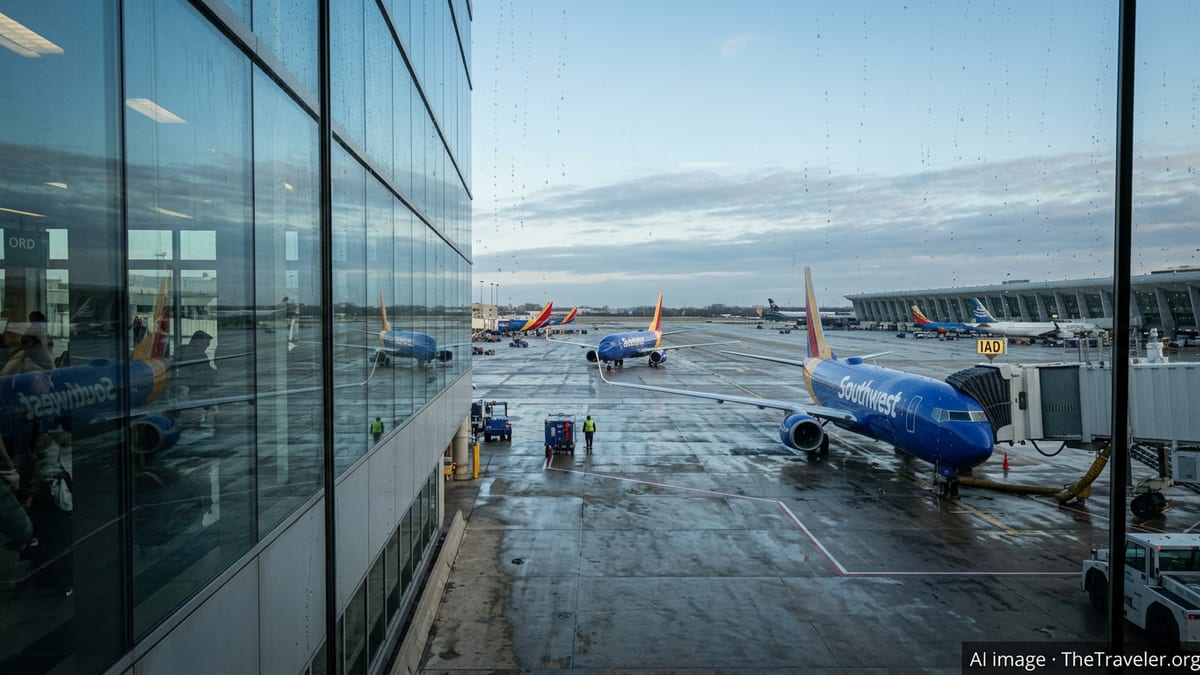
Southwest Airlines is preparing to withdraw from Washington Dulles International Airport and Chicago O’Hare International Airport in early June 2026, a move that is stirring frustration among U.S. travelers and reigniting debate over access, competition, and national air travel priorities at two of the country’s most prominent aviation gateways.
Get the latest news straight to your inbox!
Exit Dates Set as Network Strategy Shifts
Publicly available schedule data and route listings show that Southwest Airlines plans to end service at Washington Dulles International Airport and Chicago O’Hare International Airport on June 4, 2026. The two exits, affecting major airports in the national capital region and the Chicago metropolitan area, together mark one of the carrier’s most visible retrenchments from large hub facilities in recent years.
Information published in updated destination lists indicates that Washington Dulles will no longer appear in Southwest’s Washington area portfolio after that date, with the airline continuing to focus on nearby Baltimore/Washington International. Chicago O’Hare, where Southwest only launched operations in 2021, is similarly flagged as ending in early June, aligning with customer reports of schedule changes and rebooked itineraries beyond that point.
The timing positions the withdrawals ahead of the peak summer travel period, traditionally one of the industry’s busiest seasons. For affected passengers, the June cutoff compresses the window to adjust plans, potentially forcing changes in airports, connection patterns, or even preferred carriers during an already congested travel calendar.
The decisions feed a narrative among some domestic travelers that a carrier long associated with broad U.S. accessibility is recalibrating in ways that feel at odds with its populist reputation. Critics argue that stepping back from such high-profile fields undercuts perceptions of national reach and presence, even if the practical alternatives remain within the same metro areas.
Impact on Washington Region: Dulles Loses a Low-Cost Player
In the Washington metropolitan area, Southwest’s withdrawal from Dulles reinforces the carrier’s long-standing emphasis on Baltimore/Washington International as its primary regional stronghold. Current destination lists and schedule displays show Dulles marked as a station ending in June 2026, while Baltimore continues to feature dense Southwest service on domestic routes.
For travelers in Virginia’s suburbs and exurbs, the change narrows nonstop low-cost options at an airport traditionally dominated by legacy and international carriers. The shift may push price-sensitive passengers toward either Baltimore, which can require significantly longer ground travel, or toward competing low-cost offerings where available at Dulles and Reagan National.
Aviation analysts note that Dulles has seen multiple rounds of strategic repositioning by airlines over the past decade, as carriers balance the airport’s strong international profile with cost structures and domestic demand patterns. Southwest’s relatively modest Dulles footprint compared with its operations at Baltimore and other focus cities made it a likely candidate for reassessment once broader fleet, cost, and reliability pressures intensified.
Public commentary in the region reflects disappointment among travelers who valued Southwest’s fare policies and customer-friendly image at a field otherwise associated with higher average fares. Some view the exit as a symbolic retreat from a premier national capital gateway, interpreting it as a setback for consumer choice and competitive pricing in the corridor between Washington and the rest of the country.
Chicago O’Hare Pullback After a Short, High-Profile Run
Southwest’s move at Chicago O’Hare carries particular resonance because the airline only began serving the airport in 2021, breaking a decades long practice of flying exclusively from Chicago Midway. At the time, the expansion into O’Hare, one of the world’s busiest airports and a key hub of U.S. aviation, was framed in public coverage as a major competitive step into territory long dominated by larger network rivals.
Updated destination information now indicates that O’Hare service is scheduled to end on June 4, 2026, returning Southwest to a single-airport strategy in Chicago centered on Midway. Travelers have reported receiving notifications that O’Hare flights are being removed or shifted after early June, reinforcing the planned cutoff date for operations at the airport.
Industry observers suggest that O’Hare’s complex operating environment, higher costs, and intense competition from entrenched hub carriers may have limited Southwest’s ability to scale profitably. Combined with an ongoing industry wide aircraft shortage and delivery delays, airlines have been forced to prioritize where to deploy limited capacity, and secondary or overlapping stations have come under renewed scrutiny.
For Chicago area travelers, especially those in the northern and northwestern suburbs with easier access to O’Hare, the change will feel immediate. Many will either accept longer ground travel times to Midway in exchange for Southwest’s fare structure or migrate to alternative carriers based at O’Hare. The decision also trims a visible symbol of Southwest’s push into legacy hub territory, fueling perceptions among some travelers that the airline is retreating from marquee national stages.
Travelers Weigh Convenience, Identity, and National Reach
Reactions across traveler forums and public commentary channels suggest a mix of practical concern and emotional disappointment. For frequent fliers, the exits from Dulles and O’Hare translate into longer commutes to alternate airports, modified connection patterns, and in some cases the loss of familiar nonstop options. For others, the announcements are perceived as a broader statement about how major U.S. airports are evolving and which travelers they are prioritizing.
Both Dulles and O’Hare carry symbolic weight in the U.S. aviation landscape, representing the capital’s global gateway and one of the country’s largest domestic and international hubs. Southwest’s decision to step back from each field, while maintaining strong presences at Baltimore and Midway in the same regions, raises questions for some travelers about how national pride and identity intersect with airline business strategies.
Some commentators have framed the exits as a blow to the idea of a carrier that once seemed determined to be present at every major U.S. crossroads. By narrowing its footprint at such high-profile locations, Southwest is seen by critics as ceding ground not only to rival airlines but also to a perception that convenience for certain communities can be subordinated to tighter network economics.
At the same time, others note that the airline is not abandoning either metropolitan area but rather consolidating volume at airports where it has long held a structural advantage. From that perspective, the decisions are interpreted less as a slight to national prestige and more as an acknowledgment that a single carrier cannot be everywhere at once, particularly amid industry wide capacity and cost pressures.
What Travelers Should Expect Next
For passengers holding tickets involving Washington Dulles or Chicago O’Hare beyond early June 2026, publicly available information suggests that airlines typically notify affected customers of schedule changes and offer rebooking options to alternate airports or flights. In recent days, travelers have reported receiving such notices related to O’Hare itineraries, indicating that re-accommodation efforts are underway in advance of the official end date.
Experts recommend that travelers review their itineraries for June and beyond, verify departure and arrival airports, and monitor airline communications closely. In the Washington region, many former Dulles customers may find viable options from Baltimore or Reagan National, while Chicago based travelers may need to evaluate the tradeoffs between staying with Southwest at Midway or shifting to other carriers at O’Hare.
Airport authorities at both Dulles and O’Hare are expected, based on prior patterns in similar situations, to seek new or expanded service from other airlines to backfill any vacated gates and maintain route diversity. Large hubs typically attract interest when a carrier withdraws, particularly on high-demand domestic routes.
In the longer term, the exits highlight how quickly U.S. air networks can evolve. Routes and airport presences that once symbolized expansion or national reach can be reversed within a few years as cost pressures, fleet realities, and competitive dynamics shift. For travelers, the developments at Dulles and O’Hare serve as a reminder that airport loyalty and airline identity are increasingly subject to the changing calculations of modern commercial aviation.