

More news on this day
Southwind Airlines has restarted flights to the European Union with a renewed nonstop route between Antalya and Berlin, marking the Turkish leisure carrier’s first return to Germany since an EU flight ban halted its European network nearly two years ago.
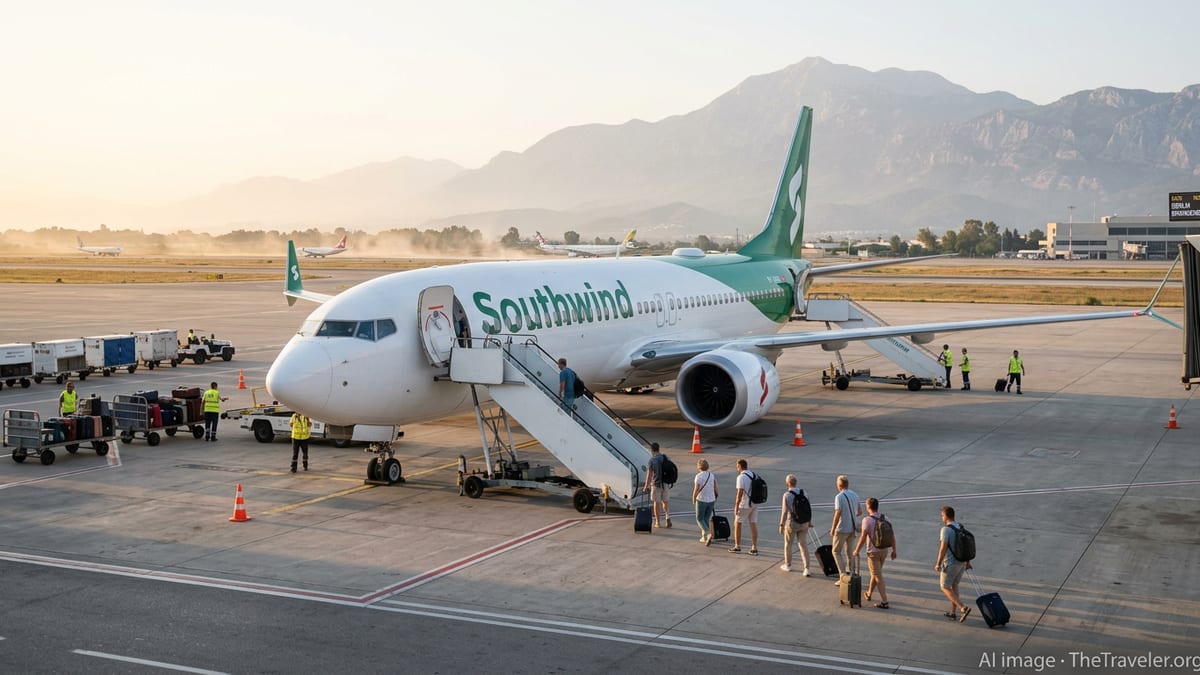
First Flight Marks Return to European Skies
The carrier operated its comeback service from Antalya to Berlin Brandenburg Airport on March 2, 2026, coinciding with the opening of the ITB Berlin travel trade fair. The charter flight signalled Southwind’s re-entry into EU airspace after restrictions related to the airline’s alleged Russian ties led to a suspension of its European operations in 2024.
Industry schedules and flight tracking data show the airline using its Boeing 737 MAX 8 aircraft on the Antalya–Berlin sector, a workhorse narrowbody type commonly deployed on leisure routes between Turkey and Germany. The flight time is just over three hours, slotting into the popular early spring travel window for German holidaymakers bound for Turkey’s Mediterranean coast.
Southwind confirmed the operation in statements on its social channels, framing the Berlin flight as the first step in a broader return to Western European markets. While further destinations have yet to be formally announced, the airline has indicated that additional European routes will follow once commercial discussions with airports and tour operators are finalised.
The move puts Southwind back into a highly competitive corridor between Germany and Antalya, a route dominated in recent years by established leisure airlines and low-cost carriers catering to package tourists and independent travelers.
From EU Ban to Measured Reopening
Southwind’s renewed presence in Berlin comes after a turbulent period in which regulators across Europe scrutinised the airline’s ownership structure and operational links to Russia. In 2024, the European Union followed Finland in effectively closing its airspace to the Antalya-based operator, forcing the cancellation of planned routes to multiple German cities and other EU destinations.
The ban cut off Southwind from some of its most lucrative target markets just as it was scaling up operations from its Antalya base. The airline pivoted toward services to Russia, Belarus and a handful of non-EU countries, but the loss of access to Germany and other Western European nations sharply limited its growth potential in the short term.
The March 2026 charter flight to Berlin indicates that Southwind has now secured at least limited permissions to operate into the EU again, though details of any conditions tied to those approvals have not been publicly disclosed. Aviation analysts note that charter arrangements, often brokered by tour operators, can sometimes offer a more flexible path back into regulated markets than scheduled services.
For German and Turkish tourism stakeholders, however, the regulatory nuances matter less than the practical impact: more capacity between Berlin and Antalya at a time when demand for Mediterranean holidays is rebounding, and hotel partners along Turkey’s southern coast are seeking additional lift for the coming summer season.
Tourism and Trade Ties Between Antalya and Berlin
The Antalya–Berlin corridor has long been one of the busiest leisure markets linking Germany with Turkey, driven by both holiday travel and a large Turkish diaspora in and around the German capital. Berlin Brandenburg Airport is a key gateway for outbound package tourists, while Antalya is a cornerstone of the Turkish tourism economy, known for its beachfront resorts and all-inclusive hotel offerings.
Existing carriers already offer a mix of charter and scheduled flights on the route, with services ramping up in late March and April ahead of the main summer season. Southwind’s re-entry adds another player to that mix, potentially putting downward pressure on fares during peak travel weeks and giving tour operators more bargaining power as they assemble holiday packages.
Local tourism officials in Antalya have consistently highlighted Germany as one of their most important source markets, both in terms of visitor numbers and length of stay. The restoration of even limited Southwind operations into Berlin is therefore seen as a symbolic boost, suggesting that regulatory obstacles that once seemed entrenched may now be easing.
For Berlin’s travel trade, the timing around ITB is also significant. The fair is one of the largest global gatherings for the tourism industry, and an Antalya–Berlin charter linked to the event provides a high-visibility platform for Southwind to showcase its product to tour operators and travel agents from across Europe.
Competitive Pressures in a Crowded Market
Southwind’s renewed Antalya–Berlin service drops into a marketplace where capacity is already robust and competition intense. Established leisure operators and low-cost carriers have spent the past two years strengthening their presence on Turkey–Germany routes, in some cases adding extra frequencies and seasonal flights to capture demand during Southwind’s absence.
Analysts expect Southwind to focus initially on partnering with tour operators rather than chasing aggressive stand-alone ticket sales. By positioning itself as a flexible charter and seat-only provider, the airline can target high-demand departure days and peak holiday periods while avoiding direct head-to-head competition on every rotation with larger rivals.
At the same time, Southwind’s use of fuel-efficient narrowbody aircraft gives it a cost base that can support competitive pricing, particularly when load factors are strong. If the Antalya–Berlin operation proves successful through the spring and summer, industry observers say the carrier could look to revive previously planned links to other German cities, subject to regulatory clearances.
For now, the resumption of service to Berlin is being watched closely by both regulators and competitors as a test case for Southwind’s long-term prospects in Europe. Its performance on this single corridor may help determine whether the airline can reclaim a broader role in connecting Turkey’s Mediterranean resorts with the EU’s largest outbound travel market.
Passengers See More Choice for Summer 2026
For travelers, the most immediate consequence of Southwind’s return is greater choice in flight times, fares and package options between Berlin and Antalya ahead of the 2026 summer season. Additional capacity tends to benefit price-sensitive customers in particular, as airlines and tour operators adjust offers to fill seats during shoulder weeks around school holidays.
Southwind is expected to align its departures from Antalya with early morning and late-evening slots that allow same-day hotel check-ins and maximise time in resort, a pattern common among leisure airlines serving Turkey from Germany. That schedule flexibility is especially attractive for families and groups seeking short, four to seven-night sun breaks.
As booking engines and travel agencies update their inventories to reflect Southwind’s renewed operations, consumers are likely to see the carrier appear alongside long-standing competitors on Antalya–Berlin search results. The airline’s challenge will be to rebuild brand recognition in Germany after a prolonged absence, while reassuring passengers about reliability and regulatory stability on its European routes.
Whether Southwind’s Berlin comeback remains a one-off charter linked to ITB or evolves into a sustained seasonal presence, it underscores a broader trend: despite geopolitical headwinds and regulatory scrutiny, the demand for travel between Germany and Turkey’s Mediterranean coast remains strong enough to lure airlines back into the market as soon as conditions allow.