

More news on this day
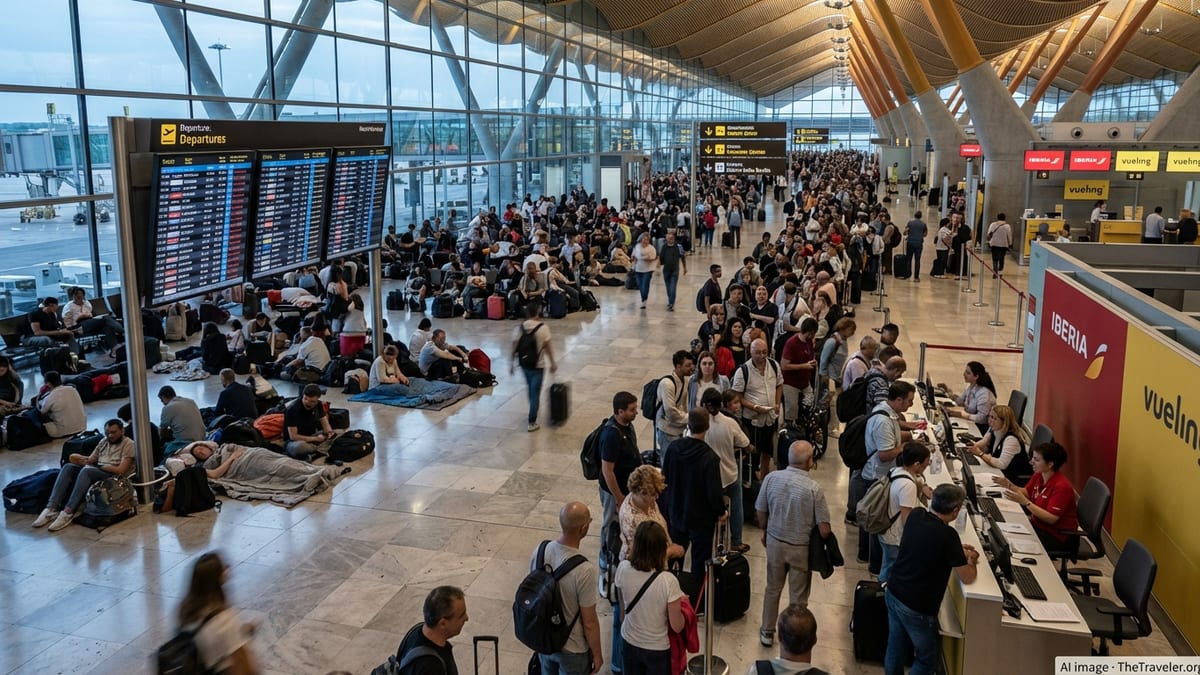
Hundreds of passengers were left stranded at Spain’s busiest airports as widespread disruption at Madrid-Barajas, Barcelona-El Prat, Malaga and Palma de Mallorca triggered 460 flight delays and 15 cancellations, snarling operations for Iberia, Vueling, Air Europa and several other carriers and rippling across regional airports nationwide.
Major Spanish Hubs Brought to a Standstill
The disruption unfolded across four of Spain’s primary aviation gateways, with Madrid-Barajas and Barcelona-El Prat bearing the brunt of the delays. Airport operator data and airline updates indicated that Madrid, Spain’s largest hub, logged well over a third of the 460 delays as ground operations struggled to keep to schedule. Barcelona, the country’s second-busiest airport, also reported a high volume of late departures and arrivals, leaving terminals crowded with anxious travelers watching departure boards turn increasingly red.
Further south, Malaga-Costa del Sol Airport and Palma de Mallorca Airport, key entry points for leisure traffic along the Costa del Sol and the Balearic Islands, experienced prolonged knock-on effects. Aircraft rotations were thrown off balance, and arriving passengers found themselves waiting on the tarmac or at gates while stands and ground crews were reassigned. Even when runways remained technically open, the network of turnaround times, crew shifts and slot allocations began to fray, amplifying delays across the system.
While only 15 flights were ultimately cancelled, the volume of delays created the impression of a near shutdown for many passengers. In practice, airports continued to operate, but at significantly reduced efficiency. That gap between technical operation and practical usability defined the day for travelers forced to rebook connections, queue for customer service and search for last-minute hotel rooms.
Airlines Scramble as Iberia, Vueling and Air Europa Hit Hard
Flag carrier Iberia, low-cost operator Vueling and full-service rival Air Europa were among the airlines most heavily affected, with their closely interlinked schedules at Madrid and Barcelona particularly vulnerable to disruption. Iberia’s hub-and-spoke model at Madrid-Barajas meant that late-arriving aircraft cascaded into missed connections, forcing the carrier to prioritize certain long-haul departures and consolidate some short-haul services. Passengers on intra-European routes were frequently asked to accept rebookings later the same day or, in some cases, the following morning.
Vueling’s dense web of short and medium-haul flights out of Barcelona-El Prat left it equally exposed. High-frequency routes to major European cities depend on tight turnaround times and aircraft utilization. Once early-morning operations were delayed, subsequent rotations struggled to recover, resulting in rolling delays that stretched late into the evening. Some flights departed hours behind schedule even after boarding was completed, as crew and slot approvals were juggled to keep aircraft moving.
Air Europa, which has built a strong presence on both domestic and international routes from Madrid, faced similar challenges. The airline reported disrupted schedules to several European and Latin American destinations, with some passengers missing onward connections and needing hotel accommodation and meal vouchers. Smaller carriers operating at the four hubs, including regional and leisure-focused airlines, were not spared either. Their limited fleets meant that even a single aircraft out of sequence could derail an entire day’s flying program.
Regional Airports and Europe-Wide Knock-On Effects
The problems at Madrid, Barcelona, Malaga and Palma de Mallorca quickly spread beyond Spain’s primary hubs. Secondary airports that depend on aircraft and crews rotating through the big four began to experience growing delays of their own. Services to and from cities such as Valencia, Tenerife, Bilbao and Seville were reported operating behind schedule as airlines struggled to reposition aircraft.
Because many Spanish routes are tightly integrated into broader European networks, the disruption spilled across borders. Delayed departures from Spain forced late arrivals into airports elsewhere on the continent, affecting schedules at major hubs such as Paris, London, Amsterdam and Frankfurt. Some European carriers operating into Spain reported that their aircraft were held on the ground awaiting delayed inbound flights with through-passengers, while others opted to depart without connecting customers to protect their own networks.
Charter and seasonal services, particularly those carrying winter sun and city-break tourists, were also caught up in the chaos. In some cases, aircraft originating in Northern Europe were forced to wait on stand for delayed departure slots from Spanish airports, extending flight times and stretching crew duty limits. Industry analysts noted that such knock-on effects are typical in highly interconnected air travel systems, where a disturbance at a few large hubs can reverberate far beyond national borders.
Passengers Face Overnight Stays and Mounting Frustration
For passengers caught in the middle, the operational complexities translated into a long, uncomfortable day in crowded terminals. At Madrid-Barajas and Barcelona-El Prat, lines at airline service desks quickly grew as travelers sought new itineraries, compensation information and accommodation. Families with children, elderly passengers and those with limited mobility were among the most affected, with some reporting difficulties securing assistance and clear guidance.
Scenes at Malaga and Palma de Mallorca, typically associated with holiday departures, were similarly tense. Holidaymakers returning home in the wake of the disruptions found themselves sitting on terminal floors or queuing at makeshift information counters, clutching paper meal vouchers and watching departure times slide further into the night. Many travelers reported that airport public address systems and information screens struggled to keep pace with frequent schedule updates, leading to confusion about whether flights were boarding, delayed again or cancelled outright.
Hotels near the airports quickly filled up as evening approached, with airlines required under European air passenger regulations to offer accommodation and meals when significant delays or cancellations occur for reasons within their control. Where rooms were scarce, some customers accepted transport to more distant lodging, adding yet more time to an already exhausting journey. Others chose to stay airside, sleeping on benches and using jackets or carry-on bags as makeshift pillows while waiting for morning flights.
Operational and Weather Strains Behind the Disruption
While the precise mix of causes varied by airport, a combination of adverse weather conditions and operational bottlenecks lay at the heart of the disruption. Periods of low visibility and bursts of heavy rain affected approach and departure procedures at several airports, forcing air traffic controllers to increase spacing between aircraft for safety, thereby reducing runway capacity. Even short-lived weather deteriorations can create a backlog of flights that is difficult to clear during peak operating periods.
On the ground, resource constraints intensified the challenge. Airline and handling staff faced pressure to turn aircraft quickly within a congested ramp environment, where each delay rippled across multiple flights using the same gates, baggage belts and catering services. In some cases, crew duty-time limits became a factor, with pilots and cabin crew reaching regulatory thresholds and needing to be replaced or their flights rescheduled. That added further complexity to an already strained operational picture.
Industry observers pointed out that Spanish airports have been operating close to, and in some cases above, pre-pandemic passenger volumes, especially during peak travel periods. In such an environment, even routine irregular operations can escalate into widespread disruption when infrastructure and staffing levels are stretched. The day’s events underscored how vulnerable the system remains to external shocks at a time of strong travel demand.
Guidance for Affected Travelers and Future Flyers
Authorities and consumer advocates urged passengers caught up in the disruption to retain all documentation related to their journeys, including boarding passes, delay notifications and receipts for meals and accommodation. Under European air passenger rights rules, travelers may be entitled to assistance and, in some cases, financial compensation depending on the cause and length of delay, as well as the distance of their flight. However, such claims typically require clear evidence of the disruption and its impact.
Passengers scheduled to travel through Spanish airports over the coming days were advised to check their flight status frequently via airline apps, text alerts or airport information channels. Airlines also recommended arriving at the airport well ahead of departure, particularly for morning flights that may still be recovering from aircraft and crews displaced by the day’s events. Travel agents and tour operators reported an uptick in inquiries from customers seeking to adjust itineraries to avoid tight connections through heavily affected hubs.
Experts in travel planning suggested that passengers build additional buffer time into itineraries involving transfers in Spain’s busiest airports, especially during periods of unsettled weather or peak travel seasons. Flexibility in travel dates, willingness to accept alternative routings and the purchase of comprehensive travel insurance can all help mitigate the impact of future disruptions that may resemble the latest episode.
Industry Response and Calls for Resilience
In the aftermath of the disruption, airline and airport representatives emphasized that safety remained the overriding priority throughout the day, even as schedules unraveled. They defended decisions to delay or cancel flights where necessary, arguing that pushing operations beyond safe limits would be unacceptable. Nevertheless, trade associations and passenger groups alike called for renewed efforts to build resilience into Spain’s air transport system.
Suggestions ranged from greater investment in ground handling resources and staff training to improved coordination between airlines, air traffic control and airport operators when irregular operations arise. Some industry voices argued for expanded use of predictive analytics to anticipate bottlenecks sooner, allowing airlines to preemptively adjust schedules and reduce last-minute chaos for passengers. Others highlighted the need for more transparent real-time communication tools so that travelers receive timely, consistent information, regardless of which airline or airport app they use.
As Spain prepares for upcoming peak travel periods, particularly Easter and the summer holiday season, the latest wave of delays serves as a reminder that demand recovery must be matched by operational robustness. For now, hundreds of passengers are left with disrupted travel plans and an unwelcome reminder of how quickly a day at the airport can shift from routine to chaotic when a finely tuned system comes under stress.