

More news on this day
Spain is moving into a central role in Europe’s latest wildfire response plans, joining Portugal, Greece, France and Bulgaria in a reinforced Mediterranean-focused strategy that combines shared aircraft fleets, pre-positioned firefighting crews and new risk monitoring tools ahead of increasingly severe fire seasons.
Get the latest news straight to your inbox!
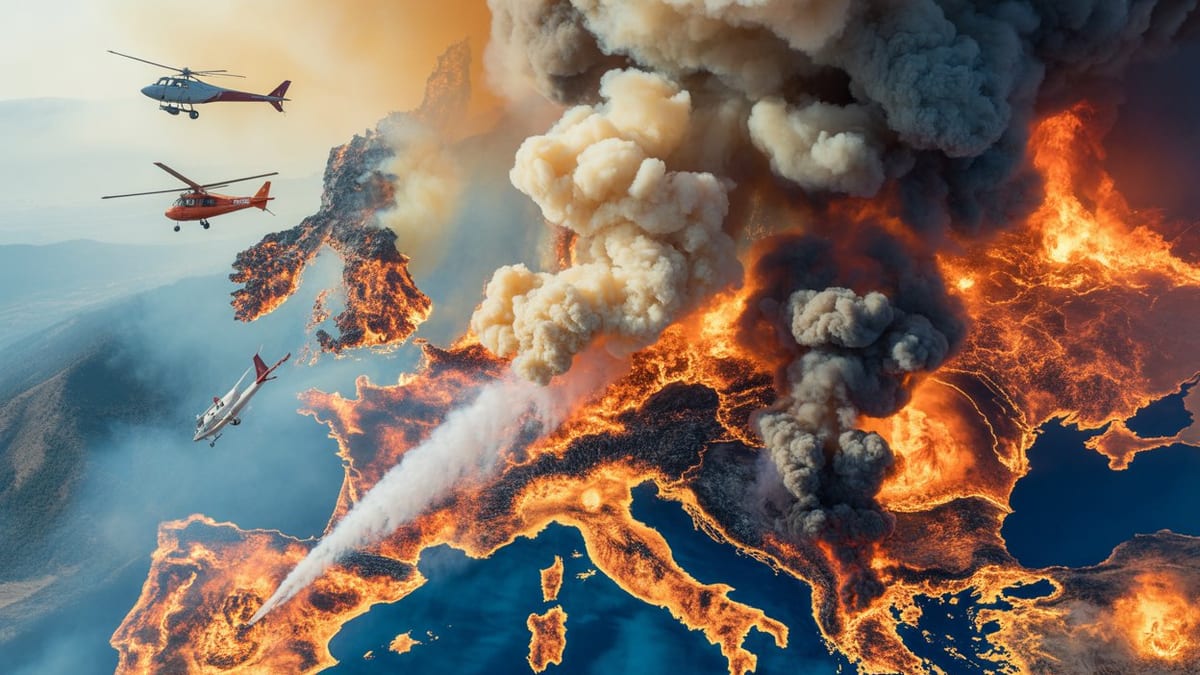
Image by Global Travel Alerts, Advisories, International Travel Alerts
Stronger Joint Fleet Puts Southern Europe at the Center
Publicly available information from European institutions shows that Spain has become one of the primary hosts of the European Union’s expanded rescEU aerial firefighting fleet, alongside France, Greece and Portugal. The bloc has assembled a core pool of 22 firefighting airplanes and several helicopters positioned in high-risk member states, with Spain’s bases viewed as critical for rapid deployment across the western Mediterranean.
Press material from the European Commission and its civil protection arm describes a long term plan to shift from ad hoc aircraft loans to a permanent, centrally funded fleet. Under this framework, Spain joins France, Greece, Italy and Portugal as key operators of new-generation water bombers and helicopters, backing up national fleets that have struggled to keep pace with longer, drier fire seasons.
The arrangement allows aircraft stationed in Spain to support operations not only on the Iberian Peninsula but also in neighboring countries when requested through the EU Civil Protection Mechanism. This shared capacity has already been used in recent seasons to move support between Portugal, Spain and France during overlapping heatwaves.
Reports from specialist outlets tracking civil protection policy indicate that the fleet expansion is being matched by investments in maintenance and pilot training, with southern countries pressing for faster delivery schedules after recent summers exposed gaps in available aircraft during peak fire days.
Pre-positioned Firefighters Link Spain, Portugal, Greece and France
Alongside the aircraft, the EU has scaled up the practice of pre-positioning ground firefighting teams ahead of the summer. According to published coverage summarizing the EU plans for the 2025 season, nearly 650 firefighters from 14 European countries are being stationed in high-risk areas of France, Greece, Portugal and Spain during July and August.
This rotating force includes teams from Bulgaria, which, while not currently a main host of aerial assets, has emerged as both a contributor of personnel and a beneficiary of cross-border assistance during severe fire episodes. Previous seasons saw Bulgarian fires tackled with planes coming from rescEU bases in Spain, France and Greece, a pattern that the new strategy aims to formalize and streamline.
For Spain and Portugal, the pre-positioned crews add depth to national brigades that already deploy thousands of firefighters and military emergency units during heatwaves. Their presence is intended to shorten response times when multiple large blazes break out simultaneously, particularly in interior regions and along the border where cross-border cooperation is becoming more frequent.
Greece and France are playing a similar hosting role, receiving mixed-nationality teams that can be redeployed quickly to other EU countries if risk maps show a sudden deterioration elsewhere. The approach reflects a move away from strictly national fire campaigns toward a rolling, Mediterranean-wide deployment model.
Bulgaria Brought More Fully Into EU Wildfire Planning
While early phases of the EU’s wildfire strategy focused on western and central Mediterranean states, more recent documents and regional reporting indicate that Bulgaria is now more tightly integrated into planning. The country has been repeatedly affected by summer brush and forest fires linked to prolonged heat and drought in southeastern Europe.
Accounts of recent response operations describe how rescEU aircraft based in countries such as France, Greece, Spain and Sweden were mobilized to Bulgaria when national capacity was exceeded. These missions highlighted both the benefits and the logistical challenges of long range deployments from western Mediterranean hubs to the Balkans.
In response, Bulgaria has stepped up participation in shared training exercises and has contributed firefighters to the pre-positioned pools that rotate through Spain, Portugal, France and Greece. Analysts of EU civil protection policy note that this reciprocal involvement is seen as a step toward a more geographically balanced system in which eastern and southern member states can both send and receive reinforcements more easily.
The inclusion of Bulgaria in communications about Europe’s evolving wildfire strategy is being interpreted by regional observers as a signal that the bloc expects climate driven fire risk to extend further into southeast Europe in the years ahead.
New Technology and Data Tools Guide the Strategy
The latest strategy also relies on a suite of new technologies to monitor and anticipate fire behavior across Spain, Portugal, Greece, France and Bulgaria. Research projects cited by European agencies describe the use of upgraded Meteosat satellite imagery, real time fire spread algorithms and harmonized fuel and drought maps to support early warnings.
These tools feed into the EU’s Emergency Response Coordination Centre in Brussels, where a dedicated wildfire support team now tracks conditions across the continent during the fire season. Public information on this system explains that analysts work in shifts to interpret satellite data, model potential spread and advise on where to position aircraft and ground crews ahead of forecast heatwaves or wind changes.
National services in Spain, Portugal and Greece have been among the early adopters of these tools, integrating them into their own command centers and using the outputs to inform evacuation planning and the deployment of specialized brigades. France and Bulgaria are also expanding the use of satellite based fire monitoring and are contributing data from their own meteorological and forestry agencies.
Experts quoted in academic and policy reports argue that this common data environment is essential for the success of the new strategy, since aircraft and personnel now cross borders frequently and need shared situational awareness to operate safely.
Longer Fire Seasons Push Prevention and Tourism Adaptation
Behind the operational changes is a recognition that wildfire seasons in southern and southeastern Europe are lengthening. Monitoring systems such as the European Forest Fire Information System have recorded burnt areas well above long term averages in recent years, particularly during the 2025 season, with Spain, Portugal, Greece, France and Bulgaria all experiencing major incidents.
As a result, governments are broadening their focus from emergency response to year round prevention. Publicly available plans reference increased forest management, fuel reduction around communities, and stricter land use rules in high risk zones. Portugal has launched large scale forest reorganization and mapping projects, while Spain, Greece and France have expanded budgets for clearing firebreaks and improving access roads for firefighting vehicles.
For the travel sector, the new wildfire combat strategy is also prompting adjustments. Tourism boards in Spain, Portugal and Greece are highlighting early warning systems, evacuation protocols and close coordination with EU partners as part of their messaging to visitors. In France’s Mediterranean departments and coastal Bulgaria, local authorities are encouraged to align summer event planning and visitor information campaigns with updated fire risk assessments.
Analysts following climate and tourism policy in Europe suggest that the strengthened cooperation between Spain, Portugal, Greece, France and Bulgaria is likely to shape how both residents and travelers experience future summers, with wildfire mitigation becoming a permanent feature of seasonal planning across the region.