

More news on this day
Spain’s airports are heading into Easter 2026 under mounting strain, as recent strike waves among ground handlers, security staff and cleaners raise fears of a fresh holiday-season meltdown for flights serving Madrid, Barcelona, Málaga and Palma de Mallorca.
Get the latest news straight to your inbox!
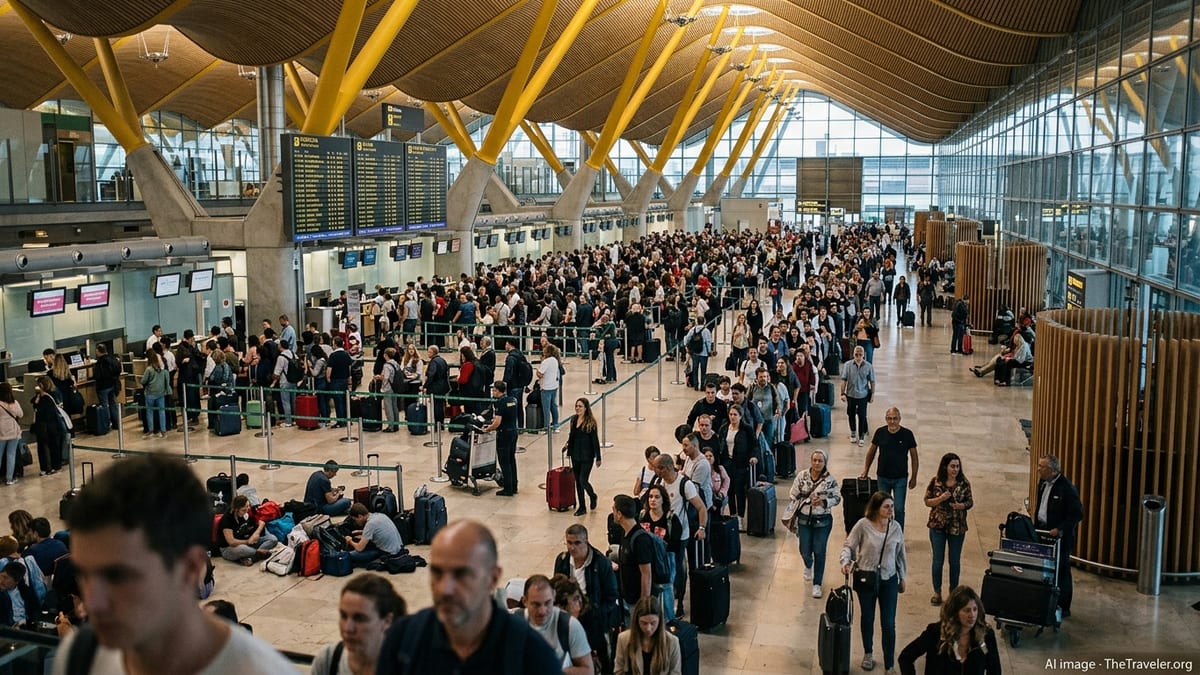
A Perfect Storm Building Around Easter 2026
Easter Monday in Spain falls on 6 April in 2026, placing the key holiday travel window at the end of March and first week of April. That timing comes uncomfortably soon after an intense period of industrial disputes and partial walkouts across the country’s busiest aviation hubs, which have exposed structural vulnerabilities in how Spain’s airports are staffed and managed.
Over the past year, Madrid’s Adolfo Suárez Madrid-Barajas has experienced repeated strikes involving security staff, cleaners and ground handlers, with some actions escalating into long queues, flight delays and visible operational strain. Similar pressures have been reported at Barcelona-El Prat, Málaga-Costa del Sol and Palma de Mallorca, all among Spain’s top six airports by passenger volume in 2025. Taken together, these hubs carry tens of millions of domestic and international travellers each year, and any coordinated disruption over Easter could ripple across Europe’s flight network.
Publicly available information shows that strike notices around ground handling and support services have increasingly targeted peak travel dates such as Christmas, New Year and summer holiday periods. Analysts warn that if unions or contractors opt to extend this strategy into the Easter 2026 calendar, even short stoppages could trigger disproportionate disruption because of the sheer density of departures and arrivals scheduled during Semana Santa, when many Spaniards travel and inbound tourism surges.
While no nationwide airport shutdown has been announced for Easter itself, the pattern of recent disputes has put airlines, airports and passengers on high alert. Travel industry observers now talk openly about the risk of a “flightblock” effect, in which localised stoppages at one or two hubs cascade into widespread cancellations and missed connections.
Ground Handling: The Weak Link in Spain’s Airport Chain
Ground handling has emerged as a critical pressure point in Spain’s aviation system. In Madrid, a series of strikes by ground service providers in late 2025 and early 2026 targeted the busiest days of the winter peak, including 23, 26 and 30 December and 2 and 7 January. Published coverage indicates that these stoppages primarily affected flights operated by Iberia and other International Airlines Group carriers that rely on contracted handling at Barajas.
The disputes have their roots in years of restructuring in Spain’s liberalised handling market. Airport operator Aena awards contracts at major hubs to competing providers, and recent tenders have shifted business between legacy in-house units and newer companies. Worker organisations argue that staffing levels and scheduling practices have not kept pace with rising passenger volumes, leading to intense pressure on ramp agents, baggage teams and dispatch staff. Companies, for their part, have defended the need to remain competitive under Aena’s tender framework.
Operationally, even limited ground-handling stoppages can have outsized effects. If baggage belts, pushback operations or aircraft loading are slowed for one carrier, shared infrastructure can quickly become clogged. Reports from earlier disruptions at Madrid-Barajas describe aircraft stuck on stands, delays in unloading luggage, and queues of containers waiting for belt access. When those bottlenecks arise during dense departure waves, knock-on delays can spread to airlines not directly involved in the original dispute.
As airlines finalise their Easter 2026 schedules, these vulnerabilities are back in focus. Madrid, Barcelona, Málaga and Palma all rely on a patchwork of handlers serving different carriers, and observers note that any industrial action at one provider can spill across the airport ecosystem, especially if combined with other staffing shortfalls.
Security and Cleaning Strikes Add to Pressure
Ground handling is not the only area of concern. In 2025, security staff at Madrid-Barajas engaged in an indefinite strike that led to long queues at checkpoints and reports of missed flights, particularly at the airport’s Terminal 4, the main hub for Iberia’s long-haul and European operations. Public reporting from that period described waits of around an hour or more at peak times, despite contingency measures designed to keep the airport functioning.
Cleaning services have also become a flashpoint. Ahead of the busy spring period in 2025, workers responsible for cleaning at Madrid-Barajas called an indefinite strike, citing staff shortages, new work methods and the strain created by nearly 10 percent annual passenger growth. The combination of fuller terminals, intense turnaround schedules and fewer cleaning staff raised concerns about hygiene standards and passenger comfort, particularly in check-in halls and rest areas.
Although these actions did not fully close the airport, they demonstrated how support functions that are often overlooked in public debates are essential to smooth operations. When cleaning teams are reduced during high traffic periods, turnaround times can lengthen, boarding gates may be left untidy and restrooms fall below expected standards, all contributing to a perception of disorder that can heighten tensions among travellers already worried about delays.
Security and cleaning staff in Barcelona, Málaga and Palma have so far seen fewer large-scale, high-profile disputes than their counterparts in Madrid, but union statements and local news reports frequently highlight similar concerns over workloads and staffing. This has raised fears that further industrial action could appear with relatively short notice, especially if inflation and cost-of-living pressures remain high into 2026.
Why Easter 2026 Is So Exposed
Several factors make Easter 2026 particularly vulnerable to disruption compared with previous years. Passenger numbers at Spain’s main airports have continued to climb, with Aena statistics for 2025 showing Madrid, Barcelona, Palma and Málaga all recording year-on-year increases. These figures confirm that demand has not only recovered from the pandemic but is exceeding earlier peaks, particularly on European holiday routes and domestic links between major cities and coastal resorts.
At the same time, the recent timetable of strikes has revealed that unions and worker committees are increasingly adept at timing stoppages to coincide with the busiest travel days. By focusing on a handful of key dates but repeating limited, four-hour walkouts, they can maximise leverage while staying within legal requirements for minimum service levels set by Spain’s Transport Ministry. This approach was visible during the Christmas and New Year period and has become a template that could be replicated at Easter.
Additionally, rail disruptions in early 2026 following major accidents have pushed some long-distance travellers back toward air travel, tightening capacity on key domestic routes such as Madrid to Málaga and Barcelona. If rail reliability remains in doubt by late March and early April, more passengers may opt for flights, raising load factors and leaving airlines with less flexibility to absorb cancellations or delays triggered by strike action.
For holidaymakers heading to or through Spain over Easter, the combination of high demand, exposed ground-handling structures and recent industrial tensions is fuelling concern that even modest stoppages could translate into crowded terminals, baggage backlogs and missed onward connections, especially for itineraries built around tight transfer windows.
What Travellers Can Expect and How to Prepare
With no confirmed, nationwide airport strike announced specifically for Easter 2026, flights to and from Spain remain scheduled to operate as normal. However, the experience of recent strike waves suggests that conditions could change rapidly if negotiations between companies and worker organisations break down or if new disputes emerge in the coming weeks.
Travel industry analysts broadly expect airlines and Aena to refine contingency planning ahead of Easter, including updated staffing rosters, rebooking policies and ground-handling backup options where contracts allow. Yet the complex web of providers at major airports limits how much redundancy can realistically be built into the system. History shows that when multiple disputes overlap, passengers can still face long lines, delayed baggage and sporadic cancellations even where minimum service levels are in place.
Public guidance from consumer associations and travel forums repeatedly emphasises the importance of allowing extra time at airports during known risk periods, booking longer connection windows where possible and travelling with carry-on luggage only on short breaks to reduce exposure to baggage-handling problems. Travellers connecting through Madrid or Barcelona on multi-leg itineraries are often advised to monitor their booking apps and airline notifications closely in the week before departure in case schedules are adjusted.
For now, Spain’s Easter 2026 travel season stands on a knife-edge: there is no inevitability of chaos, but the ingredients for a serious disruption are clearly present. Whether they combine into a full “flightblock” across Madrid, Barcelona, Málaga and Palma will depend largely on how talks between employers and workers unfold in the coming weeks, and on whether both sides choose to avoid a confrontation over one of the most important holiday periods in the Spanish travel calendar.