

More news on this day
Hundreds of air travelers were stranded across Spain today as a fresh wave of disruption hit Barcelona, Madrid, Malaga and Valencia, where at least 21 flights were cancelled and a further 447 delayed, snarling operations for Iberia, Qatar Airways, Vueling Airlines, Ryanair, Lufthansa, Air Europa and other major carriers.
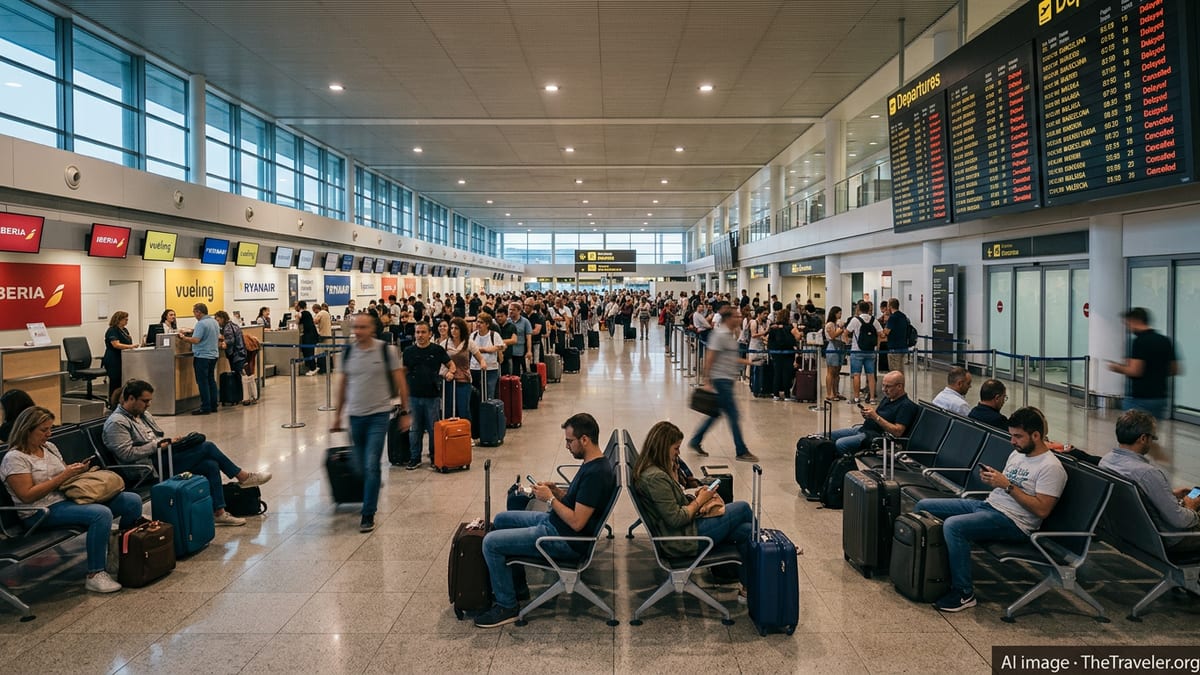
Spain’s Busiest Airports Buckle Under Mounting Disruptions
The latest figures from operational tracking platforms on March 9 show Spain among the European countries hardest hit by ongoing aviation turbulence, with its four key hubs struggling to keep services on schedule. Barcelona–El Prat, Adolfo Suárez Madrid–Barajas, Malaga–Costa del Sol and Valencia airports all reported long queues at check in, security and customer service desks as passengers tried to rebook missed connections or secure hotel vouchers after overnight delays.
While Spain is only one component of a wider European and Middle Eastern disruption picture, today’s cancellations and delays quickly translated into crowded terminals and growing frustration. Many affected flights were not outright cancelled but pushed back by several hours, a pattern that leaves travelers technically still scheduled to fly but with onward plans in tatters. Staff at ground handling agents described a “rolling” disruption, with late-arriving aircraft and crew rotations cascading through the day’s timetable.
Airport operators urged passengers to arrive earlier than usual and to rely on digital channels to monitor their flights, noting that boarding times and gate assignments were being revised repeatedly. Departure boards in both Madrid and Barcelona showed strings of amber “retrasado” notices, while loudspeaker announcements advised customers to remain close to gates even when new departure estimates stretched well beyond the original schedule.
Global Ripple Effects From Middle East and European Airspace Woes
Today’s problems in Spain are closely intertwined with severe disruption across Europe and the Middle East, where airspace restrictions, weather alerts and network congestion have forced carriers to redraw their flight plans. Airlines operating via Gulf hubs have been particularly affected, triggering knock-on issues for services into Spanish cities. Qatar Airways, for example, has had to reroute and retime flights linking Doha with Barcelona and Madrid, adding extra time in the air and tightening already‑stretched aircraft rotations.
Across Europe as a whole, hundreds of flights were cancelled and thousands delayed on March 9, according to aggregated operational data, with Spain sharing the burden alongside the United Kingdom, France, Germany, Denmark and Italy. When long‑haul and transfer passengers miss connections at major European hubs, the impact quickly ripples out to secondary destinations such as Malaga and Valencia, where aircraft may arrive hours late or depart without full connecting loads.
Carriers have also been battling the lingering effects of recent storms and strong winds over parts of the Iberian Peninsula and western Mediterranean, which previously forced holding patterns and diversions. Even after weather alerts ease, the residual imbalance of aircraft and crew continues to distort schedules for days, especially at peak times. For Spanish airports heading into a busy spring travel period, that means little slack in the system to absorb fresh shocks.
Airlines Scramble to Rebook and Recover Schedules
Iberia and its low‑cost partner Vueling bore a significant share of today’s disruption in Spain, given their extensive short‑haul networks and heavy reliance on Madrid and Barcelona as primary hubs. Both airlines deployed additional staff to customer service counters and encouraged passengers to use mobile apps to change itineraries where possible, in some cases waiving change fees and fare differences on disrupted routes.
Foreign carriers were also caught up in the turmoil. Ryanair faced clusters of delayed departures from Malaga and Valencia as it cycled aircraft through late‑running rotations elsewhere in Europe, while Lufthansa and other network airlines contended with congestion at their own base airports before flights could continue on to Spain. Qatar Airways and other Gulf carriers saw Spanish arrivals and departures reshuffled as they reconfigured long‑haul schedules around airspace constraints further east.
Despite public apologies and offers of rebooking, many passengers reported difficulty securing clear information on the cause of their delay or the realistic prospects of departure. With aircraft often positioned at out‑of‑sequence stands and crew rosters stretched by longer‑than‑planned duty periods, airlines were frequently only able to confirm updated departure times at short notice, leaving travelers torn between queuing at desks and waiting at gates.
Stranded Passengers Face Long Waits, Sleepless Nights
For many travelers at Spain’s major airports, the statistics of 21 cancellations and 447 delays translated into hours of waiting in crowded halls, hastily rebooked itineraries and, in some cases, unexpected nights in airport hotels. Families returning from winter‑sun holidays in the Canary Islands and North Africa found themselves stuck in Barcelona and Madrid as missed connections wiped out same‑day onward options to regional cities.
At Malaga–Costa del Sol, one of Spain’s key gateways for the Costa del Sol, passengers on delayed evening services described long lines at airline counters and vending machines running low on stock as crowds built up. In Valencia, travelers on disrupted low‑cost flights to European city‑break destinations were offered rebooking several days later or refunds that did little to address immediate accommodation and transport needs.
Some travelers turned to social media to share images of people sleeping on terminal floors and on rows of seats pushed together into makeshift beds. Others reported that hotel rooms near major airports quickly sold out or surged in price, pushing budget‑conscious passengers to remain airside overnight. With many flights heavily booked due to early spring demand, spare seats on alternative services were limited, prolonging the ordeal for those seeking to get home or start long‑planned trips.
What Passengers Can Do Under EU Air Passenger Rights
Consumer advocates reminded affected travelers that European Union rules offer robust protection in cases of significant delay or cancellation, particularly for flights departing from EU airports or operated by EU carriers. Depending on the circumstances and the length of the delay, passengers may be entitled to meals, refreshments, hotel accommodation, transport between the airport and hotel and, in some situations, fixed‑sum financial compensation.
However, eligibility often hinges on the root cause of the disruption, which can be difficult for passengers to verify in real time. Events considered outside the airline’s control, such as severe weather, airspace closures or certain air traffic control restrictions, may exempt carriers from paying compensation even though they must still provide basic care and assistance. Operational or staffing issues within an airline’s control, by contrast, typically strengthen the case for compensation claims.
Travel experts recommend that stranded passengers keep boarding passes, booking confirmations, receipts for out‑of‑pocket expenses and screenshots of delay notifications, as these can prove crucial when filing claims later. Using airline apps or websites to self‑rebook can also save valuable time compared with waiting in physical queues, especially during large‑scale disruption when call centers and airport counters are overwhelmed.