

More news on this day
Spain’s two busiest airports, Madrid Barajas and Barcelona El Prat, were hit by a fresh wave of air travel disruption today, with 209 flight delays and 36 cancellations affecting hundreds of passengers and snarling operations for major carriers including Lufthansa, Qatar Airways, Iberia and Ryanair.
Get the latest news straight to your inbox!
Barcelona and Madrid Bear the Brunt of New Disruptions
Operational data compiled today from Spanish airport authorities and flight-tracking services show that Barcelona and Madrid have emerged as the main hotspots in the latest bout of flight disruption, accounting together for 209 delays and 36 outright cancellations. The figures underscore how quickly congestion at the country’s primary hubs can ripple through airline schedules across Europe and beyond.
While Spain has seen recurring pockets of disruption in recent months, today’s numbers stand out for their concentration on just two airports. Both Madrid Barajas and Barcelona El Prat typically rank among Europe’s busiest hubs, handling hundreds of daily movements. Even a relatively small percentage of disrupted operations can translate into thousands of travelers facing missed connections, overnight stays and rebooked itineraries.
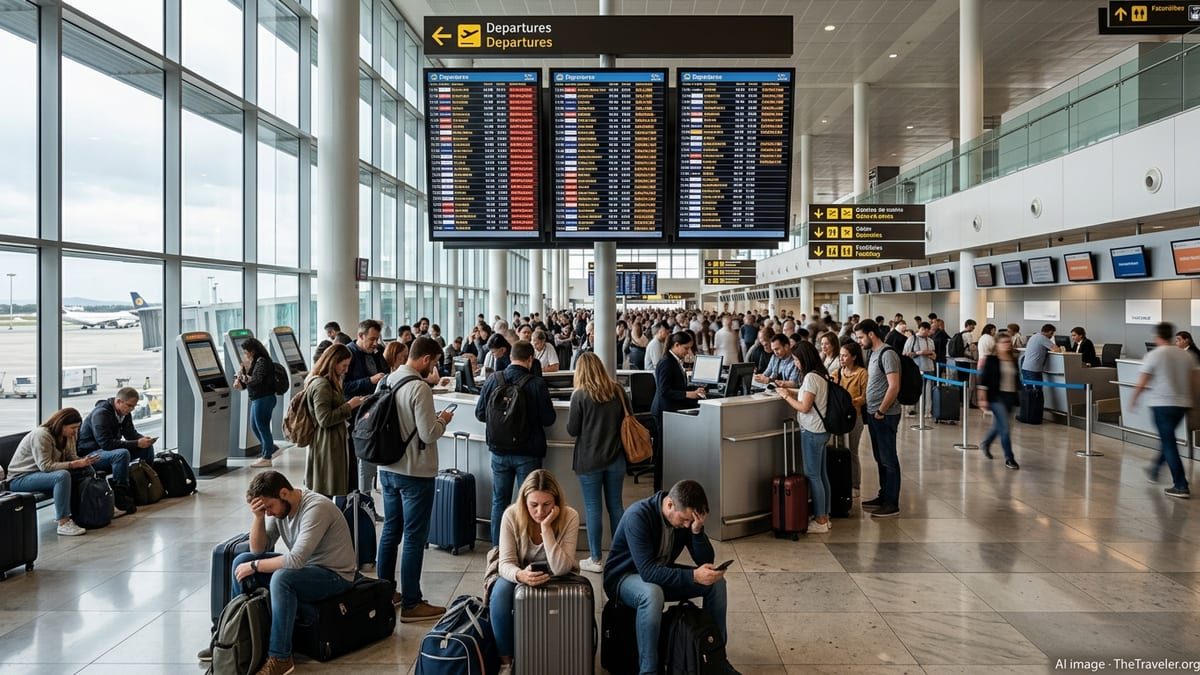
Passengers arriving in the terminals this morning reported long queues at airline service desks and self-service kiosks, with many travelers attempting to secure alternative routings after short-haul and long-haul services were delayed by several hours or scrubbed from departure boards entirely. Airport authorities said they were working with airlines to ease bottlenecks, but warned that knock-on effects could continue into the evening.
Travel industry analysts note that the pattern mirrors wider European disruption seen over the winter, where localized operational shocks have repeatedly tipped already tight networks into cascading delays, particularly at hub airports that serve as key connection points for intercontinental traffic.
Major Carriers Hit: Lufthansa, Qatar Airways, Iberia and Ryanair
The disruption in Barcelona and Madrid has cut across a broad mix of full-service and low-cost airlines, with Lufthansa, Qatar Airways, Iberia and Ryanair among the most affected today. Monitoring data indicate that these carriers together account for a significant share of the 36 cancellations and more than 200 delays, though a range of other European and regional airlines have also reported irregular operations.
Lufthansa, which relies on Spanish routes to feed its Frankfurt and Munich hubs, has seen a cluster of cancellations and short-notice schedule changes, according to passengers who reported receiving rebooking messages or discovering changes directly in airline apps. Some travelers bound for Spain via Germany spoke of having to reroute through alternative European cities after feeder flights were pulled from the schedule.
Qatar Airways passengers with itineraries touching Barcelona or Madrid have also been caught up in the disruption amid the wider Middle East airspace challenges that have already forced the carrier to significantly adjust its global network. Travelers holding tickets issued by partner airlines such as Iberia report complex rebooking processes, particularly when journeys involve multiple segments and codeshares spanning Europe, the Gulf and Asia.
Iberia and low-cost rival Ryanair, two of the largest operators in the Spanish market, have reported dozens of delays as tight aircraft rotations and high aircraft utilization leave little room to absorb schedule shocks. Delayed turnarounds on early morning departures quickly cascaded into subsequent waves of flights, particularly on popular domestic and intra-European routes from Barcelona and Madrid.
Underlying Causes: Airspace Constraints and Operational Strain
Today’s disruption comes against a backdrop of mounting operational pressure on European aviation. Industry reports in recent weeks have highlighted a sharp rise in delays across Spain compared with previous years, with congestion in key corridors and staffing challenges in air traffic control cited as recurring issues. Airlines have warned that even minor airspace restrictions or weather events can now lead to disproportionate knock-on effects.
Compounding the situation are continuing airspace uncertainties linked to geopolitical tensions in parts of the Middle East, which have forced long-haul carriers such as Qatar Airways to reroute or temporarily suspend certain services. Those changes have added complexity to network planning and crew scheduling, and have pushed more connecting traffic through already busy European hubs, including Madrid and Barcelona.
Operational experts say the current environment leaves airlines with limited flexibility. Many carriers are running close to capacity during peak periods, with aircraft and crews scheduled tightly across multiple legs each day. A delay in one sector can quickly result in crews exceeding maximum duty hours or aircraft missing crucial maintenance slots, triggering further delays or cancellations down the line.
For passengers, these structural pressures translate into a higher probability of disruption on any given travel day, particularly during busy periods or when several hubs are affected simultaneously. Today’s situation in Spain, they argue, is less an isolated incident and more another manifestation of a fragile system operating with very little margin for error.
What Stranded Passengers Are Facing on the Ground
At both Barcelona and Madrid, travelers caught in today’s turmoil are contending with lengthy waits, limited information and uncertainty over when they will reach their destinations. Social media posts from terminals show crowds gathering around departure boards as rolling updates turn scheduled flights into delayed or cancelled services.
Families, business travelers and tour groups have reported standing in line for hours to speak with airline agents or to access customer service hotlines. Some passengers with long-haul connections say they have been provided with hotel vouchers and meal coupons after missing onward flights, while others are choosing to stay in the terminal in the hope of securing earlier rebookings.
Despite the strain, airport operations teams in Barcelona and Madrid have stressed that core services remain functioning, with security and check-in operating, albeit under pressure. Ground handlers and airline staff are attempting to prioritize vulnerable passengers and those with imminent departures, though high passenger volumes have made consistent service difficult.
Travel agents report a surge in last-minute requests for alternative routings, particularly on routes linking Spain with Northern Europe, the Middle East and Latin America. With seat availability tightening rapidly, some travelers are being offered complex itineraries involving multiple stops, or are being advised to postpone trips by a day or more to secure viable options.
Advice for Travelers Flying to or from Spain
With disruption still unfolding, aviation experts are urging anyone due to travel through Barcelona or Madrid to assume that schedules may change at short notice. Passengers are being advised to monitor airline apps and airport information channels closely on the day of travel, rather than relying solely on initial booking confirmations.
Travel professionals recommend arriving at the airport earlier than usual to leave extra time for check-in, baggage drop and potential rerouting. Where possible, travelers with flexible plans are being encouraged to accept rebookings offered by airlines, even if they involve indirect routings or different carriers, as later options may be more limited once disruption spreads through the network.
Under European air passenger regulations, travelers whose flights are significantly delayed or cancelled may be entitled to care, assistance and, in some cases, financial compensation, depending on the cause of the disruption and the length of the delay. Consumer groups are reminding passengers to keep documentation such as boarding passes, booking confirmations and receipts for meals or accommodation incurred as a result of schedule changes.
For now, there is no clear indication of when operations at Barcelona and Madrid will return fully to normal, and airline planners warn that some residual delays are likely to persist even after today’s cancellations and backlogs are addressed. With Europe’s aviation system already under strain, many in the industry expect similar episodes of concentrated disruption to remain a feature of the coming months.