

More news on this day
Hundreds of passengers were left stranded across Spain on Friday as widespread delays and cancellations at Adolfo Suárez Madrid-Barajas, Malaga and Barcelona airports disrupted more than 300 flights and rippled across major European routes to Paris, London, Rome and Frankfurt.
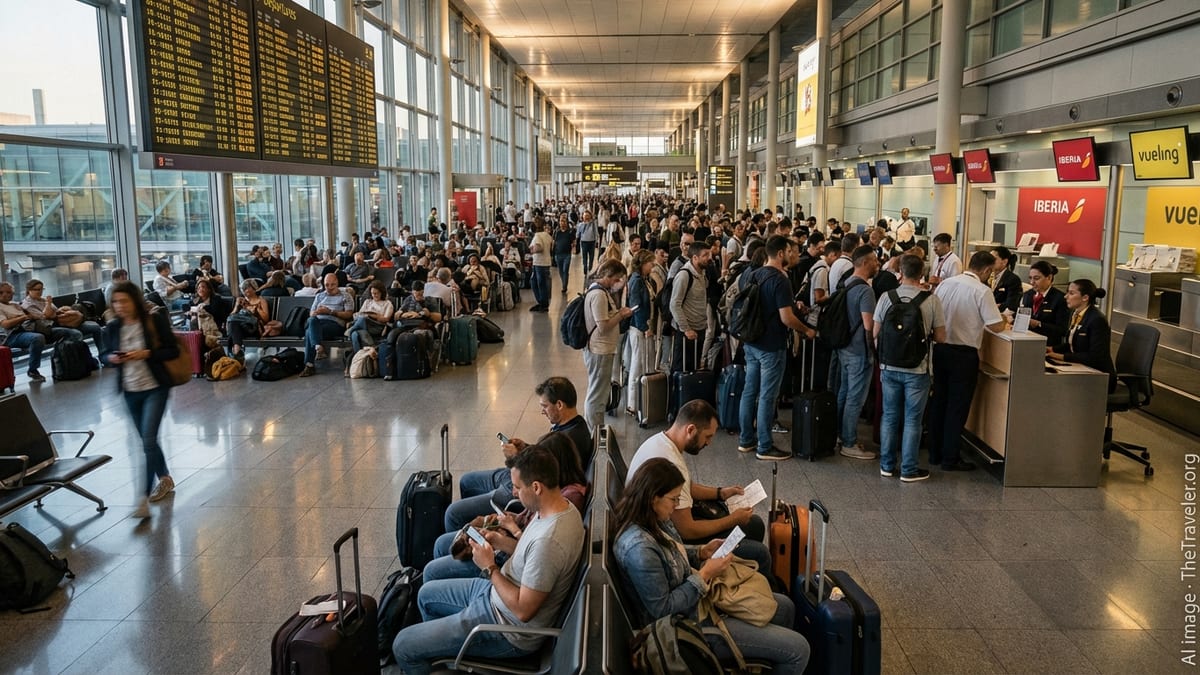
303 Delays and 11 Cancellations Snarl Spain’s Busiest Hubs
Spain’s Ministry of Transport and airport operator AENA reported a combined 303 delayed flights and 11 cancellations across the three airports, turning the country’s main aviation gateways into scenes of queues, missed connections and crowded terminal floors. The disruption struck at the heart of Spain’s domestic and international network, with services operated by Iberia, Vueling, Air Europa and several foreign carriers among those affected.
At Adolfo Suárez Madrid-Barajas, Spain’s primary long-haul hub, 126 flights were delayed and 7 canceled, causing knock-on effects for connecting passengers bound for European cities including Paris, London, Rome and Frankfurt, as well as onward long-haul destinations. Malaga, a key entry point for the Costa del Sol, registered 94 delays and 2 cancellations, while Barcelona-El Prat saw 83 delays and 2 cancellations, compounding pressure on airlines already operating near full capacity.
Although core safety and air traffic control functions remained intact, the scale of the disruption exposed how quickly routine operational stress, compounded by adverse weather and tight aircraft rotations, can overwhelm airport schedules. Ground staff and airline agents reported heavy congestion at check-in desks and transfer counters as they attempted to rebook passengers whose itineraries had fallen apart mid-journey.
With many flights operating late into the evening to clear backlogs, airport staff warned that residual delays could continue into the weekend as crews and aircraft gradually returned to position. Passengers were urged to monitor airline apps and airport information screens closely before traveling to the airport.
Passengers Face Overnight Strands and Missed Connections
The operational statistics translated into a difficult day on the ground for travelers. In Madrid’s terminals, long lines formed at airline service counters as passengers whose flights to major hubs such as Paris Charles de Gaulle, London Heathrow, Rome Fiumicino and Frankfurt were delayed or canceled scrambled to secure scarce alternative seats.
Families with children could be seen stretched out on terminal benches and floors near boarding gates, clutching luggage and plastic-wrapped takeaway meals as they waited for updated departure times. Several passengers reported missing onward connections to Latin America and North America after inbound flights from European cities arrived too late to complete their planned transfers.
At Malaga, popular with leisure travelers and retirees, delays to services operated by Iberia, Vueling and Air Europa left hundreds in limbo as departures to London and other UK and northern European cities slipped by several hours. Tour operators reported having to reorganize airport transfers and hotel check-in times at short notice as coaches waited outside the terminal for flights that had not yet landed.
Barcelona-El Prat, already one of Europe’s most heavily used Mediterranean gateways, saw departure boards dominated by the word “retrasado” and revised departure times. Budget-focused passengers on intra-European routes, particularly those connecting via Barcelona to Italy and Germany, voiced frustration at limited compensation and limited same-day rebooking options during already busy travel periods.
Airlines Iberia, Vueling and Air Europa Under Pressure
Spain’s main carriers bore the brunt of passenger anger as the day’s problems unfolded. Iberia, the country’s flag carrier and a cornerstone of traffic through Madrid-Barajas, saw multiple services to and from European hubs run behind schedule, affecting onward links to long-haul destinations. Even where flights eventually departed, knock-on crew and aircraft imbalances affected later rotations.
Vueling, a dominant presence at Barcelona and a key operator of high-frequency routes to Paris, Rome and other Mediterranean and central European cities, experienced extensive delays that quickly cascaded through its point-to-point network. Travelers on popular weekend city-break routes reported departure times slipping repeatedly, with some services leaving several hours later than scheduled.
Air Europa, which operates a mix of domestic and medium-haul European services alongside its transatlantic network, also faced operational strain. Flights between Spain and major European hubs, including Frankfurt and Paris, saw schedule disruptions that further complicated connecting itineraries for passengers routed through Madrid and Barcelona.
Foreign carriers using the three airports were not spared, with selected services operated by other European and Middle Eastern airlines forced into holding patterns or delayed departures while airports worked through departure and arrival congestion. For passengers, the distinctions between airlines mattered little as they queued at the same customer service desks seeking re-routing, meal vouchers and information.
Operational and Weather Factors Cited as Delays Mount
Preliminary assessments from aviation officials and airline sources pointed to a combination of operational and weather-related challenges behind the disruptions. Periods of reduced visibility and shifting wind conditions forced adjustments to runway configurations and landing rates at key times, slowing arrivals and departures and triggering early bottlenecks in Madrid and Barcelona.
On the ground, tight aircraft turnaround times, pressure on baggage handling and gate availability, and lingering staffing constraints at some service providers left limited margin to absorb even modest schedule slippage. Once early morning departures were delayed, rotations throughout the day ran late, particularly on short-haul routes where aircraft were scheduled for multiple sectors.
AENA and airline representatives stressed that safety was never compromised, but acknowledged that recovery from an event of this size takes time. Operational teams were reported to be reviewing gate planning, crew rostering and contingency measures to reduce the risk of similar large-scale disruption during upcoming peak travel periods, including Easter and the early summer season.
Industry analysts noted that Europe’s aviation system has remained highly sensitive to shocks, whether from weather, strikes or technical glitches, with seemingly isolated issues at one hub quickly spreading across national and regional networks. The events in Spain, they said, fit a wider pattern of limited resilience after years of cost-cutting and tight staffing.
Advice for Travelers Flying Via Spain in the Coming Days
With residual delays likely as airlines reposition aircraft and crews, travel experts advised passengers booked to fly through Madrid, Malaga or Barcelona in the next few days to build extra time into their plans. Those connecting to long-haul flights to or from hubs such as Paris, London, Rome and Frankfurt were urged to allow longer connection windows where possible.
Passengers were also encouraged to complete online check-in early, download airline mobile apps and enable notifications for real-time updates on gate changes and schedule adjustments. Where flights are significantly delayed or canceled, travelers may be entitled to assistance such as meals, refreshments and overnight accommodation, subject to carrier policies and European passenger rights rules.
At the airports themselves, staff recommended that travelers arrive earlier than usual for departures during peak morning and evening waves, particularly if checking luggage. While the worst of the disruption is expected to ease as schedules stabilize, officials acknowledged that the day’s events would serve as a reminder of how vulnerable busy European air corridors remain to even partial system shocks.
For the hundreds who spent long hours in crowded terminals waiting for updated departure times, the experience has underlined the importance of flexible itineraries, comprehensive travel insurance and backup plans when flying through Europe’s major hubs during periods of strain on the network.