

More news on this day
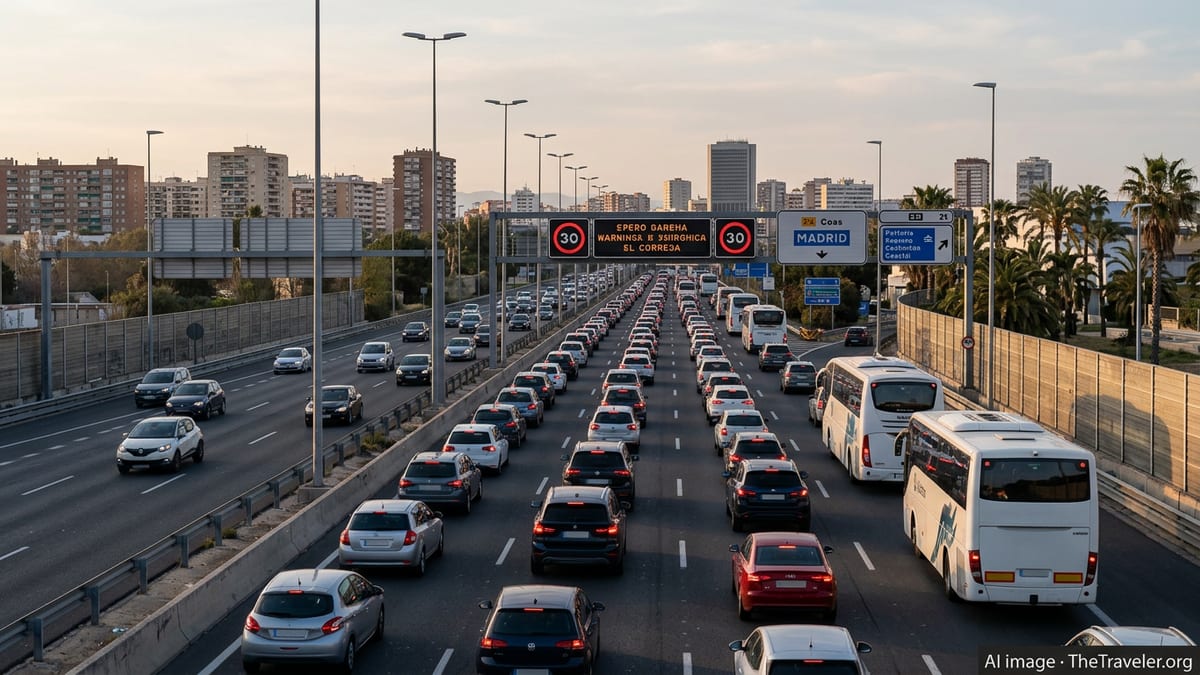
Spain’s Easter 2026 getaway is expected to generate intense congestion across motorways, coastal corridors and urban gateways, with the national traffic directorate preparing a special operation that could significantly disrupt journeys during one of the country’s busiest holiday periods.
Get the latest news straight to your inbox!
Peak Easter 2026 Travel Periods Across Spain
According to publicly available calendar data, Easter Week in 2026 runs from Sunday 29 March to Sunday 5 April, with the main long‑distance getaway concentrated around Thursday 2 April (Jueves Santo) and Friday 3 April (Viernes Santo), which are bank holidays in much of the country. Travel industry coverage indicates that many schools and workplaces align spring breaks with these dates, concentrating departures and returns into a handful of high‑pressure windows on Spanish roads.
Traffic planning documents and recent Easter operations suggest that the Dirección General de Tráfico (DGT) will activate its main Semana Santa device in two phases, mirroring previous years. The first phase is typically focused on the initial wave of departures at the start of the holiday period, while a second phase targets the mid‑week peak and subsequent return flows. For 2026, this pattern is expected to translate into especially heavy movement from the afternoon of Friday 27 March and again from Wednesday 1 April through Easter Monday in regions where that day is a holiday.
Weather and tourism forecasts published by Spanish media anticipate a strong demand for coastal, rural and city‑break travel, reinforcing expectations that traffic volumes will surge well above an average spring week. Early booking trends for accommodation in destinations such as Andalusia, the Valencian Community and Catalonia point to particularly crowded roads on the Mediterranean corridor and the main north–south axes feeding these areas.
Although precise official traffic projections for 2026 have not yet been released, recent DGT briefings for earlier years point to tens of millions of journeys nationwide during Holy Week, with several million concentrated into each major phase of the operation. Holidaymakers planning to drive in late March and early April 2026 are therefore being advised by travel information outlets to anticipate very slow progress at traditional choke points and to build generous margins into their itineraries.
Special DGT Operation and Nationwide Restrictions
A resolution on traffic measures for 2026 published in Spain’s official channels outlines a series of planned “Operaciones de Tráfico” that include Easter among the key seasonal devices. The documentation specifies that, during the Semana Santa operation, lane management systems, traffic diversions and dynamic speed limits can be activated on the busiest stretches, supported by a full deployment of monitoring technology and enforcement assets.
Based on DGT summaries of recent Easter campaigns, the special operation typically brings together fixed and mobile speed cameras, drones, helicopters, unmarked vans and real‑time traffic control centres to manage flow and curb risky behaviour. The same model is expected to apply in 2026, with an emphasis on speed compliance, safe overtaking, seat‑belt use and checks on distraction, especially mobile‑phone usage at the wheel.
The 2026 measures also include advance planning for work stoppages on numerous national highways during the peak days of the Easter operation. Annexed tables list dozens of corridors where roadworks must be interrupted or scaled back during Holy Week, reducing the likelihood of lane closures that could compound congestion. However, travel reports note that even with construction suspended, residual bottlenecks at pinch points and toll plazas can still produce delays stretching for many kilometres.
Traffic information services highlight that the Easter plan is coordinated at a national level but implemented with regional nuances. This allows adjustments to be made for specific local events, such as major processions or mass gatherings, which can affect city access routes and ring roads on particular days or at particular hours.
Major Hubs and Corridors Expected to Face Disruption
Historical DGT data and transport analyses indicate that the main gateways around Madrid and Barcelona are likely to be among the most affected hubs during the 2026 Easter operation. Outbound flows from the capital often saturate the A‑1, A‑2, A‑3, A‑4, A‑5 and A‑6 corridors in the early hours of the operation, while the ring‑road system experiences heavy pressure both at the start of the break and during the final return wave.
On the Mediterranean side, the AP‑7 and A‑7 corridors are routinely flagged as critical arteries during Holy Week, channelling vast numbers of vehicles between Catalonia, the Valencian Community, Murcia and Andalusia. Travel coverage for previous years has described recurrent slow‑moving traffic on these routes, especially near coastal resort turn‑offs and major urban nodes such as Valencia, Alicante and Malaga. Similar patterns are expected in 2026, particularly on days with fair weather forecasts that encourage last‑minute day trips.
Other hotspots identified in past operations include access roads to the Cantabrian coast via the A‑8 and A‑66, mountain approaches to ski and nature destinations, and key junctions on the Meseta such as those near Valladolid, Burgos and Zaragoza. In southern Spain, processions and city‑centre closures in Seville, Cordoba, Granada and other historic centres can push additional volumes onto bypasses and approach roads, generating unpredictable queues at certain times of day.
Airports, bus stations and train terminals in the main metropolitan areas are also expected to experience elevated road traffic as travellers transfer to long‑distance services. Urban reports from earlier Easter periods note that taxi ranks, ride‑hailing pick‑up zones and drop‑off lanes around these hubs can become saturated at peak times, further complicating circulation in already busy districts.
Safety Priorities and New Technology on Spanish Roads
Recent statistics released in connection with past Easter campaigns show that Holy Week remains a sensitive period for road safety in Spain, with a concentration of serious collisions tied to fatigue, distraction and speed. Public information from the DGT underscores that a significant proportion of fatalities in previous years have involved occupants who were not wearing seat belts, an issue that continues to feature prominently in awareness messaging ahead of major travel operations.
For 2026, the national traffic strategy continues to emphasise a combination of enforcement, education and technology. The existing network of fixed and mobile radar, supported by drones and aerial surveillance, is designed to detect excessive speed and dangerous manoeuvres across long distances. In parallel, monitoring cameras and unmarked vehicles focus on behaviours such as handheld phone use and failure to use restraint systems, particularly on high‑risk stretches and around busy junctions.
Newer vehicle equipment requirements are also set to play a role. From 2026, connected V16 emergency beacons become fully integrated into Spain’s traffic ecosystem, with some models transmitting breakdown locations directly to central platforms. Travel and motoring publications suggest that wider adoption of these devices may improve incident detection and clearance times during crowded periods such as Easter, reducing the secondary queues often caused by accidents or stalled vehicles on narrow sections.
Road‑safety campaigns in the run‑up to Semana Santa typically draw attention to issues such as excessive loading of vehicles, long overnight drives without rest and the combination of alcohol with late‑night festivities. Observers expect similar messaging in 2026, with a particular focus on younger drivers and long‑distance family travel, two groups frequently represented in Easter traffic flows.
Advice for Travellers Navigating the 2026 Easter Getaway
Tourism and mobility experts recommend that travellers planning to drive during Easter 2026 treat the DGT special operation as a clear signal to prepare thoroughly and avoid the busiest windows where possible. Suggestions include scheduling departures outside the traditional late‑afternoon rush, considering early‑morning or late‑evening starts, and allowing additional time for unplanned detours or temporary closures, especially near cities hosting major religious events.
Publicly available guidance also highlights the value of monitoring real‑time information from traffic platforms and broadcast bulletins on the days of travel. These services provide updates on congestion, incidents, weather‑related hazards and any extraordinary measures put in place, such as contraflow lanes or restrictions on heavy‑goods vehicles. Using this information to adapt route choices and departure times can significantly reduce stress and delay.
Drivers are further encouraged by travel organisations to review their planned routes in advance, identify alternative options and check for any local restrictions that may affect access to historic centres or seaside promenades. In some destinations, parking demand during Holy Week far exceeds supply, leading to extensive circulation as drivers search for spaces. Opting for park‑and‑ride facilities or peripheral parking areas can ease both congestion and frustration.
For international visitors, especially those unfamiliar with Spain’s regional holidays and road customs, the 2026 Easter operation will require particular attention to signage, speed limits and temporary measures. Taking time before departure to understand likely hotspots, respecting local regulations and maintaining conservative driving habits are being presented in travel coverage as the most reliable ways to navigate what is set to be one of the most challenging traffic periods of the Spanish year.