

More news on this day
Spain’s Directorate-General for Traffic is preparing a reinforced 2026 Easter traffic operation that is expected to slow journeys across major motorway corridors as millions of road users head to and from the country’s coastal, rural and religious tourism hubs.
Get the latest news straight to your inbox!
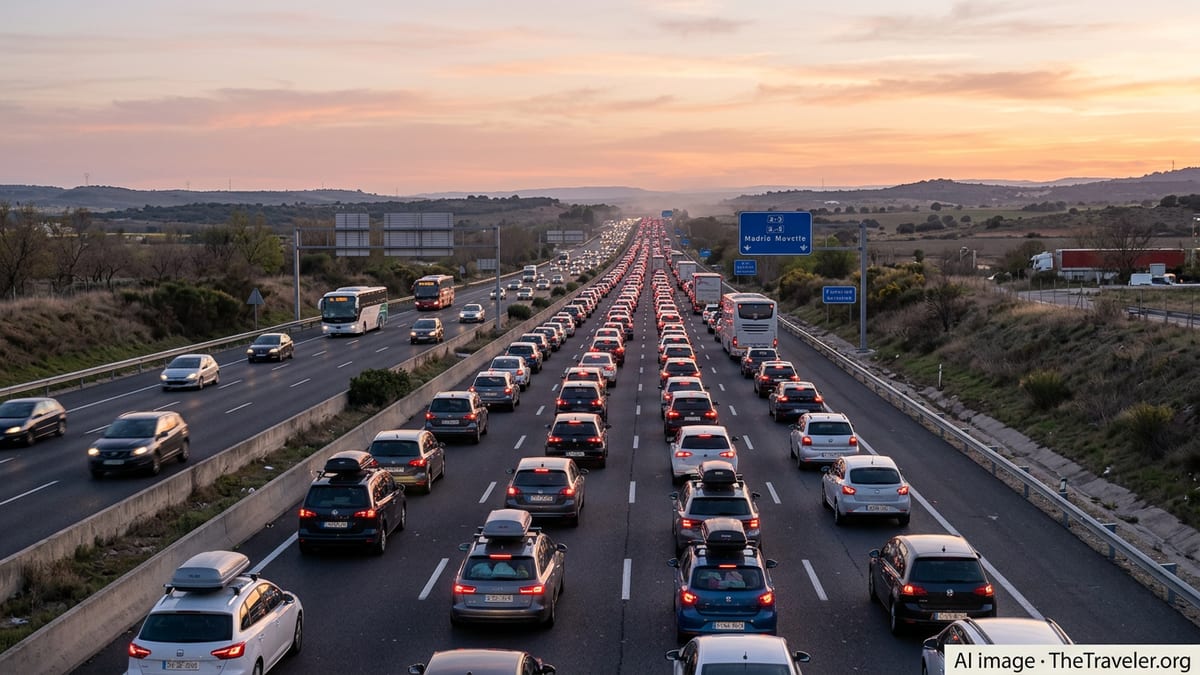
Phased Easter Operation Poised to Hit Peak Travel Days
According to recent Spanish media coverage, the DGT is finalising a multi‑phase "Operación Especial Semana Santa 2026" that mirrors and intensifies the framework used in 2025. Reports indicate that the plan will concentrate resources on two main phases: an initial wave of departures tied to regional school holidays and a second, heavier phase around the national public holidays from 1 to 5 April 2026.
Coverage of the draft calendar suggests that the second phase will begin at midday on Wednesday 1 April, coinciding with the main Easter exodus from metropolitan areas such as Madrid, Barcelona, Valencia and Bilbao. That phase is expected to continue through Easter Sunday on 5 April, with the heaviest return traffic forecast from Saturday afternoon into late Sunday night as travellers head back from the coast and interior destinations.
Based on DGT patterns from 2025, when more than 15 million long‑distance trips were recorded over Semana Santa, analysts anticipate that the 2026 operation will again prioritise major radial motorways linking the capital with the rest of the country. Travel across these axes is likely to be affected by rolling traffic management measures, temporary lane reversals and strict speed controls during the busiest hours.
Public information from the Interior Ministry on past Easter devices shows that tranches of the network can be subject to time‑limited restrictions and traffic redirection. For 2026, similar measures are expected to be announced gradually in the weeks leading up to Holy Week, with advice for drivers to avoid peak departure and return windows where possible.
Targeted Pressure on Spain’s Main Motorway Corridors
The operation is expected to place particular pressure on Spain’s busiest holiday corridors. Previous DGT bulletins highlight the A‑1 and AP‑1 towards Burgos and the north, the A‑3 towards Valencia, the A‑4 towards Andalusia, the A‑5 to Extremadura and Portugal, and the A‑6 and AP‑6 towards Galicia and the northwest as recurrent bottlenecks in long‑weekend devices.
For Easter 2026, media reports suggest a similar geographic focus, with additional attention on coastal access routes such as the AP‑7 Mediterranean corridor between Barcelona, Valencia, Alicante and Málaga, and the A‑8 along Spain’s northern coast. These roads carry a mix of domestic holiday traffic and cross‑border flows from France and Portugal, which can quickly turn routine congestion into prolonged tailbacks when weather conditions deteriorate.
Traffic specialists point out that the operation’s impact will not be limited to long‑distance drivers. Commuters and short‑range travellers living near key junctions, ring roads and airport access routes can also expect heavier congestion and intermittent slow‑downs, especially around major cities on the first and last days of the operation.
Urban and peri‑urban hubs around Madrid’s M‑40 and M‑50, Barcelona’s access routes, and bypasses serving cities such as Seville, Valencia and Bilbao are frequently cited in DGT communications as sensitive points whenever a nationwide device is activated. During Easter, the combination of local movements, tourist flows and possible adverse weather can prompt real‑time adjustments that further disrupt travel times.
New 2026 Rules and Heavy Vehicle Restrictions to Shape Flows
The 2026 Easter operation will unfold under a revised regulatory backdrop. Spanish specialist outlets have highlighted new DGT rules that enable temporary “no‑overtaking” regimes and additional restrictions on heavy vehicles on key dates such as Easter, summer operations and Christmas. These tools are designed to smooth traffic on single‑carriageway stretches and at steep gradients but can further slow overall travel for all users.
Industry information on DGT resolutions for 2026 also points to extra constraints on heavy goods vehicles that are not carrying essential or perishable cargo. During peak Easter hours, lorry bans or partial restrictions are expected on sections of the A‑1, A‑2, A‑3, A‑4, A‑5, A‑6 and other strategic corridors, redistributing freight flows to off‑peak windows and alternative routes.
At the same time, 2026 marks the full entry into force of the connected V16 emergency beacon as the standard roadside warning device in Spain, replacing traditional warning triangles on high‑speed roads. Public debate and official documentation indicate that this change is intended to reduce roadside exposure during breakdowns and collisions, particularly critical during high‑intensity operations like Easter.
Drivers who have not yet adapted to the new equipment requirements may face additional delays if roadside incidents are prolonged by inadequate signalling or secondary collisions. Mobility experts note that even minor incidents on overloaded corridors during Easter can cascade into lengthy queues, magnifying the effect of every breakdown, lane closure or enforcement checkpoint.
Airports, Coastal Towns and Religious Destinations Braced for Disruption
Although the DGT’s remit focuses on road traffic, the Easter operation has knock‑on effects across Spain’s broader travel ecosystem. Travel industry reporting suggests that major airports such as Madrid‑Barajas, Barcelona‑El Prat, Málaga‑Costa del Sol, Alicante‑Elche and Palma de Mallorca are planning for a surge in passenger numbers, with road access routes likely to suffer congestion during key departure and arrival banks.
Coastal tourism centres along the Mediterranean, the Costa de la Luz and the Cantabrian coast are also preparing for dense road traffic as domestic travellers combine beach stays with traditional Easter observances. Roads leading into high‑profile religious destinations, including cities with major processions in Andalusia and Castile and Leon, regularly register intense saturation in DGT Easter balance reports.
Publicly available information from previous years shows that secondary and regional roads around pilgrimage sites and procession routes can become significant choke points, even when the main motorways are flowing relatively well. Municipal controls, temporary closures and parking restrictions around historic centres can force visitors into longer detours or shuttle systems.
Tourism and mobility analysts warn that travellers who underestimate these localised constraints risk missed reservations, delayed check‑ins and extended journey times, particularly when combining intercity motorway travel with last‑mile access to old town districts or coastal resorts.
Guidance for Travellers Navigating the 2026 Easter Operation
Public guidance derived from DGT communications and coverage by national broadcasters consistently emphasises cautious planning for Easter journeys. For 2026, drivers are being encouraged to check the traffic forecast maps and restriction calendars published ahead of Holy Week, including detailed timetables for heavy vehicle limits and anticipated peak periods on each corridor.
Travel commentators underline the importance of avoiding mid‑afternoon and early evening departures on the main getaway days, particularly Wednesday 1 April and Thursday 2 April, as well as late‑afternoon returns on Easter Sunday. Early‑morning departures or off‑peak overnight travel on safer, well‑lit routes are often presented as a way to reduce stress and the likelihood of encountering severe congestion.
In addition, observers point to the growing role of real‑time information channels. The DGT’s traffic map services, social media updates and radio and television bulletins are expected to provide continuous updates on incidents, weather impacts and evolving congestion patterns during the 2026 operation, allowing drivers to reroute or adjust timing where possible.
For international visitors unfamiliar with Spain’s Easter travel dynamics, the overarching message from publicly available information is clear: Holy Week is one of the most demanding periods of the year on Spanish roads. In 2026, strengthened enforcement tools, new safety equipment rules and tighter controls on heavy vehicles are likely to make the network safer but also more tightly regulated, with a tangible impact on travel times across the country’s main holiday and religious tourism hubs.