

More news on this day
Spain is moving to the front line of Europe’s backlash against mass tourism, rolling out tougher rules on short-term rentals and visitor numbers as cities from Barcelona to Santiago de Compostela seek to protect housing for residents and push back against overtourism that has reshaped historic centres and coastal resorts.
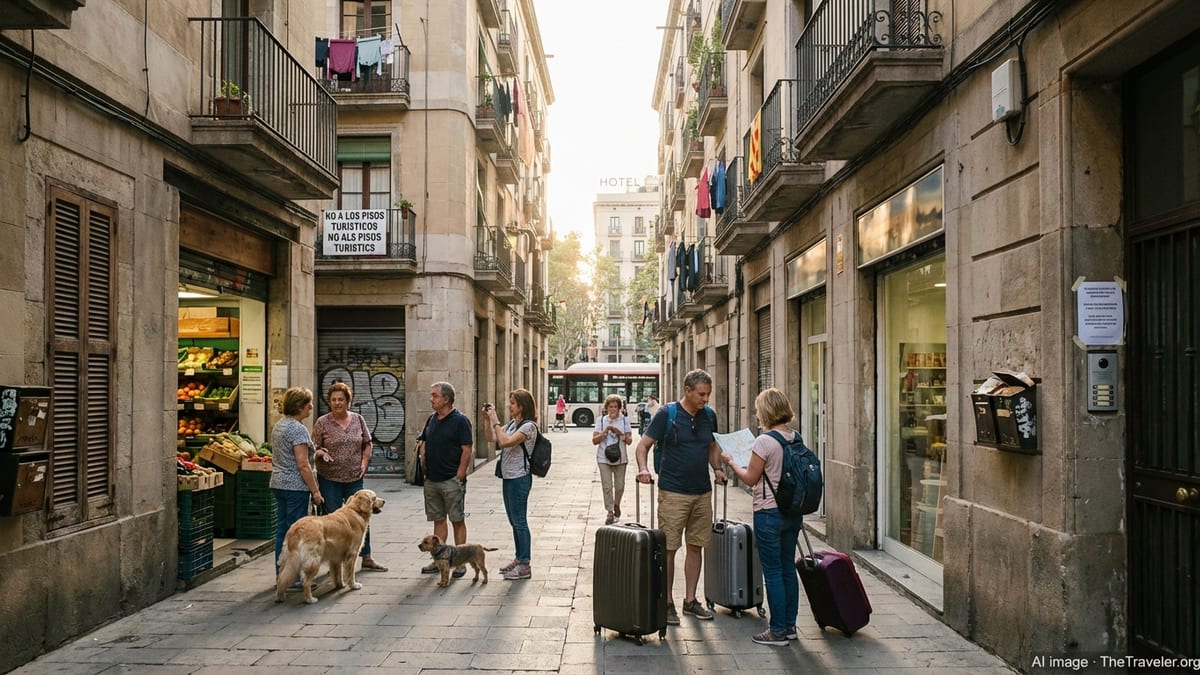
Spain Tightens the Screws on Holiday Lets
Across Spain, national and regional reforms introduced since 2024 are steadily reshaping how homes can be rented to tourists, bringing the country into line with some of the toughest anti-overtourism regimes in Europe. A major legal change that took effect in April 2025 strengthened the power of residents’ associations inside apartment buildings, meaning owners can no longer simply list their property as a holiday rental without explicit community authorization. The reform, backed by a new national organic law, is designed to give neighbours a direct veto over disruptive tourist flats that have multiplied in dense urban areas and popular seaside towns.
Local authorities in hotspots such as the Balearic Islands say the combination of soaring prices and shrinking supply of long-term rentals has made housing increasingly inaccessible to local workers. In Mallorca, officials warn that tourist flats have helped drive up costs, prompting complaints over noise, overcrowding and a sense that whole stairwells are being converted into revolving-door accommodation for short-stay visitors. By requiring building-wide approval, lawmakers hope to slow the expansion of holiday rentals in residential blocks and nudge more properties back into the conventional rental market.
Other Spanish regions are layering additional controls on top of national law. Several autonomous communities have tightened licensing rules, capped the number of tourist beds, and given municipalities new tools to revoke or refuse short-term rental permits in areas officially defined as facing a housing emergency. Officials argue that the reforms are not about rejecting tourists outright, but about reducing pressure on the most fragile neighbourhoods and ensuring that local residents can continue to live in historic centres that have become global tourism brands.
Barcelona’s Plan to Eliminate Tourist Apartments
Barcelona has become the emblem of Spain’s hardening stance, with the city council pledging to remove all licensed tourist apartments by late 2028. Under a plan first unveiled in June 2024, the city’s 10,101 officially registered tourist flats will simply see their licences expire and not be renewed, effectively forcing owners to convert properties back to long-term residential use or mid-term stays. The move builds on a Catalan decree adopted in 2023 that limits the duration of tourist licences to five years in municipalities where housing is officially scarce.
Mayor Jaume Collboni has defended the policy as a necessary “drastic” step to tackle what he describes as Barcelona’s number one problem: the cost and availability of housing. Over the past decade, average rents in the city have jumped far faster than wages, while around 32 million visitors descend each year on a municipality of about 1.7 million residents. City hall argues that concentrating thousands of tourist apartments in central districts has hollowed out communities, strained local services and fuelled tensions between residents and visitors.
The 2028 phaseout is already reshaping the market. Legal tourist flats in Barcelona once commanded a significant price premium, but analysts note that values are now slipping as the deadline draws closer and there is no prospect of renewal or compensation. The city has simultaneously ramped up enforcement against illegal listings, planning thousands of inspections and rolling out new requirements such as QR code registration at building entrances. Officials say more than 9,000 unlicensed tourist apartments have been shut down since 2016, with thousands of homes returned to residential use.
The policy is facing fierce resistance from property owners and rental platforms, who have launched legal challenges in Spanish courts and at the European level. Industry groups accuse the city of “expropriation” and warn that removing so many tourist beds could hit local jobs and major events. For now, however, Barcelona’s approach enjoys backing from Catalan authorities and has been bolstered by a Constitutional Court decision upholding regional powers to restrict tourist housing, making the city a test case for aggressive anti-rental measures elsewhere in Europe.
Tourist Taxes, Quotas and New Rules Across Spain
While Barcelona has captured global attention, other Spanish destinations are steadily tightening their own anti-overtourism toolkit. In 2025, several cities including Barcelona, Santiago de Compostela and Toledo are introducing or increasing overnight tourist taxes, adding a few euros per person per night to hotel bills and short-stay accommodation. Officials insist the levies are not designed to deter all visitors, but to raise funds for cleaning, security, and infrastructure that must cope with sharply seasonal spikes in population.
Catalan authorities have signed agreements allowing the region’s most-visited cities to raise regional tourism fees on higher-end hotels and cruise passengers, while Barcelona’s municipal surcharge on overnight stays continues to rise. In practice, guests in luxury accommodation can now pay well over 10 euros in combined taxes per night. The Balearic Islands are also raising their seasonal tourist taxes on resorts in Mallorca, Ibiza and Menorca, with the highest rates applying in peak summer months and at the most luxurious properties.
Elsewhere in Spain, local governments are experimenting with additional controls on visitor flows. Canary Island municipalities have begun trialling modest per-night tourist charges, while regional leaders debate broader levies amid protests over the environmental and social impact of mass tourism. Some town halls are restricting coach access to historic centres, re-routing buses to out-of-town parking and forcing tour operators to rely on smaller vehicles or guided walking tours once inside old quarters.
Beyond taxation and access rules, Spain’s courts are also becoming a battleground. Tenants’ unions and neighbourhood associations are bringing strategic cases against landlords and investment funds accused of pressuring residents to leave so that buildings can be converted into tourist lodgings. Recent legal actions in Madrid and Barcelona highlight mounting political and judicial scrutiny of investor-driven displacement, adding a further layer of risk for owners who bet heavily on short-term rental income in recent years.
Italy, France and Portugal Double Down on Overtourism
Spain’s moves are part of a broader shift across southern Europe, where tourism accounts for a large share of economic output but is increasingly perceived as a threat to liveability in major cities and small islands alike. In Italy, Venice has expanded its controversial day-tripper tax, charging visitors who enter the historic centre without staying overnight a fee that varies by date and registration time. The scheme, which now applies on dozens of peak days each year, is designed to manage the tide of day visitors that can reach 75,000 people on the busiest dates, dwarfing the resident population of the lagoon city.
Italian authorities are also restricting access in other heavily visited locations. Coastal destinations in the Cinque Terre and along the Amalfi Coast have introduced reservation systems and alternating licence plate schemes for private cars on certain days, in a bid to ease congestion on narrow cliffside roads. Local councils have limited new hotel permits and sharply curtailed the issuance of fresh licences for tourist apartments in historic centres such as Florence and Rome, where the number of beds available to visitors is now comparable to or greater than the number of permanent residents in some districts.
France has moved aggressively to rein in short-term rentals in Paris and other cities. The capital has long capped the number of nights that primary residences can be rented to tourists, requiring registration numbers on listings and threatening hefty fines for owners who illegally convert entire buildings into seasonal apartments. In 2024, lawmakers approved a sharp increase in the tourist tax in Paris and surrounding municipalities, giving local officials more room to differentiate between mass, low-spend tourism and longer stays that are seen as bringing higher economic value.
Portugal, meanwhile, has sought to cool overheating housing markets in Lisbon and Porto by freezing new local housing licences for most short-term rentals in urban pressure zones and offering tax incentives to landlords who switch properties back to long-term leases. The government has rolled out buyback schemes and renovation grants aimed at putting vacant or degraded housing back into use for residents rather than for tourists. Critics in the tourism sector argue that these policies risk undermining an industry that helped lift the country out of the last financial crisis, but opinion polls consistently show strong support among urban residents worried about rent inflation and displacement.
Netherlands and United Kingdom Target Short-Term Stays
Further north, the Netherlands and the United Kingdom are also tightening rules on home-sharing platforms and short-term lets. Amsterdam, one of the cities most synonymous with the boom in platform-based rentals, has raised its tourist tax to what is now among the highest levels in Europe and continues to limit the number of nights homeowners can rent out their primary residence. The city has banned new bed-and-breakfast permits in some central districts and uses a combination of data-sharing agreements and on-the-ground inspections to track down illegal listings that evade local caps.
Dutch officials present the policies as a response to mounting concerns about housing affordability and noise disturbances in inner-city neighbourhoods where visitor numbers rival the resident population. By gradually shrinking the space for commercial-style tourist flats and reallocating old canal houses and apartments back to long-term tenants, Amsterdam hopes to reduce friction between locals and visitors while preserving its heritage streetscapes.
In the United Kingdom, national and devolved governments have started to respond to similar pressures in cities such as London and Edinburgh and in rural hotspots from Cornwall to the Scottish Highlands. Central government has proposed mandatory registration schemes for short-term lets in England, giving councils a clearer picture of how many properties operate as de facto holiday rentals and where. Authorities in Scotland are going further, rolling out local licensing systems that can cap or refuse new short-term lets in saturated areas and require fire safety and planning compliance checks for existing hosts.
Some British seaside towns and national park authorities are exploring planning rules that designate short-term rentals as a specific use class, forcing owners to seek change-of-use permission if they wish to convert regular homes into holiday accommodation. Parish councils and community groups argue that without such measures, schools and local services become unsustainable as permanent populations decline, even as second homes and short-stay rentals proliferate.
European Union Seeks Common Ground on Data and Housing
As national and local authorities experiment with different tools, the European Union is trying to impose a degree of order on the fragmented short-term rental market. New EU-wide rules adopted in recent years aim primarily at improving transparency and data sharing rather than setting hard caps on visitor numbers, but officials say they are a crucial step toward more effective regulation. Platforms such as Airbnb, Booking, Expedia and TripAdvisor are now expected to provide standardized data to public authorities on listings and guest nights, enabling cities to monitor how tourist rentals evolve street by street and season by season.
The legislation responds to a rapid post-pandemic rebound in short-stay accommodation, with nights spent in private rentals across the bloc surpassing pre-2020 levels. Lawmakers in Brussels have argued that while short-term lets can support rural tourism and spread visitors beyond traditional hotel districts, their unregulated expansion has also contributed to a shortage of affordable housing in Europe’s most popular destinations. By giving municipalities clearer information on who is renting what, where and for how long, the EU hopes to support more targeted interventions, from zoning rules to differentiated tax regimes.
Housing advocates, however, insist that data alone will not reverse the damage already done in cities where investors have amassed entire portfolios of tourist apartments. They argue that European institutions should go further and explicitly recognize access to housing as a fundamental right that can justify tougher restrictions on tourism-related economic activity. Industry representatives counter that Europe risks sending an unwelcoming signal to visitors and undermining the competitiveness of its tourism sector just as long-haul markets are recovering.
For now, Brussels is positioning itself as an arbiter between competing interests, encouraging best-practice exchanges among cities while leaving politically sensitive decisions on caps, bans and taxes to member states and local governments. The result is a patchwork of regimes that can vary significantly even between neighbouring cities, complicating compliance for hosts and platforms but also allowing for experimentation tailored to local conditions.
Balancing Visitor Economies with Residents’ Rights
What unites the new wave of anti-overtourism measures across Spain, Italy, the Netherlands, the United Kingdom, France, Portugal and beyond is a growing willingness by policymakers to treat tourist accommodation as a distinct, heavily regulated use of housing, rather than as a casual sideline for homeowners. From Barcelona’s planned elimination of tourist flats to Venice’s expanded day-tripper fees and Amsterdam’s caps on new bed-and-breakfasts, the focus is shifting from simply attracting more visitors to actively managing how many come, where they stay and how they affect everyday life.
Residents’ movements have played a central role in forcing this shift, organizing street protests, legal challenges and neighbourhood campaigns that highlight the human cost of overcrowding and displacement. In Spain in particular, tenants’ unions and local platforms against touristification have framed the debate as one of basic rights, arguing that public authorities must prioritize stable housing, accessible services and community cohesion over the demands of investors and short-term visitors.
Tourism and property industry groups warn that rushed or overly restrictive policies risk unintended consequences, including a surge in informal rentals, a loss of jobs in hospitality and pressure on major events that rely on flexible accommodation capacity. In Barcelona, owners of tourist apartments are fighting the 2028 phaseout in court and hinting that big conferences could relocate if tens of thousands of beds disappear. Similar arguments surface in Venice, Lisbon and Amsterdam, where tourism still represents a critical pillar of local GDP.
With another peak summer season approaching, Spain’s new rules and those of its European neighbours will be closely watched by destinations worldwide struggling to reconcile booming visitor economies with livable cities. Whether the latest crackdowns deliver more affordable housing and calmer streets, or simply shift the pressures elsewhere, may determine how far governments are willing to go in rewriting the social contract between tourists and the places they visit.