

More news on this day
Morocco’s tourism boom is accelerating into a new phase, with Spain now surpassing traditional heavyweights such as France, Egypt, South Africa, Germany and Tunisia as the kingdom’s most dynamic growth engine, helping drive travel revenues beyond the 11 billion dollar mark and reinforcing Morocco’s ambitions to cement itself as a global tourism leader ahead of its Vision 2030 horizon.
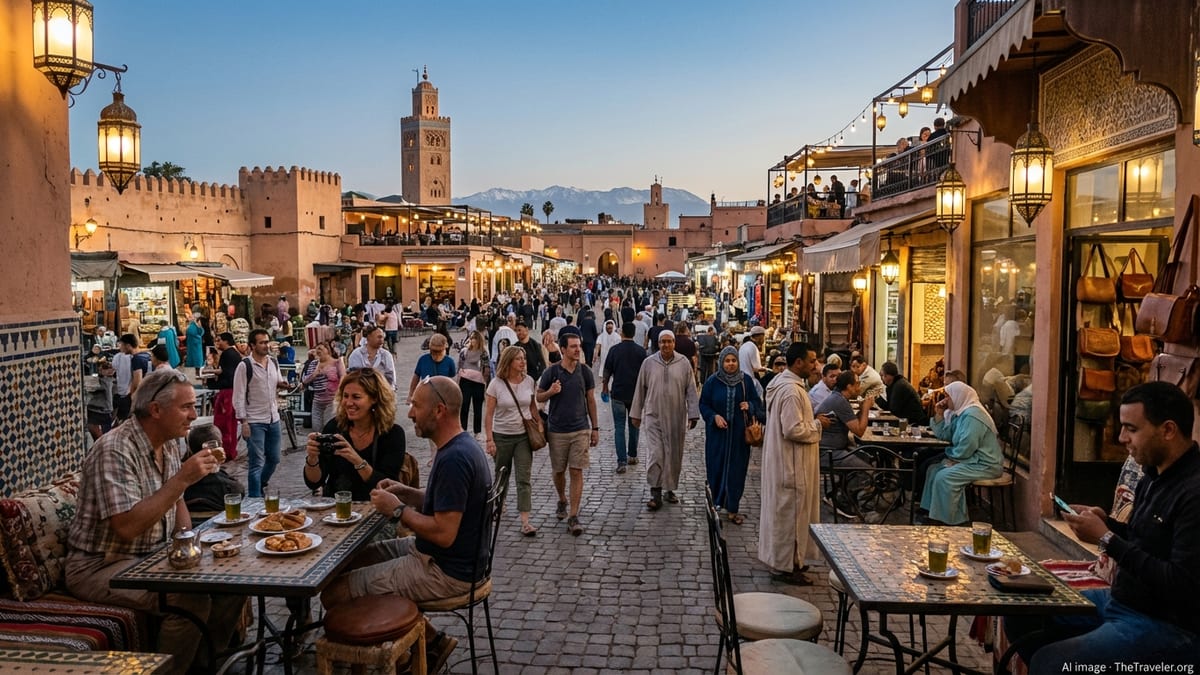
Record Revenues Push Morocco Into the Global Tourism Elite
Morocco’s tourism sector has shattered successive records over the past three years, transforming the country from a resilient post-pandemic player into one of the world’s fastest-rising destinations by both arrivals and revenue. Official foreign-exchange data show tourism receipts climbing from roughly 97 billion dirhams in 2023 to more than 112 billion dirhams in 2024, before surpassing 113 billion dirhams by October 2025 alone, equivalent to more than 11.3 billion dollars in just ten months.
That trajectory has continued into 2025, with the Ministry of Tourism reporting close to 18 million visitors by November 2025 and nearly 20 million by year-end, supported by expanded air connectivity, aggressive marketing and the staging of major sporting events. Analysts say Morocco has not only erased the damage from the pandemic years, but has leapt ahead of many competitors in Africa and the Mediterranean in the speed and scale of its recovery.
Behind the headline figures lies a deeper structural shift. Tourism’s direct contribution to Morocco’s economy has surged, with sectoral GDP reaching almost 12 billion dollars in 2024 and tourism’s share of national output rising to around 7.3 percent, its highest level in modern statistics. That puts Morocco firmly among the global tourism elite, even as it competes with far larger markets such as Spain and France in the wider Mediterranean basin.
Spain Becomes Morocco’s Star Source Market
While France has historically been Morocco’s dominant source of foreign visitors, recent data show Spain pulling ahead as the most dynamic growth market into the kingdom, a shift that has reconfigured regional tourism flows across the western Mediterranean. Industry officials say Spanish travelers have been at the forefront of demand for Morocco’s city breaks, desert circuits and surf destinations, taking advantage of short-haul flights and improved ferry links across the Strait of Gibraltar.
Spanish arrivals are rising from a broad base: independent travelers escaping crowded European resorts, families drawn by Morocco’s value-for-money positioning, and a growing cohort of young professionals seeking weekend cultural escapes in cities such as Tangier, Tetouan and Chefchaouen. Tour operators in both countries have layered new itineraries on top of this demand, while Moroccan authorities have added fresh air routes from key Spanish hubs and strengthened joint promotion campaigns.
This surge has allowed Spain to outpace not only France, Germany and the United Kingdom as a driver of incremental growth, but also regional competitors such as Egypt, Tunisia and South Africa that traditionally vie with Morocco for European holidaymakers. Moroccan officials argue that the breadth of the Spanish market, from budget travelers to upmarket food and culture enthusiasts, is giving the kingdom a more resilient, diversified inbound base than many of its peers.
Beating Regional Rivals in a Crowded Tourism Race
The numbers underscore Morocco’s widening lead over several traditional tourism powers in its neighborhood. While Egypt, Tunisia and South Africa remain major destinations in their own right, they have faced more volatility from security concerns, currency pressures or infrastructure constraints. Morocco, by contrast, has leveraged its reputation for stability, its Atlantic and Mediterranean coastlines, and its proximity to Europe to capture a growing share of north–south travel flows.
Officials point to the 17 to 20 percent annual increases in arrivals recorded across 2024 and 2025, even as some competitors struggled to regain pre-pandemic levels or saw only modest growth. Morocco’s strategy of diversifying its offer beyond classic sun-and-sea tourism to include cultural, nature, sports and desert experiences has helped it stand out from rivals that remain heavily concentrated in a single product segment.
At the same time, stronger air connectivity has been a decisive advantage. Since 2023, Morocco has launched dozens of new international routes and expanded seat capacity into destinations such as Marrakech, Agadir, Tangier and Rabat, allowing it to reach mid-sized European cities that are not always well served by flights to Egypt or South Africa. Combined with streamlined visa policies and digital marketing partnerships, this has enabled the kingdom to convert interest into concrete bookings at a faster pace than many neighboring countries.
Vision 2030: From Record Year to Long-Term Strategy
Morocco’s recent tourism milestones are not occurring in a vacuum. They form part of a broader national roadmap running through 2030 that seeks to make tourism a central pillar of economic diversification, job creation and international influence. Under this strategy, the country aims to attract at least 26 million visitors by 2030, up from fewer than 20 million in 2025, while continuing to increase average spending per tourist and extend length of stay.
The Vision 2030 horizon is closely tied to Morocco’s role as a co-host of the 2030 FIFA World Cup, a mega-event expected to unlock billions of dollars in infrastructure upgrades. Investments are flowing into airport expansions, high-speed rail extensions, new or renovated stadiums, and hotel capacity in key hubs such as Casablanca, Rabat, Marrakech, Tangier, Fez and Agadir. Authorities say these projects are designed not only for a single tournament, but to support sustained tourism flows long after the final whistle.
Crucially, the government has framed tourism as a vehicle for regional development, not just a showcase for flagship cities. The national roadmap includes incentives for private investment in lesser-known coastal stretches, mountain villages and desert oases, aiming to spread visitor spending more evenly and create jobs in areas with high youth unemployment. Officials insist that the record 11 billion dollars in tourism revenues achieved in 2024 and surpassed in 2025 must translate into tangible improvements in local livelihoods if the Vision 2030 project is to maintain public support.
Opportunities and Pressures in a Rapidly Growing Market
The rapid acceleration of Morocco’s tourism industry, turbocharged by Spanish demand, is also generating new pressures that the country will need to manage carefully in the years ahead. Popular destinations such as Marrakech, Chefchaouen and parts of the Atlantic coast are already grappling with crowding, housing tensions and questions over the sustainability of short-term rentals, trends that echo debates currently unfolding in Spain and Portugal.
Environmental sustainability is another concern. The expansion of air traffic, water-intensive resort developments and the strain on historic medinas all pose long-term risks if growth is not carefully regulated. Policymakers have begun to talk more openly about “quality over quantity,” mirroring language used by tourism ministries in Spain and France, and are promoting investment in eco-lodges, heritage preservation and greener transport options.
For now, however, the mood in Rabat and across Morocco’s tourism sector remains one of cautious optimism. The kingdom has emerged from a period of global uncertainty with one of the strongest tourism rebounds in its region, backed by more than 11 billion dollars in annual growth and a deepening partnership with Spain as its leading source of new visitors. With Vision 2030 on the horizon and the World Cup spotlight approaching, Morocco is positioning itself not just as an alternative to France, Egypt or South Africa, but as a global tourism leader in its own right.