

More news on this day
Spain is rapidly emerging as a central force in Europe’s high-speed rail revolution, joining France, Italy, Germany, the Netherlands and other neighbours in a continent-wide push to slash travel times, expand cross-border links and shift millions of passengers from short-haul flights to fast, low-carbon trains.
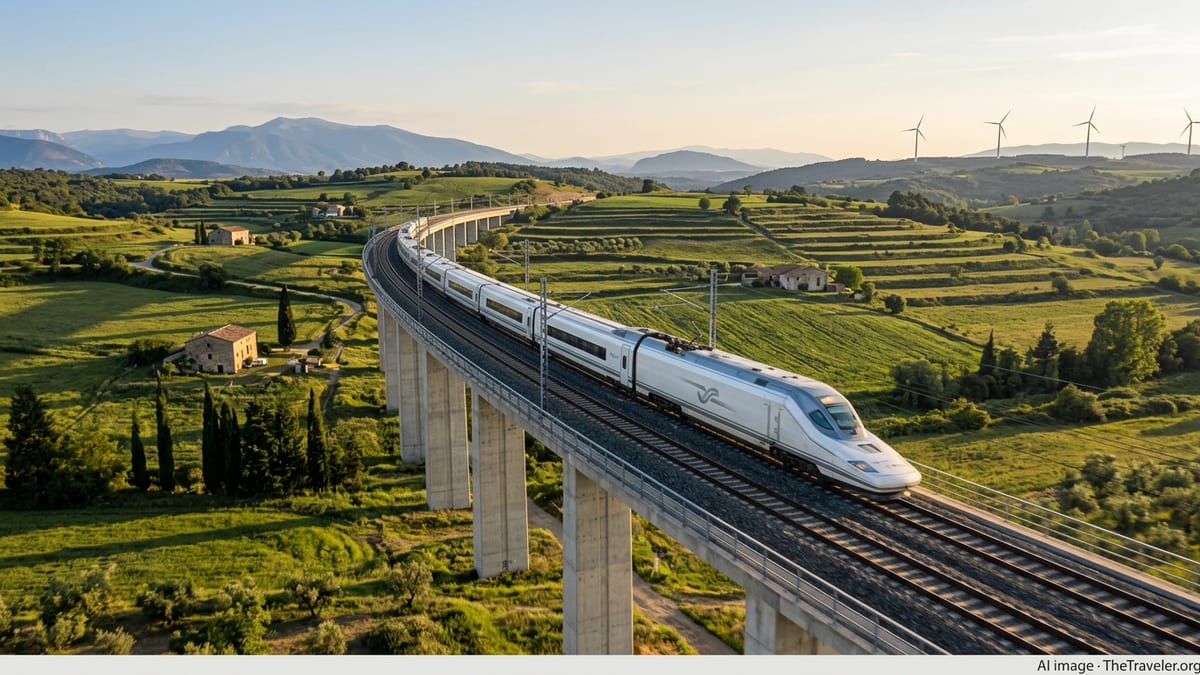
Spain Extends Europe’s Longest High-Speed Rail Network
While France long symbolised European high-speed rail with its TGV, Spain has quietly built the continent’s largest network of dedicated high-speed lines, now approaching 4,000 kilometres in operation and second only to China worldwide. New corridors radiating from Madrid to Galicia, Burgos, Murcia, Granada and Extremadura have come online in recent years, giving medium-sized cities fast links that rival air on key domestic routes.
Traffic figures show how quickly travellers are embracing the network. Spanish authorities reported around 40 million passengers on high-speed routes in 2024, with the flagship Madrid to Barcelona corridor alone carrying nearly 15 million as competition between Renfe, Iryo and Ouigo pushed down fares and increased frequency. Southern routes from Madrid to Seville, Málaga and Granada, as well as the line to Valencia, have seen double-digit percentage growth as journey times fall and prices become more accessible.
Infrastructure manager Adif is simultaneously extending the system and upgrading existing lines for higher speeds and mixed traffic. New high-speed sections to Extremadura and along the Mediterranean Corridor are being built to European standard gauge and integrated into the Trans-European Transport Network, improving both passenger and freight connectivity to ports such as Valencia and Algeciras. A recent network statement for 2026 highlights ongoing works that will tighten links between central Spain, Andalusia and the Mediterranean coast.
On the flagship Madrid to Barcelona corridor, the government has authorised technical upgrades that will allow AVE services to reach up to 350 kilometres per hour, lifting commercial speeds and cutting journey times on one of Europe’s busiest rail arteries. Combined with open-access competition, these improvements are positioning Spain as a testbed for how high-speed rail can be scaled rapidly while keeping tickets affordable.
Cross-Border Connections Reshape European City Pairs
Spain’s high-speed expansion is unfolding in parallel with major projects elsewhere in Europe that are reshaping how travellers move between countries. France is adding capacity and increasing speeds on key axes south of Paris and toward the Spanish border, while work continues on the long-planned Bordeaux to Dax high-speed section that will ultimately strengthen the Paris to Madrid rail corridor.
Italy is pressing ahead with upgrades and new infrastructure on its Milan to Naples trunk line and branches toward Genoa and the French border, while also preparing rolling stock for service into Germany. The Turin to Lyon base tunnel through the Alps, although years in the making, is viewed as a cornerstone of a future high-speed spine linking the Iberian Peninsula, Italy and central Europe. Germany, for its part, continues to modernise and infill its high-speed and upgraded lines, supporting growing international services and open-access operators.
In the Netherlands and Belgium, existing high-speed sections form the backbone of dense cross-border services connecting Amsterdam, Brussels, Paris and Cologne. Operators and policymakers see Spain’s network, when fully connected through southwestern France, as a natural extension of this north–south high-speed axis. Over time, this would allow journeys such as Amsterdam to Barcelona, or Hamburg to Madrid, to be completed in a single day primarily by rail.
Private operators are increasingly part of this picture. In Germany, FlixTrain has announced large orders for new high-speed trainsets, signalling a push to expand affordable long-distance rail across multiple countries. Spanish, Italian and French incumbents are likewise positioning their fleets and business models to compete beyond national borders, turning Europe’s once-fragmented high-speed systems into an increasingly integrated market.
EU High-Speed Rail Deal Targets Faster, Greener Travel
The high-speed rail surge in Spain and its neighbours is closely tied to European Union climate and mobility policies. The European Commission has presented a dedicated plan to accelerate high-speed rail across the bloc, aiming to complete the core Trans-European Transport Network by 2040 and to make rail a convincing alternative to short-haul flights on many intra-European routes.
This emerging High-Speed Rail Deal combines national investment with EU co-financing and calls for more harmonised technical standards and operating rules. Brussels has endorsed design speeds of at least 250 kilometres per hour for new high-speed lines, arguing that only genuinely fast services can draw passengers away from aviation and long-distance driving. Sector associations have welcomed the move and urged governments to back it with predictable infrastructure funding and streamlined permitting.
The strategy also emphasises interoperability, from signalling systems to ticketing. Spain’s recent choice to build all new high-speed lines in standard gauge compatible with France and the rest of continental Europe is a key example of this approach. As cross-border bottlenecks are removed and rolling stock is certified to run seamlessly in multiple countries, it becomes easier to operate through services that link, for example, Barcelona with Lyon, Milan or Frankfurt without complex transfers.
Crucially for travellers, the EU agenda aims not only at faster trains but also at more frequent, reliable and affordable services. By encouraging open-access competition and simplifying cross-border operations, policymakers hope to replicate the Spanish experience of falling ticket prices and rising ridership, using market dynamics to accelerate the modal shift toward rail.
From Planes to Trains: Cutting Emissions and Travel Times
Environmental arguments sit at the heart of Europe’s high-speed rail revolution. Rail already accounts for a small fraction of the transport sector’s greenhouse gas emissions despite carrying a substantial share of passengers and freight. Studies underpinning the European Green Deal highlight that shifting short-haul journeys from air to high-speed rail, complemented by better conventional rail and night trains, is among the most effective ways to decarbonise mobility while maintaining connectivity.
On many intra-European routes, journey times by high-speed rail are already competitive with flying once airport transfers and security checks are taken into account. Madrid to Barcelona is a clear example: trains typically cover the route in around two and a half hours from city centre to city centre, matching or beating overall air travel time while generating significantly lower emissions per passenger.
Spain is also experimenting with cleaner technologies within its rail ecosystem. Domestic manufacturer Talgo has been developing hydrogen-powered high-speed train concepts, positioning the country at the forefront of zero-carbon traction research. While these trains are still in development, they reflect a broader push to pair infrastructure expansion with more sustainable rolling stock and energy systems.
As climate constraints on aviation tighten and new environmental charges are debated or introduced, high-speed rail’s advantage is expected to grow. Countries such as France have already restricted some short domestic flights where a rail alternative of around two and a half hours exists, and similar debates are emerging elsewhere in Europe. Spain’s rapidly expanding network makes it a prime candidate for further such policy shifts, especially on dense corridors where trains already dominate.
What Travellers Can Expect in the Coming Years
For travellers planning European trips over the next decade, the implications of this high-speed build-out are significant. Spain’s network will continue to expand toward ports and border regions, improving connections from cities such as Seville, Valencia and Murcia to France and, in time, to Portugal via planned links between Madrid, Extremadura and Lisbon. Once key missing cross-border sections in southwestern France are resolved, direct high-speed trains between major Spanish cities and Paris should become more frequent and faster.
Elsewhere, Italy is preparing new high-speed services that could run from Milan toward Munich and beyond, while France and Germany refine their joint offerings linking Paris, Frankfurt, Stuttgart and other hubs. The Netherlands is likely to benefit from more through services that extend south to Spain or east toward central Europe, giving travellers additional options for predominantly rail-based itineraries.
Competition is likely to intensify, especially on well-travelled routes where multiple operators can viably run services. Spain’s experience with three high-speed brands on the Madrid to Barcelona corridor has shown that this can bring lower prices, more flexible schedules and differentiated on-board service levels. Similar dynamics are beginning to appear in Italy and Germany and could extend to cross-border services as technical barriers fall.
For tourism, the emerging map is transformative. Multi-country rail journeys that link Amsterdam, Paris or Berlin with Barcelona, Madrid or Valencia in a series of fast, comfortable segments are becoming more practical and appealing. As Spain joins France, Italy, Germany, the Netherlands and other partners at the forefront of Europe’s high-speed rail revolution, the continent’s classic grand tour is being rewritten for an age of climate-conscious, rail-first travel.