

More news on this day
Spain’s high-speed rail network is struggling to regain full momentum after a deadly collision near Adamuz and a separate landslide in Málaga province, leaving services between Madrid, Málaga and Algeciras heavily disrupted and travelers facing prolonged journey times, last-minute changes and widespread uncertainty.
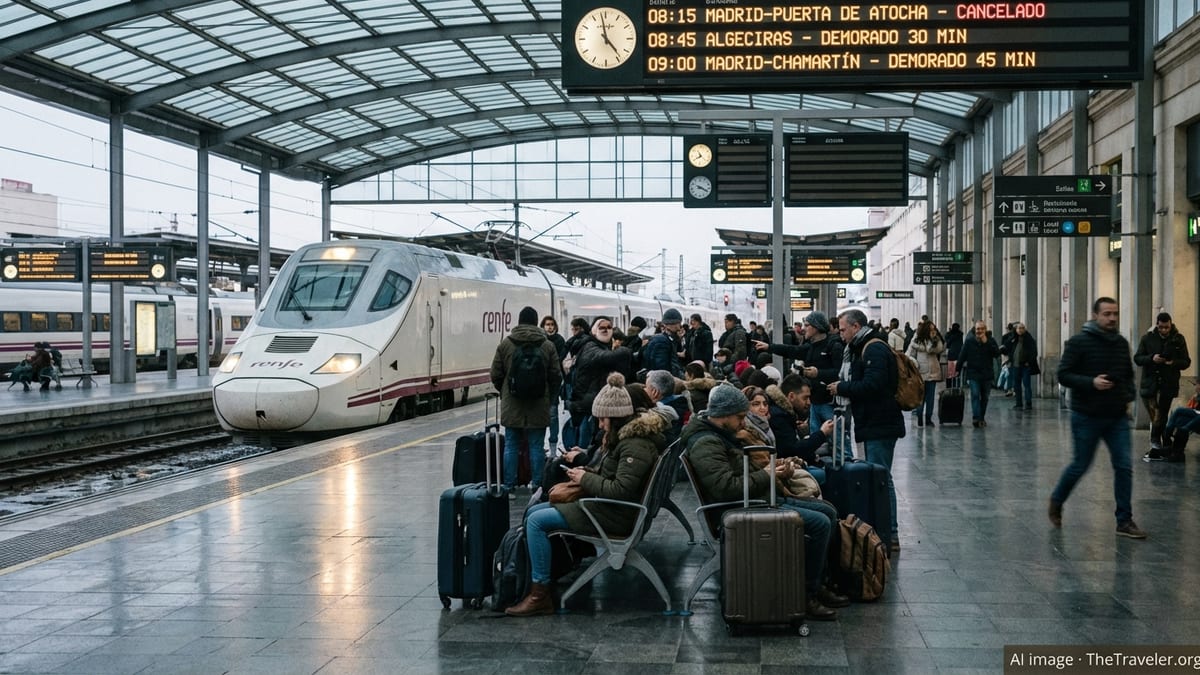
Deadly Adamuz Collision Casts Long Shadow Over Spain’s High-Speed Network
The fatal collision on January 18 near the town of Adamuz in Córdoba province, in which two high-speed trains derailed and collided on the busy Madrid–Seville line, has become Spain’s worst rail disaster in more than a decade. An Iryo service traveling from Málaga to Madrid derailed and was struck moments later by a Renfe Alvia train heading from Madrid to Huelva. The crash killed 46 people and injured nearly 300, shocking a country that has invested heavily in modern high-speed infrastructure.
The section of line north of Córdoba was badly damaged in the impact, with mangled track, catenary and signaling equipment requiring complete replacement. Infrastructure manager Adif obtained court authorization to begin emergency works, but adverse winter weather slowed progress and extended the closure far beyond initial expectations. For nearly a month, through high-speed services between Madrid and much of Andalucía were either suspended or forced onto complex alternative routings.
The scale of the tragedy has revived painful memories of the 2013 Santiago de Compostela disaster and triggered fresh scrutiny of Spain’s rail safety culture. Investigators are examining the condition of the track, the behavior of both trains in the minutes before the crash and the performance of signaling and protection systems on one of Europe’s flagship high-speed corridors.
Madrid–Andalucía High-Speed Services Restart, but With Gaps
After 29 days of intensive reconstruction, Adif authorized the reopening of the damaged stretch of the Madrid–Seville high-speed line on February 17. High-speed operator Renfe has restored its through AVE and Alvia services from Madrid to Seville, Cádiz, Granada and Almería, returning these key southern destinations to their pre-crash timetables and journey times. Private competitors Iryo and Ouigo have also restarted services on the corridor, with early-morning departures once again linking the capital with Andalucía’s largest cities.
Rail operators emphasize that safety checks have been exhaustive. Test runs were conducted at line speed to verify signaling and track geometry before passenger trains were allowed to return. Temporary speed restrictions initially considered for the repaired section have been eased after successful trials, allowing trains to reach up to 250 kilometers per hour across the reconstructed zone.
For travelers heading to and from Seville, Cádiz, Granada and much of western Andalucía, the reopening marks a clear step toward normality. However, the broader network is far from fully recovered. The combination of infrastructure repair windows, rolling-stock rotations and lingering operational constraints means that some frequencies remain reduced and peak services can sell out more quickly than usual.
Málaga Link Still Partially Broken After Álora Landslide
While the Adamuz section has reopened, high-speed passengers between Madrid and Málaga face a more complicated picture. A separate landslide near Álora, northwest of Málaga, damaged tracks and overhead power lines on the branch that connects the Costa del Sol to the main Madrid–Andalucía high-speed spine. That incident, which occurred amid persistent heavy rain earlier this month, forced a complete halt to direct AVE and low-cost high-speed services between the two cities.
As of this week, Renfe and its low-cost brand Avlo have begun selling tickets again on the Madrid–Málaga corridor, but journeys now include a compulsory transfer to a bus between Antequera and Málaga. Trains run from Madrid to Antequera’s high-speed station, where passengers disembark and board chartered coaches to complete the final stretch to Málaga María Zambrano station on conventional roads.
The workaround adds significant time and uncertainty to a route that normally offers a fast, seamless trip of around two and a half hours. Current itineraries can exceed four hours door to door, with travelers advised to factor in additional waiting time for bus transfers and potential congestion on the A-45 motorway. Adif expects track repairs in the Álora area to continue into early March, meaning at least several more weeks of partial disruption on one of Spain’s busiest leisure corridors.
Private operator Ouigo has resumed ticket sales on the corridor but has been criticized by some passengers for a lack of transparency in how the bus transfer requirement is communicated at the time of purchase. Iryo, meanwhile, has yet to restart commercial operations on the Madrid–Málaga route, preferring to wait until direct high-speed running can be restored.
Costa del Sol Tourism Counts the Cost as Trains Sit Idle
The suspension and now partial restoration of high-speed connections with Málaga have delivered a sharp economic shock to the Costa del Sol, one of Europe’s most tourism-dependent regions. Provincial officials estimate that the absence of direct AVE services from Madrid since the Adamuz crash has cost the local tourism industry more than 100 million euros in lost revenue. Hoteliers and resort operators report tens of thousands fewer arrivals than expected for the second half of January and early February.
For the Costa del Sol, Madrid is not just another origin market but a vital source of year-round domestic tourism, filling hotel rooms outside the peak summer season and supporting airlines, restaurants and cultural attractions. The high-speed line has effectively functioned as an air bridge on rails, with business travelers and weekend visitors from the capital accustomed to boarding trains at Atocha station and stepping out in central Málaga just a few hours later.
The combination of the Adamuz crash and the Álora landslide has severed that link at a sensitive moment. Winter sun seekers, conference delegates and international visitors using Madrid as a gateway have all faced trip cancellations or complex rebookings. The regional tourism board has called for extraordinary state aid and targeted marketing campaigns once full rail connectivity returns, arguing that the sector should not be left to absorb the financial fallout of a national infrastructure crisis on its own.
Some businesses along the coast report that they are already trimming staffing plans for the spring shoulder season, citing weaker-than-usual booking curves. Others warn that if confidence in the reliability of high-speed services is not quickly restored, more visitors may revert to private cars or short-haul flights, undermining years of investment in rail as a greener alternative.
Algeciras and the Campo de Gibraltar Feel the Ripple Effects
Further west along Andalucía’s coastline, Algeciras and the wider Campo de Gibraltar region have also been caught in the turbulence. While Algeciras is linked to Madrid via a conventional-gauge long-distance service rather than the core high-speed network, the shock to passenger flows and rolling-stock availability has cascaded across timetables. Some services have been retimed or replaced by buses, while others have seen reduced capacity as operators juggle trainsets and crews to prioritize core high-speed routes.
For travelers heading to the busy port city, gateway to ferries for Morocco and a key logistics hub, the result has been longer journey times and fewer direct options than usual. Passengers coming from Málaga or the Costa del Sol who might have relied on seamless rail connections into the Campo de Gibraltar have faced additional changes, with more dependence on regional trains and road coaches.
Local authorities in Cádiz province say the disruption compounds long-standing complaints about underinvestment in rail links to Algeciras, whose freight terminal and port operations are critical to Spain’s international trade. Tourism bodies add that the perception of unreliable service reinforces a sense of remoteness that undercuts efforts to promote the region as an easy rail-to-coast destination from Madrid and Málaga.
As high-speed services on the main north–south axis resume, pressure is mounting on the Ministry of Transport and Adif to articulate a clearer roadmap for strengthening both passenger and freight connectivity to Algeciras, ensuring that future shocks on the trunk network do not so easily reverberate across southern Spain’s secondary routes.
Passengers Face Longer Journeys, Bus Transfers and Booking Confusion
For travelers on the ground, the combined impact of the Adamuz crash and the Álora landslide has translated into a patchwork of partial resumptions, bus transfers and rapidly changing timetables. On the Madrid–Málaga route, tickets now routinely show split segments, with high-speed rail to Antequera and dedicated buses for the final leg to the coast. Travelers must keep a close eye on departure boards and station announcements, as operating patterns can shift with little notice while works continue.
At Madrid’s Atocha station and Málaga María Zambrano, staff are fielding a steady stream of questions from confused passengers unsure whether their train will run the full route, where to find connecting buses and how much extra time to allow. Families with luggage, older passengers and those with reduced mobility have found the combination of train and coach particularly taxing, especially when transfers involve walking between platforms, station exits and external bus bays.
Rail operators have offered rebooking and refund options for those affected by cancellations in recent weeks, but consumer groups say information has not always been clear or consistent across sales channels. Some passengers have reported discovering the need for a bus transfer only after purchasing tickets through third-party platforms, adding stress to already complex itineraries.
Despite these challenges, trains that are running on the restored Madrid–Seville and related routes have quickly filled, reflecting strong underlying demand. Many travelers say they are willing to accept longer journeys and some discomfort in the short term as long as safety assurances are robust and communication improves.
Renfe Launches Flat-Fare Offer to Lure Passengers Back
In an effort to rebuild confidence and stimulate demand on the disrupted Madrid–Málaga corridor, Renfe has introduced a temporary flat-fare promotion. Throughout the remainder of February and up to March 1, all tickets on the route are being sold at a reduced, single price point of just over 22 euros, regardless of time of day or booking horizon. The offer applies even though the journey currently involves a bus transfer between Antequera and Málaga.
Renfe frames the measure as an exceptional response to an exceptional crisis, arguing that lower prices will help offset the inconvenience of longer journeys and reassure passengers that the train remains an attractive option compared with flying or driving. The state operator is also keen to retain market share at a moment when competition from Ouigo and Iryo has been reshaping Spain’s high-speed landscape, especially on price-sensitive leisure routes.
Industry analysts note that the flat fare could play a double role, both compensating customers for recent disruption and encouraging travelers who might otherwise postpone trips to commit now in expectation of smoother service from March onward. However, some warn that such deep discounts may be difficult to sustain if full capacity returns quickly and demand rebounds sharply for the spring holiday period.
For now, many travelers see the promotion as a welcome gesture after weeks of uncertainty. Travel agencies report heightened interest from Madrid residents considering late-winter breaks on the Costa del Sol, despite the extra time required to reach the coast.
Safety Probes and Calls for Resilience Shape the Months Ahead
Even as services gradually return, the long-term consequences of the Adamuz disaster and the associated disruptions are only beginning to emerge. Judicial and technical investigations will seek to determine precisely why the Iryo train derailed and how a second high-speed service was able to collide with the wreckage on a line renowned for its safety record. Findings could lead to changes in operational rules, signaling protocols or infrastructure maintenance regimes across Spain’s high-speed network.
Rail unions and passenger groups are already calling for greater investment in monitoring technology, landslide detection systems and weather-related risk management, pointing to the near-simultaneous landslide at Álora as evidence that climate-driven extremes are placing new pressures on infrastructure. They argue that resilience planning must move beyond reactive repairs toward more systematic prevention, particularly on heavily trafficked tourist routes.
For travelers planning journeys in the coming weeks, the message from operators and authorities is to plan ahead, allow extra time and monitor service updates closely. While Madrid’s high-speed lifeline to Andalucía is largely back in operation, the continuing disruption around Málaga, the knock-on effects toward Algeciras and the ongoing investigations into January’s tragedy mean that Spain’s southern railways will remain under close watch for some time to come.