

British holidaymakers heading to Spain’s southern hotspots are being warned to brace for major rail disruption on routes linking Madrid with key Andalusian destinations, after a serious high-speed rail incident near Córdoba and subsequent infrastructure damage have forced operators to modify or suspend services to Málaga, Algeciras and other popular gateways.
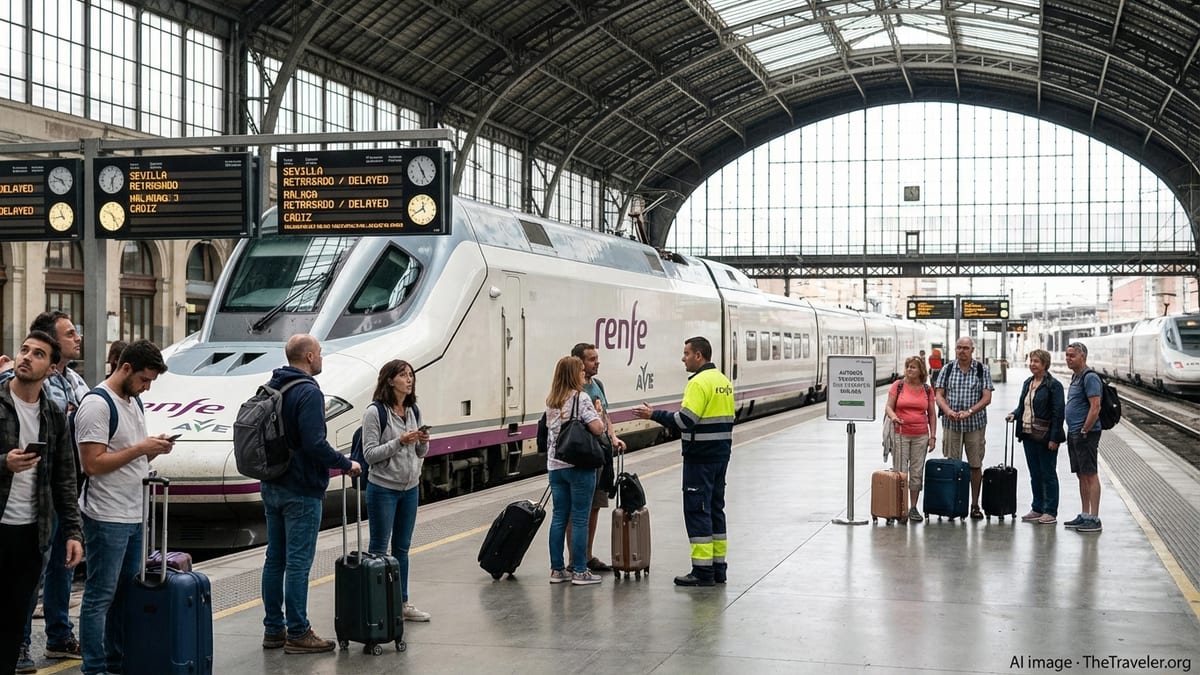
UK Foreign Office Issues Updated Spain Travel Advisory
The United Kingdom’s Foreign, Commonwealth & Development Office has updated its travel advice for Spain to flag significant disruption on the country’s crucial north–south rail spine between Madrid and Andalusia. The advisory highlights continuing operational changes following a fatal high-speed incident near Adamuz, in the province of Córdoba, and additional infrastructure problems on the approach to Málaga that are affecting journeys deeper into southern Spain, including the Algeciras corridor.
While the overall risk level for travel to Spain remains unchanged, British officials are urging rail users to check timetables carefully, allow extra time for journeys and be prepared for last-minute changes. The warning is particularly relevant for travellers relying on high-speed links from Madrid to Andalusian destinations such as Seville, Málaga, Cádiz, Granada, Almería and onward bus or rail connections to the Campo de Gibraltar and Algeciras.
In its latest communication, the UK Foreign Office points to partial service resumptions combined with temporary replacement buses and altered stopping patterns. The message to tourists and business travellers is that Spain’s high-speed network remains safe but is operating under exceptional conditions on several southern routes, with schedules still in flux as engineering work continues.
For British travellers, the advisory underlines the importance of closely coordinating rail plans with flight arrivals and departures, especially at Madrid and Málaga airports, where high-speed trains are a key component of multi-leg itineraries to and from the Costa del Sol and western Mediterranean ports.
From Adamuz Collision to Network-Wide Southern Disruption
The latest warning to UK travellers stems from a chain of incidents that began with a major derailment and fatal collision near Adamuz, north of Córdoba, on the Madrid–Seville high-speed line on 18 January. The crash caused extensive damage to track, signalling and associated infrastructure on one of Spain’s busiest long-distance corridors, forcing operator Renfe and infrastructure manager Adif to suspend through services between the capital and much of Andalusia.
In the immediate aftermath, high-speed AVE and long-distance services between Madrid and key southern cities were either cancelled outright or truncated at Córdoba, with onward connections restructured under an extensive Alternative Transport Plan. For several weeks, thousands of passengers were moved by a patchwork of diverted trains and emergency buses linking Córdoba with Seville, Cádiz, Granada, Huelva and Almería.
The disruption came on top of earlier operational challenges, including industrial action in the Málaga commuter network and weather-related cancellations across parts of Spain. For visitors, especially those unfamiliar with local geography and language, the situation created confusion over which trains were running, how bus transfers would operate and what compensation or refunds might be available.
Spanish authorities stressed throughout that safety testing and infrastructure repairs would take priority over speed of reopening, a stance that extended the period of disruption but was widely supported by unions and passenger groups following the seriousness of the Adamuz incident.
Madrid–Andalusia High-Speed Services Resume, With Caveats
After nearly a month of intensive engineering work and signalling checks, Spain officially reopened the high-speed link between Madrid and Andalusia on 17 February. Renfe has restored normal AVE timetables on several core routes, including Madrid–Seville, Madrid–Cádiz, Madrid–Granada and the Alvia service towards Almería via Granada, re-establishing a crucial long-distance artery for both domestic and international travellers.
Adif authorised the resumption of through services only after replacement track and signalling equipment near Adamuz had been installed, tested and certified. Overnight test runs by Renfe trains were used to validate signalling and speed controls before the first passenger services re-entered the affected section. Spanish transport officials describe the reopened stretch as fully operational, with safety margins at least as stringent as before the crash.
Private operator Iryo has also restarted commercial operations on the Madrid–Seville axis, adding further capacity and restoring a measure of competition that had helped lower fares in recent years. Its initial schedule includes multiple daily round trips between Madrid and Seville as well as extended services linking Barcelona with Seville, an option some international visitors may use as part of longer rail-based itineraries.
Despite the positive step of line reopening, both Spanish and British authorities are emphasising that passengers should not assume a complete return to pre-incident normality. Timetables may be tweaked in the coming days as operators fine-tune capacity, while residual delays and occasional cancellations remain possible as the system beds back in.
Málaga Still Partially Cut Off After Landslide Near Álora
The major outlier in the reopening is Málaga, whose high-speed connection to Madrid remains only partially restored due to a separate infrastructure problem: a significant landslide in the Álora area that damaged track and overhead lines. While trains are once again running from Madrid to Antequera on the main high-speed corridor, the final stretch to Málaga is, for now, being bridged by bus services.
From this week, Renfe and its low-cost brand Avlo are selling tickets for a limited number of Madrid–Málaga journeys that combine high-speed rail and coach under a single ticket. Passengers travel by AVE or Avlo as far as Antequera, where they are transferred to dedicated buses for the onward leg to Málaga city. Journey times have been extended to more than four hours, compared with around two and a half hours under normal direct services.
Spanish media report that this hybrid operation will continue at least until early March, when Adif expects to complete slope stabilisation and track repairs near Álora. Only once those works are finished will direct, all-rail high-speed services along the entire Madrid–Málaga route be able to resume. Until then, operators are warning that seat availability may be limited compared with usual peak-season patterns.
The situation has knock-on effects for travellers heading beyond Málaga along the Costa del Sol or seeking connections towards ports such as Algeciras. Replacement buses can carry passengers into the city, but journey planning becomes more complex, particularly for those with tight cruise departures, ferry crossings or onward bus services.
Impact on Algeciras, Campo de Gibraltar and Coastal Routes
The rail issues on the approaches to Málaga and across parts of Andalusia are particularly sensitive for travellers relying on the southern rail grid to reach Algeciras and the wider Campo de Gibraltar area, gateways to North Africa and a growing focus for British tourists and expatriates. In earlier phases of the disruption, Algeciras–Málaga Alvia services and Ronda–Antequera trains were among those suspended or curtailed, tightening capacity on already busy coastal and mountain routes.
Although the high-speed backbone between Madrid and much of Andalusia has now reopened, the altered situation around Málaga means some of these secondary links remain fragile. Fewer through services and continuing engineering work can translate into longer connection times, more frequent changes between train and bus, and greater potential for missed links, especially on days of adverse weather.
Local operators and regional authorities are promoting alternative routings via Seville or Cádiz for some journeys to the western end of the Strait of Gibraltar, but these often involve indirect loops and extended travel times. For UK visitors used to seamless high-speed connections from Madrid to coastal resorts, the current patchwork may come as an unwelcome surprise.
Travel agents on both sides of the Channel report increased demand for clarity on how best to reach Algeciras and surrounding towns during the disruption period. Many are encouraging clients to build in generous transfer windows and, where possible, to consider overnight stays en route rather than risk same-day rail-to-ferry connections.
Alternative Transport Plans, Flat Fares and Passenger Rights
In response to the crisis in southern rail services, Renfe has deployed a broad Alternative Transport Plan combining trains and buses to maintain minimum connectivity across affected routes. On the Madrid–Málaga corridor, all-in-one tickets now include the rail segment to Antequera and bus transfers to and from Málaga, with coordinated schedules designed to minimise waiting times.
As a gesture to compensate for longer journeys and inconvenience, Renfe has introduced a flat promotional fare on many Madrid–Málaga services during February, with all seats sold at a significantly reduced price compared with normal high-speed tariffs. The measure aims both to support tourism flows to the Costa del Sol and to reassure domestic and international passengers that reliable, if slower, options remain available.
Throughout the disruption, the operator has offered affected customers free changes or full refunds on cancelled or significantly altered services, in line with European rail passenger rights regulations. Travellers whose itineraries have been disrupted by the Adamuz incident or the Álora landslide can typically rebook for later dates, reroute via alternative cities or opt for a refund if their journey is no longer viable.
Consumer advocates in Spain, however, say some passengers remain unaware of the full extent of their rights, especially foreign tourists who booked via third-party websites. British travellers are being advised to keep all documentation, including tickets and any receipts for additional accommodation or transport, in case they need to pursue claims with operators or travel insurers.
Practical Advice for UK Travellers Heading South
With Spain’s southern rail network in a transitional phase, the UK Foreign Office and travel industry professionals are offering a series of practical recommendations to minimise disruption. Chief among them is the call to check live timetables as close as possible to the time of departure, using official channels from train operators and stations, rather than relying on printed schedules or historic search results.
Travellers planning to connect from flights into Madrid Barajas or Málaga Costa del Sol airports to high-speed trains should allow extra buffer time, especially if they must cross terminals or clear immigration and baggage reclaim. Where itineraries involve the temporary bus segments around Antequera and Málaga, passengers should account for potential traffic delays on the road portion.
Booking flexible or refundable rail tickets is strongly recommended while the network stabilises, even if they carry a modest premium over deeply discounted advance fares. UK visitors are also encouraged to register contact details with train operators at the time of purchase so they can receive direct notifications of timetable changes or cancellations.
For those heading to ports such as Algeciras for ferries to Morocco or to cruise terminals along the Andalusian coast, travel specialists suggest arriving in the region a day earlier than strictly necessary, reducing the risk that any single rail disruption could jeopardise a departure. In some cases, direct coach services or domestic flights may offer a more predictable, if less scenic, alternative during the current rail upheaval.
Outlook: Gradual Normalisation Ahead of Spring Travel Peak
Spanish transport officials say they expect a progressive normalisation of Madrid–Andalusia rail services in the coming weeks, with the critical milestone being the completion of works near Álora and the reinstatement of full high-speed operations to Málaga. Adif has indicated that these repairs should conclude around early March, though heavy rain or further slope instability could still affect the timetable.
Once direct services to Málaga resume, rail connectivity across much of southern Spain is likely to look far more familiar, restoring the backbone routes that underpin domestic commuting, business travel and international tourism flows. Private competitors such as Ouigo and Iryo are also expected to ramp up their frequencies as infrastructure constraints ease, potentially reinvigorating the price competition that has characterised Spain’s high-speed market in recent years.
For now, however, the message from both Spanish authorities and the UK Foreign Office is one of cautious planning rather than alarm. Rail remains one of the safest and most comfortable ways to traverse Spain, but on the Madrid–Andalusia axis it currently demands more flexibility and attention to detail than usual.
With spring and Easter holidays approaching, tens of thousands of British visitors are due to travel between Madrid and southern Spain in the next two months. Their journeys will serve as the first major test of the network’s resilience after the Adamuz collision and the Álora landslide, and will determine how quickly confidence in Spain’s once world-leading high-speed system can be fully restored.