

More news on this day
Spain is accelerating investment in high-speed and conventional rail infrastructure as passenger numbers reach historic highs, reshaping how residents and visitors move across the country.
Get the latest news straight to your inbox!
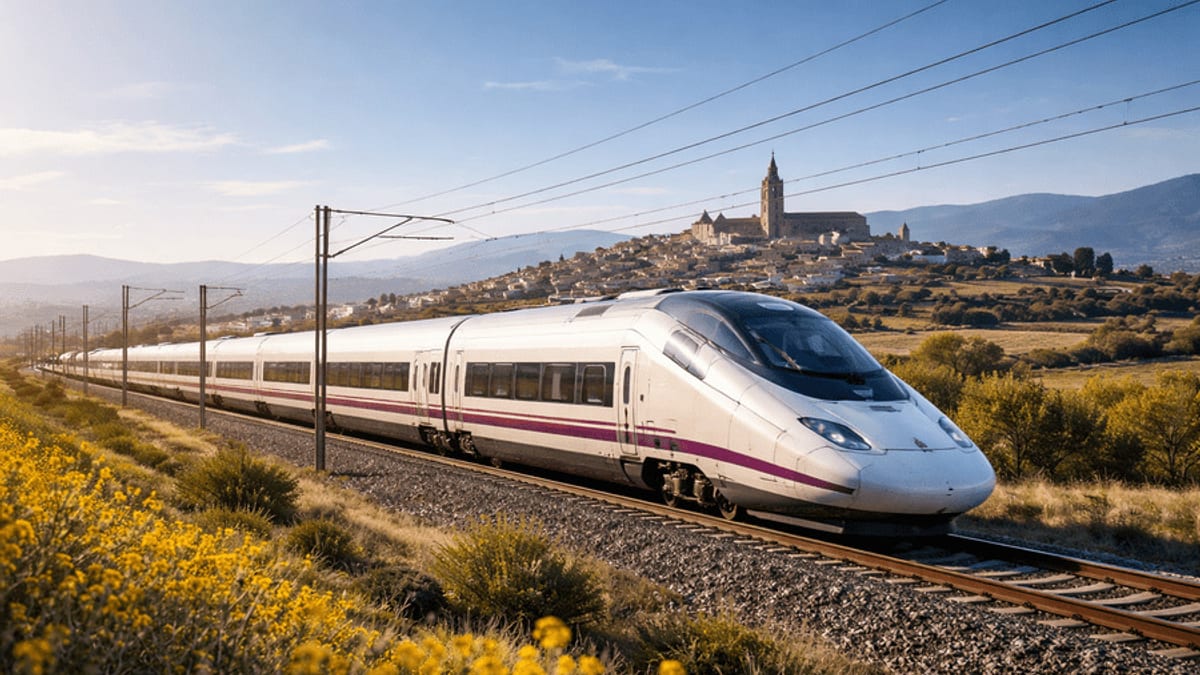
Image by Latest International / Global Travel News, Breaking World Travel News
Record Ridership Fuels New Wave of Rail Spending
Publicly available data show that rail travel in Spain has rebounded strongly in recent years, with both high-speed and conventional services carrying more passengers than before the pandemic. Figures released for 2023 and 2024 indicate that national operator Renfe surpassed 520 million passengers in 2023 and exceeded 530 million in 2025 when commuter, regional and long distance services are combined, underlining sustained growth across the network.
High-speed corridors have been a key driver. Reports from Spain’s competition watchdog describe commercial high-speed trains carrying around 40 million passengers in 2024, roughly three quarters more than before the liberalisation of the market earlier in the decade. Market opening to new entrants such as Ouigo and Iryo, alongside Renfe’s premium AVE and low cost Avlo brands, is credited with stimulating demand and pushing operators to offer more frequencies and lower average fares on the busiest city pairs.
The strong trend has continued into 2025. Industry coverage indicates that in the first half of 2025 Renfe alone transported more than 277 million passengers, setting a new half year record for the company. Long distance and high-speed services posted particularly robust gains, reflecting ongoing shifts from air and road to rail on medium haul routes such as Madrid to Valencia, Seville and Malaga.
This surge in demand is reinforcing the case for further capacity enhancements. Infrastructure manager Adif and its high-speed subsidiary have highlighted growing utilisation of key hubs in Madrid and Barcelona, as well as increased pressure on junctions that connect high-speed lines with conventional tracks serving regional and freight services.
Major Upgrades at Madrid’s Core Rail Hubs
Spain’s capital is at the centre of the current expansion push. Public project information shows that the European Investment Bank has approved several large loans in recent years to support the remodelling of Madrid’s Puerta de Atocha Almudena Grandes and Chamartín Clara Campoamor stations. A recently approved 550 million euro facility is intended to help Adif increase capacity at Atocha, which is the main gateway for high-speed services radiating towards Andalusia, the east coast and Catalonia.
The broader programme for the Madrid rail hub, framed under a multi year investment plan, includes track layout changes, new platforms and upgraded signalling designed to handle more high-speed arrivals and departures each hour. Works are also intended to improve flows between commuter, regional and long distance services, allowing faster transfers and helping to relieve congestion during peak periods.
At the same time, Adif continues to modernise key sections of the trunk high-speed network. Contracts have been awarded for infrastructure upgrades along stretches of the Madrid to Barcelona line, including work in the provinces of Zaragoza and Huesca that will renew track components and improve reliability. Similar projects have been launched on other radial corridors to reinforce performance as train paths become more heavily used.
Officials responsible for the network have emphasised in public documentation that these schemes are not limited to flagship routes. Elements of the Madrid hub overhaul, for example, are being designed to benefit both high-speed and conventional trains sharing complex approach tracks into the capital’s main stations.
Extending High-Speed Reach to Spain’s Regions
While core corridors between Madrid, Barcelona and the Mediterranean coast remain the busiest, recent years have seen high-speed services extended deeper into Spain’s northern and northwestern regions. The high-speed line between Madrid and Asturias, inaugurated in late 2023, has shortened journey times to cities such as Oviedo and Gijón and shifted more long distance travel from road and air to rail.
Further west, the completion of high-speed links into Galicia has transformed connectivity between Madrid and cities including Vigo, Ourense and Santiago de Compostela. In mid 2025, regional media reported that passenger numbers on the Vigo Madrid high-speed service had risen by more than 60 percent after Renfe reorganised frequencies and stops, while several other Galician stations on the corridor also recorded double digit growth.
Data compiled in national transport statistics show that in June 2025 rail travel between Galicia and Madrid surpassed air travel in passenger numbers on a monthly basis, reversing the balance recorded a decade earlier. This shift is frequently cited in policy papers as an example of how improved rail infrastructure and competitive services can reshape mobility patterns on medium haul intercity routes.
High-speed expansion is also being supported by station investments in regional capitals. In Santiago de Compostela, for example, a new passenger building entered service in 2025 to better accommodate growing traffic on the Madrid Galicia corridor, adding capacity for both long distance and regional services feeding into the high-speed line.
Competition Reshapes Fares and Service Patterns
The liberalisation of Spain’s high-speed market has been a central factor behind the current rail boom. According to reports from the National Commission for Markets and Competition, the arrival of Ouigo and Iryo on key routes such as Madrid Barcelona, Madrid Valencia and Madrid Andalusia has pushed overall ridership sharply higher while contributing to lower average ticket prices compared with the period before competition.
Data presented in recent competition reports point to rapid growth on southern corridors from Madrid to Seville, Malaga and Granada, which saw double digit year on year passenger increases in 2024 and 2025. On these lines, new services and promotional fares have encouraged more leisure travellers to switch from private cars and domestic flights to high-speed trains, while business demand has remained strong.
Even on the flagship Madrid Barcelona corridor, where a recent withdrawal of low cost Avlo services temporarily pushed average fares higher and led to a short term dip in passengers, the underlying offer remains dense, with Renfe, Ouigo and Iryo all operating multiple daily frequencies. Competition on this axis continues to be closely watched as a barometer for how market dynamics may evolve on other corridors due to new capacity and regulatory decisions.
Regulators are now preparing to extend open access to additional high-speed routes. In late 2025, Spain’s competition authority approved Adif’s proposal to liberalise three further high-speed corridors, opening the door to more operators and greater frequency on secondary axes. Observers expect these steps to reinforce passenger growth and place further demands on infrastructure capacity in the coming years.
Conventional Network Modernisation and Sustainability Goals
Spain’s rail expansion is not confined to high-speed lines. Adif is investing heavily in the conventional network to enhance regional passenger services and support a shift of freight from road to rail. In Andalusia, for instance, the infrastructure manager announced a package worth more than 95 million euros in 2025 to renew signalling on a 130 kilometre stretch of the Madrid Alcázar de San Juan Cádiz route and adapt parts of the line for a rolling motorway concept that allows trucks to be transported on trains.
Other projects focus on improving links between the national rail grid and major ports, reinforcing rail’s role in logistics chains. Investments in new rail accesses and upgraded terminals at ports such as Castellón are presented in planning documents as part of a broader strategy to boost intermodal transport and reduce emissions from heavy road haulage.
European Union funding, particularly through the Recovery, Transformation and Resilience Plan backed by the NextGenerationEU programme, is playing a significant role in financing these upgrades. Large EIB backed loans to Adif and Adif Alta Velocidad form part of a wider financial framework aimed at modernising both conventional and high-speed infrastructure, enhancing safety systems and preparing the network for more intensive use.
Environmental considerations are central to the expansion drive. Studies cited in government and operator reports highlight the emission savings associated with passengers shifting from air and car travel to electric rail, especially on high-demand routes where high-speed services now carry the majority of intercity travellers. As Spain advances its climate commitments, continued growth in rail’s market share for both passengers and freight is being positioned as a core plank of national transport policy.