

More news on this day
Global tourism is heading for a record-breaking year in 2025, with fresh data around ITB Berlin revealing a powerful rebound in international trips led by Spain, booming South American demand and a long-awaited revival in business travel.
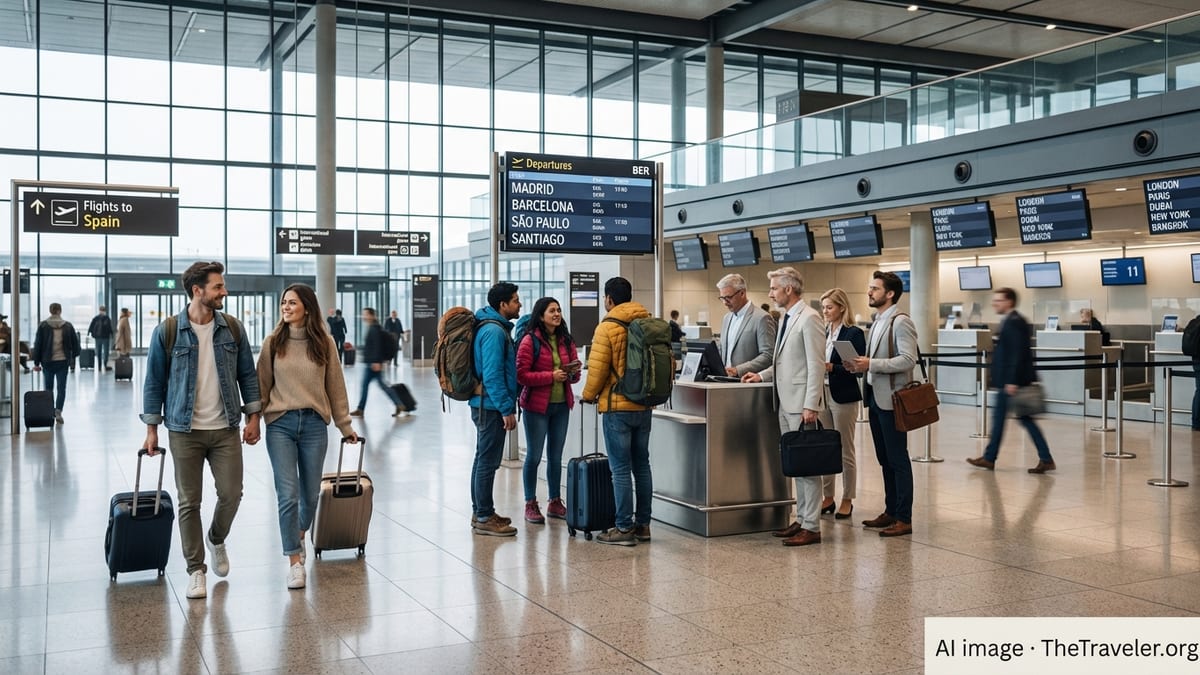
Global Travel Volumes Push Past Pre-Pandemic Highs
After several years of uneven recovery, new figures released ahead of and around ITB Berlin point to 2025 as the year international tourism not only regains its footing but moves decisively into new territory. Industry monitors report that worldwide outbound trips in 2025 are running about 4 percent higher than the previous year, cementing a steady upward curve rather than a one-off post-pandemic bounce.
The latest barometers from international tourism bodies indicate that between January and October 2025 alone, global destinations welcomed well over one billion international visitors, already surpassing the full-year total for 2023 and edging past pre-crisis benchmarks. With the crucial year-end travel period still to be fully counted, analysts now expect 2025 to set an all-time record for international arrivals.
This surge is broadly based, with strong demand out of Europe, a renewed appetite for long-haul trips from North America and a gradual but clear strengthening of interregional travel in South America and parts of Asia. The pattern suggests travelers are not simply returning to familiar habits but adding new destinations and trip types as confidence and disposable incomes recover.
ITB Berlin, one of the world’s most closely watched industry gatherings, has become the focal point for interpreting these numbers. Panel discussions and data briefings in the German capital highlight a cautious optimism: growth is back, but so are the challenges of managing capacity, sustainability and geopolitical uncertainty.
Spain Confirms Its Status as Europe’s Travel Powerhouse
Among individual destinations, Spain stands out as one of the clearest winners of the 2025 travel surge. Building on record-breaking seasons in 2023 and 2024, preliminary estimates for 2025 put Spain once again near the very top of the global arrivals ranking, rivalled only by France in total visitor numbers.
At ITB Berlin 2025, Spanish tourism officials underscored the country’s robust performance in key source markets, particularly Germany and North America. In 2024, nearly 12 million German travelers chose Spain, with both arrivals and spending rising at a healthy pace. Early 2025 data point to further increases, suggesting that Spain’s mix of sun, culture and year-round connectivity remains a compelling proposition for Europe’s largest outbound markets.
The story is not just about volume. Spending by foreign visitors in Spain has climbed faster than headcounts, reflecting a shift toward higher-value travel, longer stays and more diverse itineraries beyond the traditional summer beach break. Regions such as the Canary and Balearic Islands, Andalusia and Catalonia continue to dominate, but secondary cities and interior regions are capturing a growing slice of demand as travelers search for quieter, more authentic experiences.
For Spanish hoteliers, airlines and tourism boards present in Berlin, the numbers represent both an opportunity and a warning. While record occupancy and revenue provide welcome relief after the pandemic shock, the pressure is rising to address overcrowding in hotspot destinations, invest in greener infrastructure and ensure that growth aligns with local community expectations.
South America Emerges as the Fastest-Growing Outbound Region
If Spain is the emblem of established success, South America is the breakout storyline of 2025. New research presented in connection with ITB Berlin shows outbound travel from South America climbing by around 11 percent year on year, the strongest regional growth worldwide and nearly three times the global average.
Much of this expansion is driven by intra-regional demand. Travelers from Brazil, Chile, Argentina and other markets are increasingly exploring neighboring countries, helped by more competitive air connections, favorable currency dynamics on some routes and a renewed interest in short- and medium-haul escapes. Beach destinations, nature hotspots in Patagonia and the Amazon, and vibrant urban centers such as São Paulo, Santiago and Bogotá feature heavily in the data.
International tourism arrivals into South America are also rising, with several destinations reporting double-digit growth compared with both 2019 and 2024 levels. Industry observers in Berlin note that the region is benefiting from a global push toward nature-rich, experience-led travel, as well as government efforts to streamline visas and promote lesser-known areas.
However, the rapid acceleration is stretching infrastructure in some places. Airports, urban transport networks and popular national parks face capacity constraints during peak season, prompting calls at ITB for targeted investment and better visitor management to ensure that South America’s tourism boom remains sustainable.
Business Travel and MICE Return to the Center Stage
Beyond leisure, one of the most closely watched indicators at ITB Berlin is the health of business travel, including meetings, incentives, conferences and exhibitions. After lagging behind holiday travel in the initial recovery phase, 2025 marks a decisive comeback for corporate trips.
Surveys and booking data shared in Berlin suggest that global business travel volumes are now approaching or, in some sectors, surpassing pre-pandemic levels. Companies that once relied heavily on virtual meetings are again approving in-person travel for key negotiations, client events and internal gatherings, convinced that face-to-face contact remains critical for sales, innovation and team cohesion.
This rebound is especially visible in major hubs such as Berlin, Madrid, London and New York, where convention centers and large hotels report full calendars of international congresses and trade shows. Airlines, too, are seeing stronger demand in premium cabins on key transatlantic and intra-European routes, an indicator of healthier corporate budgets.
At the ITB Convention, new sessions dedicated to business travel strategy and MICE highlighted a shift in expectations. Corporate clients are demanding more sustainable event concepts, shorter but more intensive programs and digital tools that blend in-person and remote participation. Destinations that can offer efficient transport, modern venues and robust sustainability credentials are emerging as preferred hosts for the next wave of global gatherings.
Tech, Sustainability and Shifting Traveler Priorities
The 2025 travel surge is unfolding against a backdrop of rapid technological and social change, themes that frame much of the agenda at ITB Berlin. Travel technology suppliers fill multiple halls, showcasing tools that promise to make trips smoother, greener and more personalized, from AI-powered itinerary planning and revenue management to advanced payment solutions and eSIM services.
Industry surveys presented in Berlin show that a large majority of travel companies plan to increase their technology investment, often aggressively. For airlines, hotels and tour operators, the priority is to use data and automation to better anticipate demand, manage pricing and reduce friction at every stage of the journey. For travelers, the payoff is visible in more flexible booking options, real-time disruption management and richer on-the-ground experiences.
Sustainability features just as prominently. With destinations like Spain and fast-growing South American hotspots grappling with overtourism risks, there is rising pressure from regulators, local communities and travelers themselves to curb emissions and spread benefits more evenly. Many of the new initiatives highlighted at ITB combine climate action with community engagement, such as promoting rail over short-haul flights where alternatives exist, encouraging off-season travel and investing in greener accommodation standards.
Behind the impressive 2025 numbers lies a more nuanced reality: global travel is booming again, but it is also being reshaped by cost-of-living pressures, geopolitical tensions and changing work patterns. The data from ITB Berlin suggest that destinations and companies that adapt fastest to these shifting expectations, while managing growth responsibly, are likely to be the ones leading the charge in the years ahead.