

More news on this day
Spain’s decision to close its airspace to aircraft linked to the Iran war is intensifying an already severe aviation crisis, as large sections of the Middle East sky remain shut or heavily restricted and airlines scramble to redraw global flight paths in real time.
Get the latest news straight to your inbox!
Spain Draws a Red Line in the Skies
Publicly available information from Spanish and international media indicates that, as of March 30, Spain has barred its airspace to flights connected with the United States and Israel’s military campaign in Iran. The restriction reportedly targets aircraft involved in or supporting the operation, including those based in third countries, and comes in addition to Spain’s earlier refusal to allow its jointly operated bases at Rota and Morón to be used for the conflict.
The move does not amount to a blanket closure of Spanish skies, which remain open to commercial traffic. However, by blocking overflight for military-related movements tied to the Iran war, Spain has effectively removed a vital transit corridor for west-to-east military routing between North America, Europe, and the Middle East. Flight-tracking analyses show affected aircraft now diverting around the Iberian Peninsula, adding time and cost to already complex operations.
Reports in Spanish outlets describe the decision as a further escalation of Madrid’s opposition to the conflict, framed as a refusal to facilitate strikes on Iran. In practical terms, the ruling forces the United States and its partners to rely more heavily on alternative corridors through the central and eastern Mediterranean, as well as through North African airspace, all of which is under heightened scrutiny as the war continues.
Spain’s stance also aligns it with a broader European recalibration around the conflict. Separate reporting points to other European countries reevaluating access to their bases and airspace for Iran-related operations, underscoring how the war is reshaping not only Middle Eastern skies but also strategic routes across the wider Euro-Atlantic region.
Middle East Airspace: A Patchwork of Closures
While Spain’s move is symbolically powerful, the most dramatic changes for civilian travelers remain concentrated in the Middle East. Aviation advisories and security bulletins compiled over recent weeks describe a patchwork of full closures and strict restrictions across several states following the outbreak of hostilities on February 28. Iran, Iraq, Syria, and Bahrain are among the countries reported to have shut their airspace entirely, while Qatar, Kuwait, and parts of the United Arab Emirates have imposed sweeping limits or temporary suspensions at various periods.
In practice, these measures have created a near-continuous band of disrupted airspace stretching from the eastern Mediterranean across the Gulf. Reports describe repeated extensions of national notices to airmen, with some closures renewed in multi-day blocks as missile and drone activity continues. Jordan’s skies have remained partially available but subject to nighttime or route-specific restrictions, reflecting both its geographic exposure and its role as a key hub for regional traffic.
The cumulative effect is unprecedented congestion and complexity in the remaining open corridors. Airlines that once cut directly across Iran or Iraq now route through Turkey, the Caucasus, Egypt, or deeper into the Arabian Peninsula, competing for limited, safe altitudes and slots. Industry updates highlight the operational strain this places on air traffic control centers tasked with managing rerouted flows at short notice and under significant security pressure.
Safety agencies in Europe had already been advising operators to avoid Iranian airspace prior to the current escalation, citing elevated risk from military activity. The current wave of formal closures and restrictions has turned those recommendations into hard constraints, effectively locking a large segment of west–east trunk routes behind a moving front line of notices and risk advisories.
Widespread Disruption for Airlines and Passengers
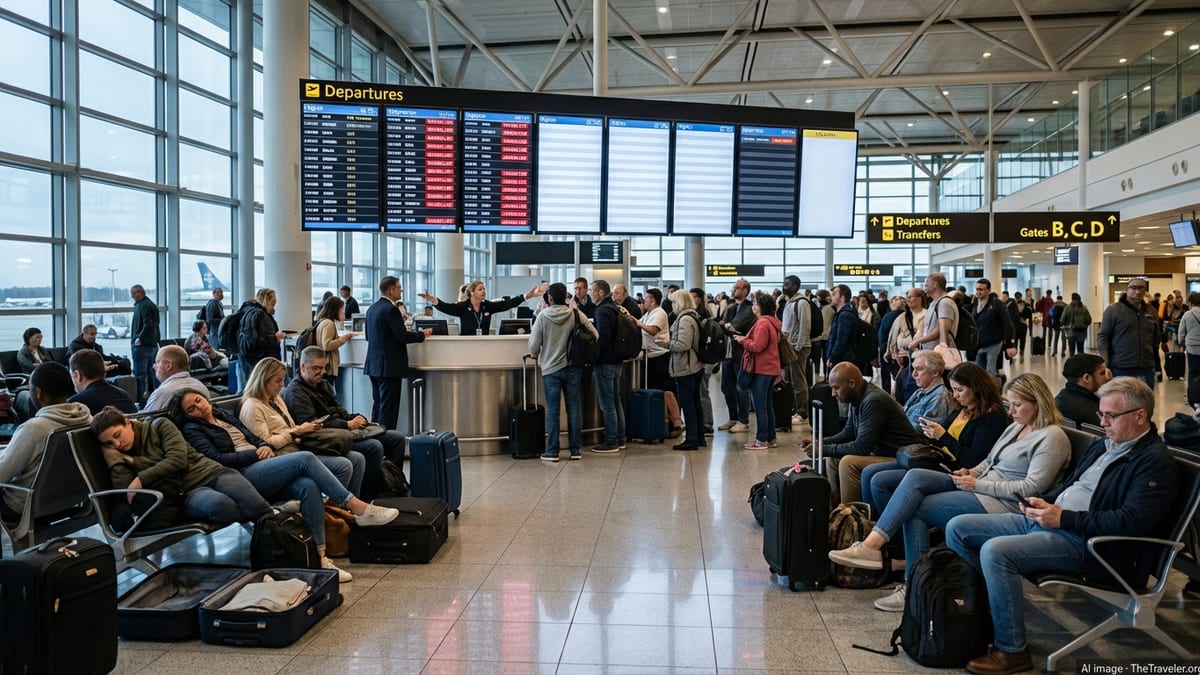
For travelers, the layered airspace shutdowns have translated into cancellations, missed connections, and diversions across multiple continents. Travel advisories compiled by governments and industry sources describe thousands of passengers stranded or forced to rebook as flights to and from Bahrain, Kuwait, Qatar, the United Arab Emirates, Iran, Iraq, Syria, and parts of Israel have been suspended or severely curtailed.
Major international carriers have responded by scaling back or halting services to several Middle Eastern destinations, sometimes extending suspensions well into the second half of 2026. Network adjustments ripple far beyond the region itself, as long-haul links between Europe and Asia must avoid the affected skies, adding hours of flying time and increasing operating costs. Some airlines are cutting frequencies or thinning their schedules to absorb the extra burden on crews and fleets.
Advisory notices from travel platforms and carriers urge passengers not to go to the airport unless their flight is explicitly confirmed, reflecting the volatility of the situation. Routes that do operate often face last-minute rerouting and extended flight times, complicating onward connections in Europe, Africa, and Asia. In some cases, passengers heading to unaffected final destinations still face disruption because their itineraries were built around now-suspended Gulf or Levant hubs.
Governments outside the region, including in North America, Europe, and the Asia-Pacific, are documenting significant numbers of their citizens caught up in the upheaval. While evacuation and repatriation efforts continue where feasible, airspace closures and shifting security conditions mean available seats are limited and subject to abrupt changes, prolonging uncertainty for travelers and operators alike.
Global Flight Paths Redrawn in Real Time
Spain’s decision to close its skies to Iran war traffic coincides with an ongoing, rapid reconfiguration of global flight paths. With Iran, Iraq, Syria, and several Gulf countries off-limits or tightly constrained, airlines are relying heavily on northern and southern arcs to bridge Europe, Asia, and the Indian Ocean region. Data from flight-tracking platforms shows dense streams of traffic skirting closed airspace via Turkey and the Black Sea to the north, and via Egypt, the Red Sea, and the Arabian Sea to the south.
This wholesale redirection is affecting more than just passenger jets. Cargo operators that previously used Gulf hubs as key transshipment points are being forced to reorient their networks, shifting capacity to alternative airports in Europe, North Africa, and South Asia. Logistics industry updates note delays, re-scheduled freighter rotations, and rising costs along key supply chains, from consumer goods and automotive parts to time-sensitive pharmaceuticals.
Operationally, airlines face a complex balancing act between safety, regulatory compliance, and economic viability. Longer routes require more fuel, add wear on aircraft, and complicate crew scheduling. Departure times are frequently adjusted to secure limited overflight slots in alternative corridors, while contingency plans must account for the possibility that additional states could tighten access at short notice if the conflict spreads.
Industry analysts point out that the current configuration of closed and restricted airspace is comparable in scale to previous crises affecting Eastern Europe and parts of the Middle East, but with a sharper impact on north–south and west–east links simultaneously. As a result, the disruption is being felt in markets that are geographically distant from the conflict zone, including transatlantic and transpacific flows that rely on Middle Eastern hubs for feeder traffic.
Travelers Navigate an Uncertain Horizon
For individual travelers, the combination of Middle Eastern closures and Spain’s selective airspace ban underscores how quickly geopolitical risk can reshape global mobility. Government travel advisories now urge heightened caution across a wide swath of destinations, citing the potential for sudden further restrictions, security incidents, and knock-on effects at major hubs.
Consumer guidance from airlines and booking platforms emphasizes flexibility as a key strategy: passengers are encouraged to monitor their bookings closely, make use of fee-waived changes where offered, and consider alternative routings that avoid the most volatile chokepoints. In some cases, travelers are being advised to depart earlier than planned or to route through secondary hubs in Europe, Africa, or Asia to reduce exposure to potential last-minute cancellations.
At the same time, the situation illustrates the growing role of real-time information in travel planning. From live tracking of airspace notices to rapid schedule updates, publicly available data is becoming an essential tool for both industry professionals and end passengers seeking to understand the shifting geography of risk. As Spain’s move demonstrates, decisions taken far from the immediate front lines of a conflict can have significant ripple effects, reinforcing the sense that, for now, the global map of aviation remains in flux.