

More news on this day
While much of Europe still crawls along on crowded, century-old tracks, Spain has quietly built a high-speed rail network so extensive and so efficient that it is now forcing the rest of the continent to rethink what modern train travel should look like.
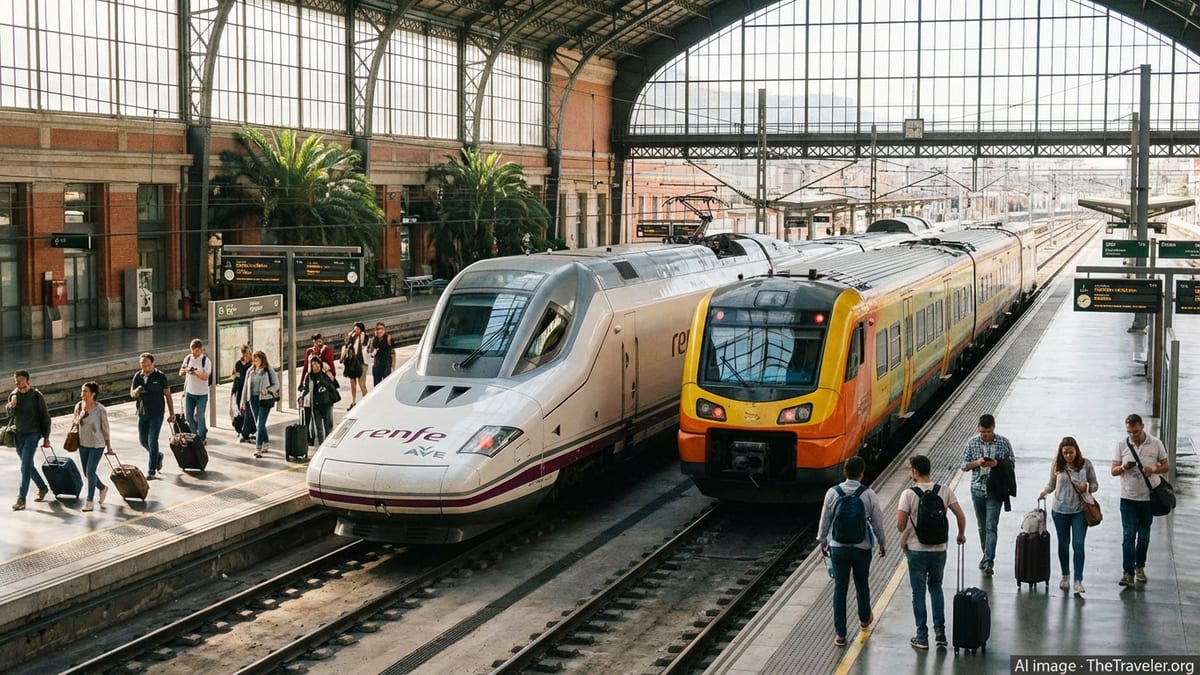
Europe’s Largest High-Speed Network, Built at Record Pace
Spain is no longer a niche player in European rail. It has become the undisputed heavyweight of high-speed infrastructure, with more kilometres of dedicated fast lines than any other country in the European Union. According to recent Eurostat data reported by Euronews, Spain now counts around 3,190 kilometres of high-speed track, a 66 percent increase since 2013, putting it ahead of France, Germany and Italy in total route length.
This expansion has not been a slow, prestige-driven vanity project. Spain’s AVE network has grown rapidly thanks to a mix of aggressive public investment, generous European Union funding and comparatively low construction costs. Transport economists note that between 2000 and 2017 Spain received almost half of all EU funds earmarked for high-speed rail, and then multiplied the impact by building multiple corridors at once, driving down per-kilometre costs through economies of scale.
The result is a fully fledged national grid of fast lines rather than a handful of isolated flagship routes. From Madrid, passengers can reach Barcelona, Valencia, Seville, Málaga, Alicante, León, Galicia and, more recently, Asturias on high-speed or mixed-gauge lines, often at journey times once reserved for domestic flights. Where neighbouring countries still rely heavily on upgraded 19th-century alignments limited to around 200 to 230 kilometres per hour, Spain has bet on purpose-built dedicated tracks designed for sustained speeds of 300 kilometres per hour or more.
That strategic choice is now reshaping the geography of travel across the Iberian Peninsula. Provincial capitals that once felt remote from Madrid or Barcelona now sit within two or three hours by train, undercutting internal flights and redefining what is considered a realistic same-day return journey for business or leisure.
Lightning Speeds and a Push Toward 350 km/h
Speed has always been central to the AVE story. Spain’s flagship services already run commercially at up to 300 kilometres per hour, with some stretches cleared for 310 kilometres per hour, placing them among the fastest scheduled trains in Europe. Travel guides now routinely list AVE alongside France’s TGV, Italy’s Frecciarossa and Germany’s ICE in rankings of the continent’s top bullet-train services.
The Spanish government is preparing to go further. In late 2025, officials signalled plans to lift top operating speeds on the key Madrid to Barcelona corridor from 300 to 350 kilometres per hour, using new aerodynamic “aerotraviesa” supports along sections of track. Reporting in Spanish media described these supports as reducing aerodynamic load on the ballast by more than a fifth, allowing higher speeds to be reached without rebuilding the entire line. The ambition is clear: cut the flagship journey from around two and a half hours to close to two hours, putting Spain among a tiny group of countries regularly running trains at 350 kilometres per hour in commercial service.
This technological push comes even as parts of the network temporarily slow for maintenance. Infrastructure manager Adif recently announced that the Madrid to Barcelona route would run around 25 minutes slower until December 2026 on a key intermediate section to allow safety-critical works. For passengers, that is an inconvenience; for engineers, it is the price of preparing the corridor for another leap in speed and capacity later in the decade.
Elsewhere in Europe, such ambition is the exception rather than the rule. Many cross-border corridors still mix slow regional, freight and faster intercity trains on the same tracks, limiting maximum speeds and reducing reliability. EU technical definitions allow high-speed lines to start at 250 kilometres per hour, but in practice many services in northern and central Europe spend long stretches at far lower velocities, either because they share older infrastructure or because signalling systems are not yet upgraded.
Comfort, Onboard Experience and the “Flying Without Airports” Feeling
Speed alone does not sell tickets; the onboard experience has to live up to the promise. Here, too, AVE has built a reputation that rivals or surpasses many European peers. Spain’s high-speed trains offer wide seats, ample legroom even in standard class, and interiors that feel closer to short-haul business cabins than to traditional rail carriages. Large windows and a generally smooth ride at 300 kilometres per hour create what many passengers describe as a “flying without airports” sensation.
The comfort extends beyond seating. AVE services typically provide quiet, well-maintained carriages, generous luggage space and reliable air conditioning, a critical factor in Spain’s increasingly hot summers. Catering ranges from trolley service to café cars, and on premium fares includes at-seat meals and drinks that are timed to fit within typical business travel patterns.
Digital connectivity remains a work in progress. A recent analysis of onboard Wi-Fi performance by Euronews, drawing on network testing firm Ookla, found that Spanish trains delivered median download speeds of around 1.5 megabits per second, well below leaders like Germany, where trains reached nearly 15 megabits per second. That disparity underscores a broader European challenge: building physical high-speed infrastructure has outpaced the roll-out of robust digital connectivity along rail corridors.
Even so, the overall comfort equation weighs heavily in Spain’s favour when compared with older, slower lines elsewhere in Europe. Passengers boarding regional and intercity trains in parts of France, Italy and central Europe still encounter cramped compartments, dated rolling stock and journey times little changed from the late 20th century. Against that backdrop, the AVE experience feels modern, dependable and, crucially, consistent across much of the network.
Fierce Competition Drives Down Fares and Lifts Standards
What truly sets Spain apart is not only the hardware but the market model running on it. Liberalisation of passenger rail has turned the country’s main high-speed corridors into some of the most competitive in Europe. Alongside state operator Renfe, low-cost French-backed Ouigo and new entrant Iryo now run trains on the core Madrid to Barcelona, Madrid to Valencia and Madrid to Seville routes, creating an environment more reminiscent of budget air than legacy rail monopolies.
This competition has had immediate, visible effects. Fares on the Madrid to Barcelona corridor have fallen sharply compared with the pre-liberalisation era, while frequency has increased. Promotional offers regularly undercut domestic flights, especially when ancillary costs like baggage and airport transfers are considered. Industry analysts note that rail’s modal share on this route has surged, with trains carrying the vast majority of travellers between the two cities and airlines shrinking their schedules in response.
Adif is now extending this model beyond the original flagship lines. In a second phase of liberalisation announced in late 2024, the infrastructure manager opened access to high-potential routes linking Madrid with Galicia, Asturias, Cantabria and the southern ports of Huelva and Cádiz. The plan foresees up to 72 new services a day across these corridors, covering 13 additional provinces and reaching roughly 70 percent of Spain’s population.
By inviting multiple operators onto these tracks, Spain aims to repeat the virtuous cycle seen on the Barcelona and Seville lines: more trains, sharper pricing, improved punctuality and service quality as competitors vie for passengers. It is a stark contrast with many European countries where high-speed services remain dominated by a single, often state-owned incumbent and where ticket prices for faster trains can still be significantly higher than for slower alternatives.
Reaching the Regions: High-Speed Access Beyond the Big Cities
A frequent criticism of high-speed rail in Europe is that it primarily links a small club of major cities while bypassing regions that lack political clout. Spain’s network is not immune to this accusation, but in recent years it has made visible strides in pushing fast services into previously marginalised corners of the map.
New and upgraded lines have brought faster connections to Galicia in the northwest, to León and Asturias in the north, and deeper into Andalusia in the south. The opening of the mixed high-speed link to Asturias, including a major base tunnel through the Cantabrian mountains, was hailed domestically as one of the most complex engineering feats in the country’s recent history, slashing journey times to the coast and integrating once-remote cities into the national high-speed grid.
Adif’s latest liberalisation phase goes further by treating routes such as Madrid to Galicia and Madrid to Asturias or Cantabria as ripe for open-access competition, not merely as peripheral add-ons. That framing reflects confidence that demand exists well beyond the Madrid to Barcelona and Madrid to Seville axes, and that high-speed or high-performance services can become a backbone for long-distance travel even in less densely populated regions.
At the same time, new stations and connections are being used to unlock additional catchment areas. A planned high-speed station at Parla, south of Madrid, is designed to allow trains from Andalusia to continue toward Catalonia without entering central Madrid, reducing congestion in the capital and saving time for through passengers. Future links to airports, including a dedicated high-speed stop serving Barcelona’s main international gateway, are intended to strengthen rail’s role as the default feeder and alternative to short-haul flights.
Europe’s Fragmented Networks Struggle to Keep Up
Spain’s achievements stand in stark contrast to the patchwork state of high-speed rail across much of the rest of Europe. While France retains an advanced network of dedicated lines radiating from Paris and Italy continues to upgrade its core Milan to Rome to Naples corridor, Europe-wide journeys still face a maze of different signalling systems, national rules and infrastructure bottlenecks.
The European Commission has outlined a vision of a truly continental high-speed network by 2040, potentially enabling journeys such as Berlin to Copenhagen in around four hours. But the current map reveals stark imbalances. Western Europe concentrates most of the existing 12,000 kilometres or so of high-speed track, while central and eastern member states remain underconnected. Cross-border routes often slow dramatically once they leave a country’s showcase high-speed line, forcing trains onto older tracks and eroding the time savings built up earlier in the journey.
By comparison, Spain’s high-speed network, though largely domestic, is remarkably coherent. Core corridors operate on the same broad technical standards, use standard gauge rather than legacy Iberian gauge on new lines, and feed into a national timetable that makes same-day connections straightforward. That internal integration is one reason Spain has been able to rapidly grow passenger numbers on high-speed services despite demographic challenges and the rise of low-cost airlines.
Other countries are watching closely. Transport think-tanks and environmental groups arguing for a shift from air to rail often point to Spain as proof that generous subsidies, clear long-term planning and competitive open access can deliver a viable, mass-market high-speed system within two or three decades. Against that benchmark, slower, fragmented networks elsewhere in Europe increasingly look like missed opportunities.
Climate, Capacity and the Future of Fast Travel
Beyond the eye-catching journey times and sleek trains, Spain’s AVE network carries a broader significance for Europe’s climate and transport agenda. Rail accounts for a tiny fraction of total transport emissions in the European Union while moving a disproportionate share of passengers and freight. Every traveller who opts for a high-speed train instead of a domestic flight or a long car journey brings the bloc closer to its decarbonisation goals.
Spain’s experience shows that people will make that switch if the offer is credible: fast, frequent, comfortable and competitively priced. On the Madrid to Barcelona corridor, rail has already seized the overwhelming majority of the market from aviation, a reversal of the pattern that still dominates many similar-distance pairs elsewhere on the continent. As more regional routes in Spain are upgraded and opened to competing operators, policymakers expect similar shifts on other axes.
Challenges remain. Maintaining and upgrading thousands of kilometres of high-speed track is expensive, and debates continue over whether every new line delivers value for money in sparsely populated areas. Onboard digital connectivity lags behind leaders in northern Europe, and the push to 350 kilometres per hour must navigate safety constraints and infrastructure wear. Yet Spain enters these debates from a position of relative strength, with a mature network, a culture of high-speed rail use and a growing cadre of operators eager to innovate.
For European travellers, the message is increasingly clear. If you want to see what truly modern high-speed rail looks like in practice rather than in policy papers, look first to Spain, where AVE and its rivals have turned lightning-fast, comfortable, competitively priced train travel from an aspiration into an everyday reality.