

More news on this day
Spain has restarted most high-speed rail services between Madrid and Andalusia, one month after a deadly derailment near Adamuz shattered confidence in one of Europe’s flagship train networks. As through-services resume and investigations continue, travelers are being urged to check timetables carefully and prepare for ongoing adjustments on some routes.
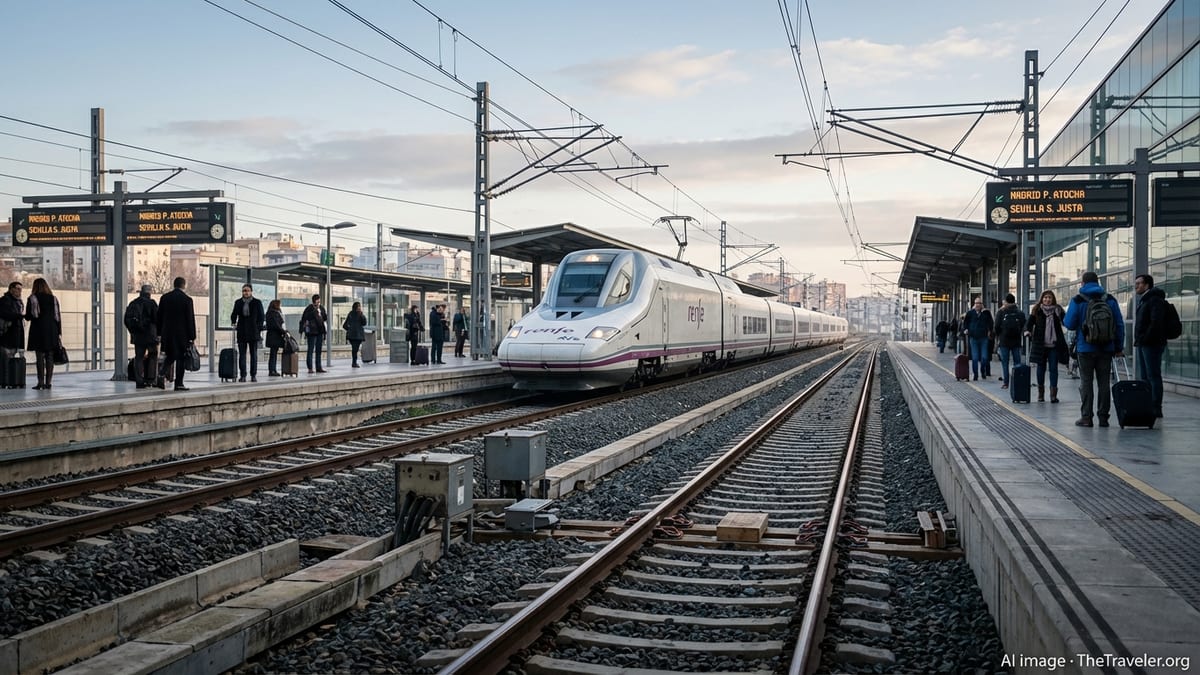
What Happened on the Adamuz Line
The resumption of services comes after a catastrophic collision on January 18 near the town of Adamuz in Córdoba province, along the Madrid–Seville high-speed corridor. A derailment and subsequent crash on the dedicated AVE line killed more than 40 people and injured well over 100, in one of Spain’s deadliest rail accidents in recent decades.
Investigators are focusing on damage to the infrastructure at the crash site, including rails and signaling equipment, while also examining train speed, track conditions and maintenance records. Early reporting from Spanish and international outlets indicates that a broken weld linking older and newer track sections is among the key lines of inquiry, raising fresh questions over how maintenance has kept pace with the rapid expansion of Spain’s high-speed network.
The tragedy occurred just days before a separate commuter derailment near Barcelona, where a train struck a collapsed retaining wall following heavy rainfall. That incident killed the driver and injured dozens of passengers, further intensifying scrutiny of how Spain manages both its high-speed and conventional rail infrastructure.
In the weeks since, public debate has shifted from celebrating the reach of Spain’s AVE system to confronting whether investment in day-to-day upkeep and safety checks has lagged behind the political push for new lines.
Which High-Speed Routes Have Now Resumed
According to Spain’s national operator Renfe and regional news outlets, full high-speed through-services from Madrid to Seville, Cádiz and Granada restarted on February 17, after infrastructure manager Adif completed repairs and safety testing on the damaged section of the Madrid–Seville line. Services that had been terminating north of Córdoba are once again running across the affected stretch, restoring the primary link between the capital and much of southern Spain.
Services on the important Alvia connection linking Madrid, Granada and Almería have also been restored, reconnecting the eastern side of Andalusia with the rest of the high-speed network. This marks a major step toward normal operations for long-distance passengers flying into Madrid and continuing south by rail, as well as for Andalusia-based travelers heading to central and northern Spain.
Private operators that share the corridor, including Iryo and low-cost carrier Ouigo, have likewise resumed their high-speed trains on the Madrid–Seville route following Adif’s green light. Iryo has relaunched its full schedule on this axis, while Ouigo is bringing back most of its frequencies, though with some reductions as the network stabilizes and repairs are finalized.
Officials at the Ministry of Transport had signaled that the line would reopen in the middle of February, contingent on successful testing of signaling and control systems. Those tests were carried out in the nights leading up to the reopening, allowing Renfe and other operators to gradually reintroduce commercial services from February 17 onward.
Where Travel Disruptions Persist
Despite the headline return of trains to Andalusia, not every route is yet operating as it did before the crash. Passengers heading to Málaga and Huelva in particular should expect partial closures, replacement buses or longer journeys as repair work continues on sections of track and nearby infrastructure.
On the Madrid–Huelva route, high-speed trains are currently running only as far as Córdoba, with the final stretch covered by road transport arranged by the operator. This hybrid rail-and-bus solution, already familiar to many travelers from the month-long shutdown, is expected to stay in place until engineers and safety inspectors sign off on the remaining works.
Málaga, one of Spain’s busiest leisure destinations, faces a slower return to normal. According to regional reporting, full service between Madrid and Málaga is not due to resume until early March, as teams work to address damage near a retaining structure on the line and stabilize slopes affected by winter weather. For now, many travelers must transfer to buses between Antequera and Málaga, adding time and complexity to what is usually a seamless high-speed journey.
Even where trains are running, reduced frequencies and occasional last-minute adjustments remain a reality as Adif and operators monitor how the repaired infrastructure behaves under daily traffic. Travelers are advised to allow extra time for connections and to be prepared for platform changes or schedule tweaks, particularly on the southern sections of the network.
How Operators Are Adjusting Schedules and Capacity
Renfe has restored its core AVE timetable between Madrid and Seville, Cádiz and Granada, reestablishing the backbone of its southern long-distance services. The company says that during the closure it offered free ticket changes and refunds and will continue to apply flexible policies where residual disruption persists, especially for Málaga and Huelva passengers still facing road transfers.
Private operator Iryo has resumed a full high-speed schedule on its Madrid–Seville corridor and reintroduced its Barcelona–Seville trains, reinforcing north–south connectivity across the peninsula. Company executives were on board the first reinstated services, underlining both the commercial importance of the route and the need to restore passenger confidence.
Ouigo, the low-cost French-backed operator, is ramping back up more cautiously. Its first reinstated morning departure from Madrid to Seville is already running, and the company expects to reach around six daily services on the route in the coming days. For now, this represents roughly 75 percent of its previous capacity, with a quarter of frequencies still suspended to give more margin for maintenance and operational recovery.
Across all operators, the pattern is clear: bring back the busiest trunk services first, then gradually reintroduce secondary routes and intermediate stops. That staged approach is designed to reduce the risk of cascading delays if anything unexpected emerges on the repaired sections of the line, while also giving engineers the data they need to verify that infrastructure is performing as modeled.
Safety Tests, Investigations and Political Fallout
Before authorizing the reopening, Adif carried out extensive checks on the damaged stretch, replacing track and catenary, verifying signaling systems and running test trains overnight at varying speeds. Transport officials have emphasized that the line would not reopen until safety was assured, pointing to additional controls and inspections introduced since the accident.
At the same time, parallel investigations by judicial authorities, accident commissions and technical experts are looking into the root causes of the Adamuz crash. These probes are examining the integrity of rail welds, maintenance logs, inspection intervals and whether any warnings about infrastructure vulnerability were missed or not acted upon in time.
The double shock of the Adamuz tragedy and the commuter derailment near Barcelona has sparked fierce political debate in Madrid. Opposition parties have accused the government of underinvesting in maintenance and neglecting conventional lines in favor of showcase high-speed projects. Ministers counter that Spain still has one of Europe’s safest railways and point to recent increases in upkeep budgets, while conceding that more needs to be done to modernize aging sections of the network.
Rail unions have seized the moment to demand structural changes, warning that years of cost-cutting and outsourcing have eroded safety margins. Drivers’ organizations have already threatened or called strikes to press for more personnel, updated training and greater investment in both high-speed and commuter infrastructure. The reopened Andalusian line is therefore not just a transport milestone, but a central arena in a broader fight over the future of Spain’s rail model.
What This Means for Tourists and Business Travelers
For international visitors planning spring or summer trips, the restoration of high-speed services to much of Andalusia is a relief. Routes such as Madrid–Seville, Madrid–Cádiz and Madrid–Granada are key for itineraries that combine the capital with historic cities, coastal resorts and cultural hubs. With AVE and competing operators now largely back on these axes, journey times and comfort levels are returning to the standards that made Spain’s trains a favorite among travelers.
However, the residual disruption around Málaga and Huelva means that door-to-door times may still be longer than advertised, particularly on weekends or peak holiday periods. Tourists connecting to flights at Málaga’s busy international airport or heading on to the Costa del Sol should pay close attention to updated schedules and any mention of bus transfers in their booking details.
Business travelers, who rely heavily on punctual Madrid–Andalusia links for same-day meetings, may wish to build more cushion into their agendas over the next few weeks. While trains are once again crossing the repaired section at normal speeds, the network remains under close observation, and any unexpected technical alerts could trigger temporary slowdowns or rescheduling.
In parallel, some airlines have seized on the rail disruption to add capacity on key domestic routes, including between Madrid and Barcelona, at capped fares. Although these extra flights are officially temporary and linked to February’s rail chaos, they underline how quickly competition can shift when confidence in high-speed rail is shaken.
How to Plan and Book Trips on Spain’s High-Speed Network Now
Travelers booking in the coming days should first verify whether their chosen route is fully rail-based or includes a road segment. Timetable notes, booking platforms and operator announcements typically flag any section operated by bus rather than train. On Madrid–Huelva and Madrid–Málaga services, this can affect both total journey time and where luggage must be transferred.
Second, flexibility remains important. Opting for fares that allow changes without heavy penalties, and avoiding very tight connections to flights or onward trains, can reduce stress if delays occur. Many passengers affected by the outage over the past month were able to change dates or obtain full refunds, and operators are likely to be more generous than usual as they work to win back trust.
Passengers should also factor in heightened security and operational checks at major hubs such as Madrid’s Puerta de Atocha and Seville’s Santa Justa stations. Increased staff presence, public announcements and occasional platform changes are part of the system’s post-crash routine, and may slightly lengthen boarding and disembarkation times during busy hours.
Finally, anyone with special mobility needs or traveling with young children or elderly relatives should allow extra time for transfers where buses are still in use. Staffing levels at interchange points have been bolstered since the accident, but queues and crowds can build quickly when multiple services arrive at once.
A Stress-Test Moment for Spain’s High-Speed Ambitions
The partial shutdown and now phased reopening of the Madrid–Andalusia high-speed artery have amounted to a stress test for Spain’s much admired AVE network. For years, the system has been seen as a model of how fast, frequent trains can displace short-haul flights and knit together distant regions, with Madrid–Barcelona regularly cited as a global benchmark corridor.
The Adamuz disaster and subsequent service suspension have exposed the vulnerabilities that come with an aging, rapidly expanded network: complex interfaces between old and new infrastructure, the sheer scale of maintenance required, and the potential consequences when weaknesses go undetected. They have also highlighted the importance of communication with passengers, after some stranded travelers complained of being left for hours without clear information.
As services resume, the measure of success will not just be how quickly trains reach their destinations, but whether the system can demonstrate that lessons have been learned. That will mean sustained investment in inspection regimes, more transparent reporting of incidents, and a willingness by both government and opposition to treat rail safety as a long-term priority rather than a short-lived political battleground.
For travelers, the immediate takeaway is more pragmatic. High-speed trains are once again linking Madrid with most of Andalusia’s major cities, largely at the speeds and comfort levels that made Spanish rail a byword for modern mobility. With a few targeted checks and a realistic margin for delay, visitors can again plan ambitious itineraries by rail, even as Spain’s broader reckoning over how to keep its flagship network safe and resilient continues in the background.