

I went to Winnipeg with a simple plan: spend a full day walking from The Forks to the Exchange District and see what this city actually feels like beyond the brochures.
I had heard about river trails, warehouse architecture, and a surprisingly creative food scene, but I also knew Winnipeg had a reputation for harsh weather, a sleepy downtown, and some rough edges.
By the end of the day, I had sore feet, a full camera roll, and a very mixed but ultimately appreciative impression of the city.
Arriving at The Forks With High Expectations
I started my day at The Forks, the obvious launching point for any first time visit to Winnipeg. The setting at the junction of the Red and Assiniboine Rivers is instantly appealing. It feels like a genuine gathering place, not an artificial attraction dropped beside the water. The wide paths, open lawns, and views across to St. Boniface were an easy way to ease into the city.
Inside The Forks Market, the first thing that hit me was the atmosphere rather than any single shop. The brick walls, high ceilings and remnants of the old rail stables give the space real texture. It did not feel overly polished, and I mean that as a compliment. Compared to many sanitized urban markets, this one still looks like a building that has had a working life.
My expectations were probably too high for the food. There is variety and some clearly well loved local spots, but not every stall looked inspiring. A few options felt generic and overpriced for what they were. Still, grabbing a coffee and a simple breakfast and then climbing up the market tower for a panoramic view was a satisfying way to get my bearings, even if the tower itself feels more like a viewing platform than a must see attraction.
One early frustration was the crowds. I visited in peak season and some parts of The Forks felt congested, especially around lunchtime. If you like a more contemplative experience, it is worth coming early in the morning or later in the day, because the midday bustle makes it harder to appreciate the site’s historic weight.
Walking the Riverfront: Beauty, Noise, and Closed Sections
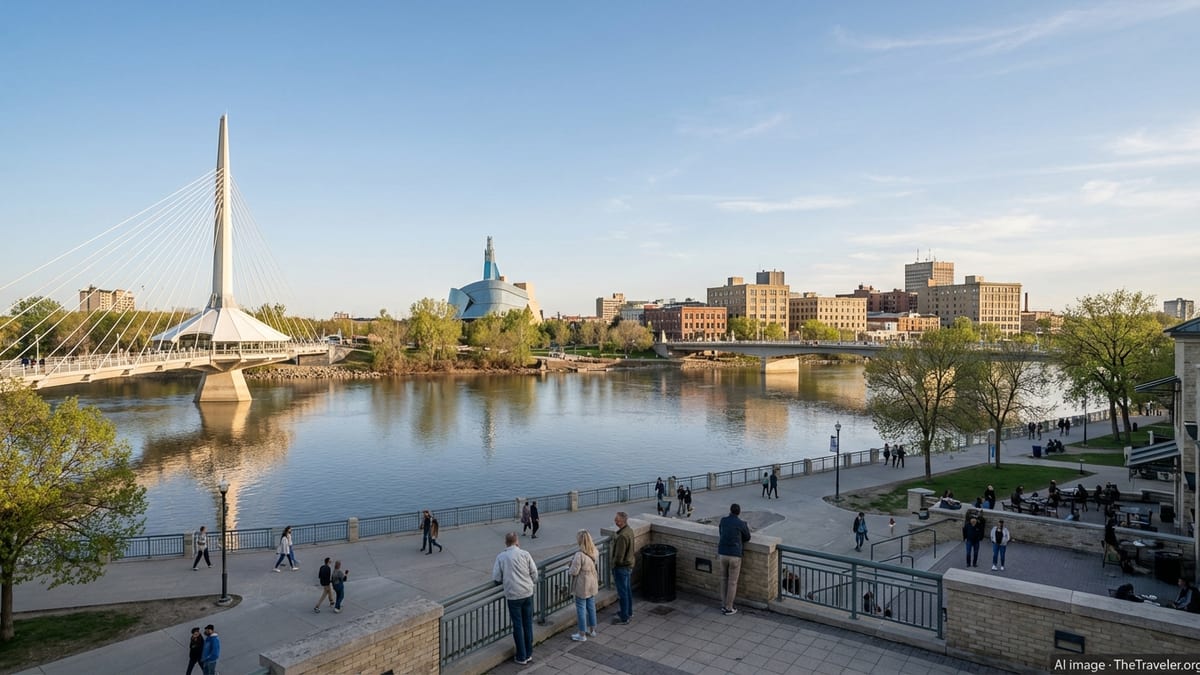
From The Forks, I headed for the riverfront paths. When everything is open, this area can be one of Winnipeg’s biggest assets. The curves of the rivers, the glimpses of the skyline, and the long views down the water make it easy to forget you are in a city known more for winter than waterfront leisure. The signage explaining some of the history along the way is a useful reminder that this land has been a trading and meeting place for thousands of years.
Reality, though, is that river paths here are at the mercy of water levels. Sections of the Riverwalk were closed during my visit because of high water, which broke up any idea of a continuous stroll. It was not catastrophic, but it did mean backtracking to street level a few times and losing that feeling of a seamless riverfront walk I had assumed I would get. If walking the entire length is important to you, be prepared for detours or seasonal closures.
Noise was another surprise. In the promotional images, the riverfront looks serene. In person, you are often walking under bridges or beside roads, with traffic humming overhead. It is still pleasant, but it is not the calm, ambient soundscape I had pictured. I had to work a little to tune out the cars and focus on the water, especially near the bridges.
Despite those annoyances, there were moments that made the walk worthwhile. Sitting on a bench and watching people cycle, skate, or just linger by the rail bridge, I felt that quiet satisfaction of being somewhere that locals actually use. It did not feel like it existed only for tourists. That authenticity, even when imperfect, was part of what eventually won me over.
Crossing Esplanade Riel and Looking Back at the City
From The Forks, I crossed Esplanade Riel, the pedestrian bridge that connects downtown to St. Boniface. In photos, the side spar design looks almost futuristic against the sky. In person, it still stands out, but the experience of walking across it is more about the perspectives it offers than the structure itself. I stopped halfway and turned back toward The Forks and the skyline. The view of the Canadian Museum for Human Rights rising above the river is one of the city’s most distinctive scenes.
What struck me, though, was how quickly that postcard moment faded once I reached the far side and turned around. The riverbanks, the bridges, and the downtown core are visually interesting, but the surrounding streets are less polished than you might expect around such a photogenic axis. Winnipeg feels like a working city first and a showpiece second, and that contrast is very clear in this area.
I had mixed feelings about the bridge’s small commercial area. The idea of having a café or restaurant perched above the water sounds ideal, but the reality is that availability and opening hours can be inconsistent. When it is quiet or when spaces sit empty, the bridge feels underused rather than buzzing. It is a reminder that iconic infrastructure does not automatically create constant street life.
Still, the combination of walking The Forks, looking out from the tower, and pausing on the bridge gave me a layered sense of where I was in the city. It is one of the few places where Winnipeg feels almost grand, with broad skies, wide water, and architecture that tries to match the scale of the landscape.
Into Downtown: Gaps Between Landmarks
Leaving The Forks and heading toward the Exchange District on foot, I realized that the journey between the city’s major attractions is part of the story. This is not a compact European center where every street is charming. There are stretches that feel utilitarian and somewhat empty, particularly on weekends or outside office hours. I walked along wide roads with relatively few pedestrians, passing surface parking lots and office towers that do not offer much to explore at ground level.
It is walkable in terms of distance but not always inviting in terms of atmosphere. I never felt outright unsafe, but there were moments when the emptiness and the hard edges of downtown made me very aware that I was a visitor passing through rather than someone folded into the daily life of the city. If you are used to bustling urban cores, Winnipeg’s downtown might feel more subdued than you expect.
On the positive side, this walk highlighted how approachable the city is in scale. I could go from riverside park to historic warehouse streets entirely on foot without needing transit or taxis. For travelers who like to connect places through their own steps, that is a real advantage, even if the in between segments are not always scenic.
If I repeated the day, I might devote less time to trying to “discover” downtown blocks that clearly cater more to office workers than to visitors. The payoff is limited unless you are specifically interested in seeing the contrast between the revitalized pockets and the still evolving ones.
First Impressions of the Exchange District
Arriving in the Exchange District felt like entering a different city. The dense cluster of early twentieth century warehouse and commercial buildings, many of them beautifully detailed and mid rise rather than towering, creates an intimate urban scale that downtown lacks. The streets suddenly narrow, the facades become more interesting, and you start to notice the textures of brick, stone, and old signage.
I was initially worried the area would feel like a backdrop rather than a neighborhood, a place that looks good in photographs but is hollow at street level. It is not. There are real businesses operating out of these buildings: independent cafés, small design shops, galleries, and restaurants that have clearly found a foothold among the heritage architecture. It feels like a creative cluster that has grown gradually rather than a packaged entertainment district.
That said, not every corner is lively. Some blocks are still quiet, and a few buildings sit underused or in transition. The overall impression is of a district that is partway through a long term revival. If you walk through expecting constant buzz, you might be disappointed. There are genuinely animated stretches, but they are interspersed with quieter patches that remind you this is not a movie set.
From a visitor perspective, this unevenness is both a strength and a drawback. It keeps the area from feeling overly curated, but it also means you need to be intentional about where you spend your time. Stumbling blindly from one street to the next does not always yield interesting finds.
Cafés, Culture, and the Rhythm of the Exchange
I spent much of my afternoon drifting between cafés and cultural stops in the Exchange District. This was where Winnipeg surprised me most in a good way. Coffee culture here is serious enough that you can find well pulled espresso and thoughtful baking without hunting for hours. Sitting by a window in a warehouse conversion, watching the changing light on century old brick, I felt that rewarding sense of having found a city’s real heartbeat.
On the cultural side, the concentration of galleries, design studios, and performance spaces gives the district genuine depth. Even if you do not go inside every venue, just seeing posters for shows and exhibitions hints at an active creative community. It helped counterbalance the image of Winnipeg as simply cold and practical. There is clearly a lot of artistic energy here, even if it is not always loudly advertised.
However, the experience depends heavily on timing. Some galleries and shops keep limited hours, especially outside summer or on certain weekdays. I turned up at a couple of doors only to find them closed, which was annoying after walking out of my way. Winnipeg is not a city that caters around the clock to visitors, and you need to be ready for that. Spontaneity is rewarded sometimes and thwarted at others.
Prices in the area were generally fair, though not a bargain compared to similar districts in other Canadian cities. A few places felt like they were charging a premium simply for being in a photogenic brick building. Still, I never felt outright gouged, and when the quality matched the cost, I was happy to pay for the setting and the sense of place.
Practical Realities: Weather, Safety, and Getting Around
Any honest review of a day in Winnipeg has to acknowledge the elements. Weather shapes the entire experience. I visited in warmer conditions, which made walking entirely feasible, but even then the wind along the rivers could be sharp, and the sun, when it was out, had that prairie intensity that makes shade precious. In shoulder seasons, puddles, slush, or lingering snow would change the feel of The Forks and the Exchange significantly.
In summer, the city’s long daylight hours are a real advantage. I was able to stretch my explorations into the evening without feeling rushed. But I also noticed that outdoor spaces can swing quickly from pleasant to exposed if clouds roll in or the wind picks up. A light jacket and comfortable shoes are not optional here, even in good weather.
Regarding safety, my experience was mostly uneventful. I encountered a few people clearly struggling with housing or addiction issues, particularly on some of the downtown blocks between The Forks and the Exchange, but I never felt directly threatened. It felt similar to many North American downtowns in transition. I stayed on main streets after dark, kept my camera discreet, and avoided wandering down alleys. Basic urban awareness goes a long way.
Getting around without a car was manageable for this specific route. The distance from The Forks to the heart of the Exchange District is absolutely walkable for someone with moderate fitness. Public transit exists and connects these areas, but for a single day of central sightseeing, I was content to rely on my feet. If you have mobility issues or you are visiting during winter, though, you may find that taxis or rideshares make the day much more comfortable.
What I Would Do Differently Next Time
Looking back on the day, there are several things I would change if I did it again. First, I would start even earlier at The Forks, ideally right as businesses begin to open. That way I could enjoy the riverfront paths with fewer people and get a quieter sense of the site’s history before the midday rush hits the market.
I would also be more selective about my downtown route. Instead of trying to cut straight through the least interesting stretches, I would loosely plan a path that threads past specific buildings or public artworks and then heads more directly into the Exchange. That would cut down on the portions that felt like walking through a generic business district.
In the Exchange District, I would time my visit to match the opening hours of at least one or two galleries or museums I really wanted to see and anchor the rest of my wandering around those. On my visit, I relied too much on chance, which meant I missed opportunities simply because a door was closed or an exhibit had limited days.
Finally, I would consciously leave space in the late afternoon or early evening to circle back to the river. Ending the day by watching the light change over the water, or by returning to The Forks as the crowds thin, would have given the experience a more cohesive arc instead of just stopping when I ran out of energy.
The Takeaway
Spending a day walking from The Forks to the Exchange District did not deliver a flawless urban fantasy, but it did give me a grounded, memorable introduction to Winnipeg. The city is at its best when it leans into what it already is: a place of big skies, working rivers, and layered histories rather than endless polish. There are beautiful views and impressive buildings, but there are also cracked sidewalks, closed riverwalk sections, and storefronts that have not yet found their second life.
If you come expecting a compact, hyper curated tourist core, you will probably be disappointed. Winnipeg reveals itself in pieces. It asks you to accept some gaps between the highlights and to tolerate stretches that are more functional than charming. In return, it offers moments of unexpected authenticity: buskers at The Forks, artists in the Exchange, and locals using public spaces in ways that have nothing to do with visitor marketing.
For travelers who like walking, photography, urban history, and observing how cities reinvent old infrastructure, this route is absolutely worthwhile, especially in decent weather. It is less ideal for those who want constant entertainment or who are uncomfortable navigating a downtown that still shows its economic and social challenges in plain view.
Under the right conditions a flexible schedule, sensible clothing, and realistic expectations a day spent moving between The Forks and the Exchange District can leave you with a complex but genuinely positive impression of Winnipeg. It may not be love at first sight, but it feels real, and that counted for more to me than a flawlessly staged experience.
FAQ
Q1. Is it realistic to explore The Forks and the Exchange District in a single day on foot?
Yes, the distance is manageable for most people with moderate fitness, but expect a full, tiring day and plan breaks for food and coffee.
Q2. What time of year is best for this walking route?
Late spring to early fall is generally most comfortable, with longer daylight and easier walking conditions along the rivers and downtown streets.
Q3. Is it safe to walk between The Forks and the Exchange District?
I felt mostly safe using main streets and basic urban awareness, though some blocks can feel quiet or a bit rough, especially in the evening.
Q4. How long should I plan to spend at The Forks?
Two to three hours is a good baseline if you want to explore the market, stroll the riverside, and linger over a meal or drink without rushing.
Q5. Are there good food options in the Exchange District?
Yes, there are several cafés, bars, and restaurants with character, though not every spot is exceptional, and prices can vary with the setting.
Q6. Do I need public transit or a car for this route?
For this specific day between The Forks and the Exchange District, walking is enough, but in winter or bad weather, taxis or rideshares are very helpful.
Q7. Are attractions and galleries open every day?
No, hours can be limited or seasonal, so checking schedules in advance helps avoid the frustration of closed doors when you arrive.
Q8. Can I rely on the riverwalk being fully open?
Not always. Sections are often closed due to high water or seasonal conditions, so be ready for detours back to street level.
Q9. Is Winnipeg’s weather really that influential on the experience?
Yes, wind, temperature, and precipitation can change the feel of both The Forks and the Exchange District, so dress in layers and stay flexible.
Q10. Who is this day trip best suited for?
It suits travelers who enjoy walking, urban photography, and historic districts, and who are comfortable with a city that feels authentic rather than polished.