

I arrived in Duncan, British Columbia with a vague, romantic idea of a walkable “City of Totems” where a day would naturally unfold from coffee to culture to countryside without much planning.
What I actually found was a compact, mostly pleasant small city core framed by highways and parking lots, some genuinely striking Indigenous art and community energy, and a few moments where I felt stranded or underwhelmed. It was not a bad day, but it was more work than I expected to make it feel coherent.
Here is how my day of moving through Duncan really flowed, hour by hour, with the good, the awkward, and what I would do differently next time.
Arriving in the “Heart of the Cowichan” and First Impressions
I came into Duncan the way most people do, along the Trans Canada Highway, with big-box stores and chain restaurants lining the approach. For a place that brands itself around art and walkability, the immediate impression from the road was more utilitarian than charming. It felt like any small North American highway town until I turned off toward the compact downtown core, where the tone changed noticeably.
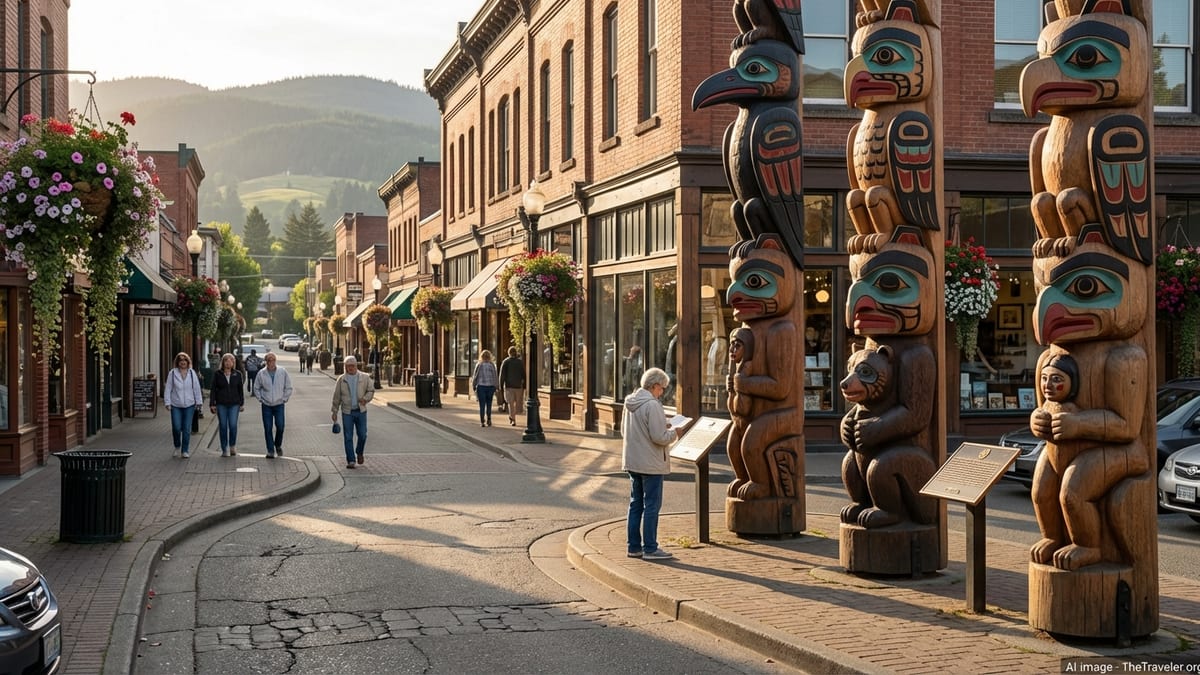
Once I parked and stepped out near City Hall, the scale became much more human. The streets were short, the blocks tight, and I could see totem poles almost immediately, scattered among older brick and timber buildings. It was a relief to discover that the “small, in a big way” tagline was not pure marketing. At street level, Duncan really is walkable, but it is also ringed by car-centric infrastructure that you have to mentally tune out.
My first frustration came from navigation. The downtown is not large, but the signage and maps are a bit scattered. I had read about following yellow footprints around the city to see the totem poles, yet at first I was not sure if I had found the right starting point or just some faded paint on the sidewalk. It took a few minutes of wandering and double-checking plaques before I felt oriented.
Starting the Day: Coffee, Quiet Streets, and Getting My Bearings
I like to begin any small-city visit in a local café, partly to wake up and partly to gauge the rhythm of the place. Downtown Duncan on a weekday morning felt slower than I expected. There was some life around the bakery and coffee shops, but it did not have the bustling village energy I had imagined from tourism blurbs. I saw a mix of locals chatting, a few tourists with cameras, and a noticeable number of people clearly just spending time downtown with nowhere else to be.
Over coffee, I spread out a paper totem tour brochure I had picked up and tried to match it to what I saw outside the window. The route looked simple enough, but it also made me realize how much of the day’s experience here is self-curated. There are no big headline attractions inside the core; instead, you stitch together art, small shops, and short walks. If you arrive expecting the seamless programming of a bigger destination, you may feel slightly underwhelmed at first.
On the plus side, the compactness meant I never felt rushed. Everything in the historic core was within a ten-minute walk, so even when I misread the map or doubled back, it was a minor annoyance rather than a real problem. The biggest noise came from traffic on nearby Canada Avenue, which reminded me that I was in a working regional center, not a sealed-off heritage village.
The Totem Walk: Highlights, Gaps, and the New Digital Layer
The obvious center of gravity for any visit to Duncan is the totem walk. The city has one of the largest outdoor collections of publicly displayed totem poles, and they are scattered across the downtown grid. I started near Charles Hoey Park, where several poles cluster around the old railway station and the Cowichan Valley Museum building. Here the experience felt most intentional and cohesive, with interpretive plaques and the new digital tour decals clearly visible on the totem stands.
The digital layer added recently, with QR codes that trigger stories, photos, and videos, worked better than I expected. When my phone signal cooperated, I could scan and immediately hear about the carver, the family, or the meaning of the figures. This made the visit feel more personal and less like I was just staring at beautiful wooden sculptures without context. I appreciated that the stories centered Indigenous voices instead of treating the poles as generic décor.
However, the experience was uneven. Some QR codes seemed a little finicky to scan in bright light, and there were stretches where I could not easily tell which pole matched which entry on my map. In a few spots, traffic noise or construction nearby cut into the contemplative mood. I also had to navigate around parked cars and delivery trucks to get a clear view of certain poles, which diluted the sense of an outdoor gallery. It was still worth doing, but it required more patience and attention than the romantic “just follow the footprints” idea suggests.
By late morning I had covered most of the main loop. I enjoyed the variety of carvings and the obvious care put into them, yet I also felt a faint sense of repetition. If you are deeply interested in Northwest Coast art, you will savor the details; if you are more casual, you might feel you have “seen it” after the first dozen. I was somewhere in between, which left me appreciating the art but ready for a change of pace by midday.
Market, Main Streets, and Midday Energy
My timing coincided with the Saturday farmers market, which turned out to be one of the most genuinely lively parts of the day. Around City Hall, the streets filled with stalls selling fresh produce, baked goods, crafts, and the usual handmade soaps and jewelry. It felt like the community’s living room, with families, dogs, and musicians filling in what had been quiet streets just a few hours earlier.
The quality of the food and crafts was high, and it drove home how agricultural the surrounding Cowichan region is. I picked up some fruit and baked snacks that were better value and more interesting than anything I saw along the highway strip. The downside was that the market also amplified how much Duncan’s mood depends on events. On a non-market day, I suspect the downtown would have felt noticeably flatter at midday.
Away from the market, I explored the main shopping streets. There are genuine independent boutiques, a few galleries, outdoor gear stores, and some heritage storefronts with character. At the same time, quite a few windows displayed “for lease” signs or looked tired and undercurated. I oscillated between nice little discoveries and stretches where I felt like I was killing time, waiting for the next highlight.
Lunch presented a similar mixed picture. There are some well-regarded local restaurants and pubs, and I managed to find a pleasant spot with a seasonal menu. It was good, not memorable, and a bit pricier than I expected for such a small town. If you are coming from Victoria or Vancouver, the prices will not shock you, but if you imagined country-town bargains, you may be surprised.
Branching Out: Museum, Forest Discovery Centre, and the Edges of Town
In the afternoon I decided to broaden the day beyond the downtown grid. First I stopped into the Cowichan Valley Museum in the old railway station building. It is small and community-oriented, focused on local settler history and the development of the Cowichan Valley. I liked the sense of place it provided, but I also wished for a deeper integration of Indigenous history beyond the totems outside. It is the kind of museum that rewards people who already care about the region, less so casual drop-ins expecting a polished, multi-sensory experience.
From there, I headed out toward the BC Forest Discovery Centre, which sits closer to the highway and the commercial fringe. The setting is surprisingly expansive, with large grounds, logging artifacts, and heritage rail equipment. Walking around the site gave me a better sense of how central forestry has been to this region’s identity. When the small train was running, it added some charm and a sense of movement that contrasted with the static downtown displays.
That said, the Forest Discovery Centre also showed its age in places. Some exhibits felt dated, and not all the interpretive panels had the kind of contemporary context I have grown used to in newer museums. I still found it worthwhile, especially as a counterpoint to the arts focus downtown, but it is more for people who enjoy industrial and regional history than for those looking for a slick attraction.
Getting between these sites without a car is technically possible via local transit and walking, but in practice it would make the day feel fragmented. Duncan is described as walkable, and the downtown absolutely is, yet the broader set of attractions is stitched together by busy roads and parking lots. I was glad I had my own vehicle; otherwise I would have felt more constrained and tired from negotiating the infrastructure.
Late-Afternoon Wandering: Murals, Side Streets, and Small Surprises
Back in the core, I spent the late afternoon wandering side streets and looking for smaller details: murals tucked between buildings, little sculptures, and architectural remnants from Duncan’s early twentieth-century growth. This was where the city’s character felt most authentic. I stumbled upon a few quiet alleys, a hidden pocket park, and a fountain celebrating the town’s famously good tap water. None of these are “must see” on their own, but together they gave the place texture.
Not everything was picturesque. Certain blocks showed clear signs of economic struggle, with vacant storefronts and worn facades. I also noticed a visible street-involved population. While I never felt unsafe, there were moments when the social realities of a small regional center were front and center rather than tucked away. It is important to acknowledge this rather than pretend Duncan is a perfectly polished resort town. The flip side was that many locals I interacted with, from shopkeepers to museum volunteers, were notably friendly and generous with their time.
As the afternoon light softened, the downtown grew quieter again. Without an event happening, the energy seemed to drain away a bit after the lunch rush. If you thrive on constant buzz, you may find Duncan’s rhythm too uneven. I learned to lean into the slower pace: taking a bench, watching people move between the bus exchange and shops, and letting the town’s role as a functional hub, not just a tourist stage set, sink in.
By this point I had walked the core several times over. The good news is that I did not feel overwhelmed; the bad news is that there are only so many loops you can do before the compactness turns into a sense of repetition. For me, one full day was just about the right amount of time in the city itself before wanting to explore the wider Cowichan Valley.
Evening in and Around Duncan: Food, Quiet Streets, and What Was Missing
As evening approached, I had to make a choice: stay in town and see what the nightlife, if any, looked like, or drive out toward Maple Bay or Cowichan Bay for dinner with a view. I opted to stay put, curious about how Duncan feels after the shops close. The short answer is: calm, bordering on sleepy. A few pubs and restaurants remained open, and there were some people coming and going, but the streets emptied quickly.
The advantage of this quiet is that the totems and heritage buildings take on a different atmosphere in the softer light. I walked the main loop again and saw details in the carvings I had missed earlier. Without traffic and crowds, I could stand in the middle of crosswalks and look down long sightlines of poles and storefronts without feeling rushed. For photography and reflection, this was actually my favorite time of day.
The trade-off is that if you want evening entertainment beyond a meal and a stroll, Duncan can feel limited. There is a performing arts center that hosts shows, but if nothing is scheduled during your visit, options dwindle quickly. I ended up in a local pub where the vibe was very much “for locals first, visitors second,” which I appreciated more than I expected. It felt like a chance to see the town on its own terms, though I doubt it would satisfy anyone craving a vibrant nightlife scene.
Walking back to my accommodation, I noticed how dark some stretches of sidewalk felt once the shops had closed. The city has been investing in active transportation corridors, and I can see the potential, but in the moment I was conscious of every passing car and every unlit side yard. I was not frightened, just aware that Duncan’s infrastructure is still catching up to the ideal of being a fully comfortable, car-light destination after dark.
What I Would Do Differently Next Time
Looking back, my main mistake was treating Duncan itself as the entire destination rather than as the cultural heart of a broader region. The city core is worth a dedicated visit, but it is best understood as one anchor in a day that also includes nearby nature or countryside. If I had a do-over, I would still spend my morning on the totem walk and in the market, but I would carve out more time for Mount Tzouhalem, the wineries, or the bays within a short drive.
I would also be more deliberate with timing. The Saturday market transformed the feel of downtown, so aligning my visit with it made sense. If I had arrived on a quiet weekday, I suspect I would have found the day less satisfying unless I had specific galleries, hikes, or events in mind. In this way, Duncan rewards people who plan around its recurring rhythms rather than those who just drop in unannounced.
On the practical side, I would accept that a car or at least a bike makes the experience considerably smoother. While the inner street grid is walkable, the distance between the visitor center, the Forest Discovery Centre, downtown, and nearby natural areas adds up when you try to do everything on foot. Public transit exists, but for a short visit it feels fiddly compared with simply driving.
Finally, I would adjust my expectations about food and drink. There are some good options, but this is not a dense restaurant city where you can wander and stumble into endless culinary surprises. Next time I would make reservations at one or two places that match my tastes and supplement with market snacks, rather than relying entirely on spontaneous discovery.
The Takeaway: Who Duncan Works For and Under What Conditions
By the end of my day, I had not “fallen in love” with Duncan in the way glossy travel features sometimes promise, but I had grown to respect it. The city wears its totems and its history openly, without over-polishing or turning the core into a theme park. It functions as a real regional hub with all the social complexity that implies, and the cultural experiences, while modest in scale, are grounded and sincere.
If you are looking for a compact, walkable stop where you can learn about Coast Salish and other Northwest Coast carving traditions, browse a few independent shops, and sample a strong local market, Duncan delivers. It is especially worthwhile if you are already moving up or down Vancouver Island by car and want to break up the trip with half a day to a day of slow exploration. In that context, the city’s small size is a feature, not a flaw.
On the other hand, if you are expecting a fully self-contained vacation town with beaches, nightlife, and a long list of blockbuster attractions, you will likely be disappointed. Duncan is best approached as a cultural and logistical base for the wider Cowichan Valley, not as a standalone resort. You get the most out of it by combining the downtown totem and market experience with hikes, bays, vineyards, or visits to nearby communities.
For me, the day was imperfect but meaningful. I left with a better understanding of this part of Vancouver Island, a mental map of the carvers and histories behind the poles, and a few small but memorable interactions with locals. I would return, but next time I would treat Duncan as the starting chapter of a broader Cowichan story rather than the entire book.
FAQ
Q1. Is Duncan, BC worth visiting for just one day?
Yes, Duncan is worth a day if you are already traveling on Vancouver Island and want a compact cultural stop focused on totems, markets, and small-town streets.
Q2. Can I experience Duncan without a car?
You can see the downtown, totems, and market entirely on foot, and there is local transit, but reaching outlying sites and trailheads is easier with a car or bike.
Q3. How walkable is downtown Duncan?
The historic core is genuinely walkable, with most shops, totems, and cafés within a ten-minute radius, though traffic noise and nearby highways can break the illusion of a fully pedestrian town.
Q4. When is the best time to visit Duncan during the week?
Weekends, especially Saturdays, are best because the year-round farmers market and occasional festivals bring more energy and variety than you will find on a quiet weekday.
Q5. Is Duncan a good base for exploring the Cowichan Valley?
Duncan works well as a practical and cultural base, with services, groceries, and transit connections, but you will still rely on a car to reach wineries, bays, and trailheads.
Q6. Are the totem poles in Duncan worth going out of my way for?
If you are interested in Indigenous art and stories, the totem collection and digital tour are compelling; if not, they may feel repetitive after a while, though still visually striking.
Q7. What are the downsides of visiting Duncan?
Downsides include limited nightlife, some tired or vacant storefronts, car-centric edges around the core, and a reliance on events to create a lively atmosphere.
Q8. Is Duncan safe to walk around, especially in the evening?
I felt generally safe walking, but some streets are quiet and dim after shops close; as in any small city, basic awareness and sticking to well-used routes is sensible.
Q9. How much time do I actually need in Duncan itself?
A focused half day can cover the totems and main streets; a full day lets you add the museum, Forest Discovery Centre, and slower wandering without feeling rushed.
Q10. Who will enjoy Duncan the most?
Duncan suits travelers who appreciate small-scale culture, Indigenous art, markets, and a slower pace, and who are happy to combine it with nearby nature rather than expect a standalone resort town.