

More news on this day
Thousands of Spirit Airlines passengers across the United States faced long lines, missed connections, and sleepless nights after the carrier suspended 35 flights and delayed more than 100 others on Tuesday, disrupting travel through major hubs including Newark, Orlando, Detroit, Fort Lauderdale, Miami, and several additional cities.
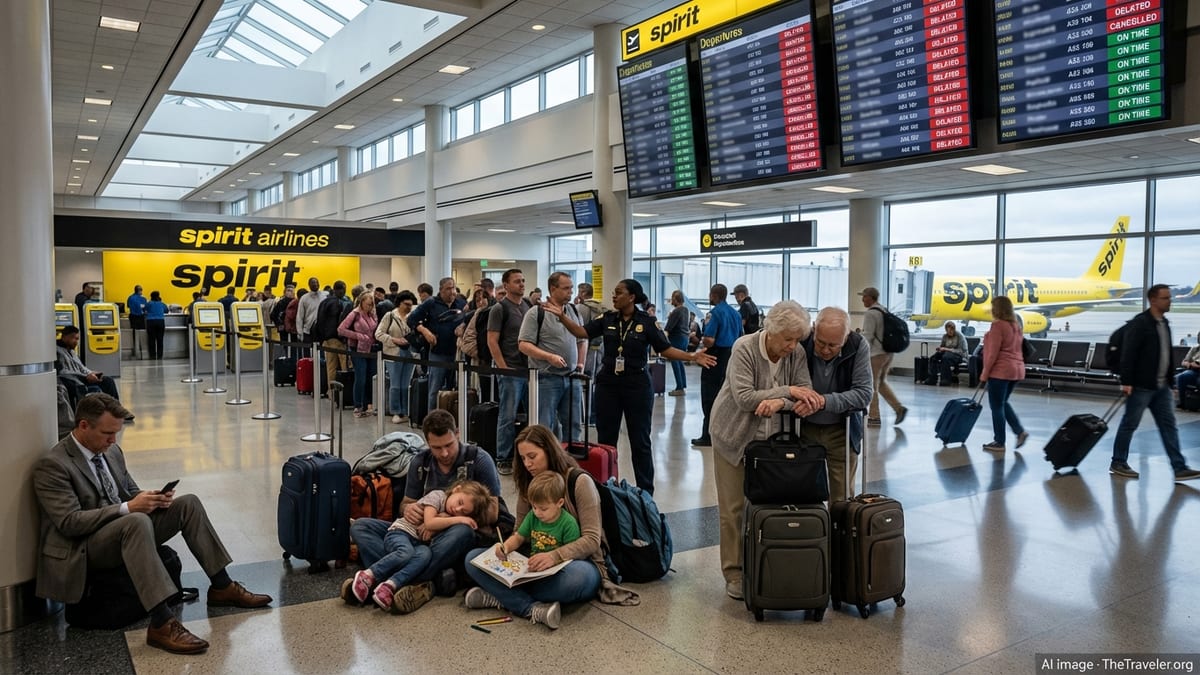
Widespread Disruptions Hit Key Spirit Airlines Markets
The latest wave of operational turmoil comes as Spirit, already under financial strain and in Chapter 11 bankruptcy, struggles to maintain its schedule at some of its busiest airports. Flight tracking data on Tuesday showed clusters of cancellations and rolling delays across routes linking the Northeast, Florida, and the Midwest, with knock-on effects rippling through the rest of the network.
In Newark, one of Spirit’s primary gateways to the New York metropolitan area, early morning suspensions triggered a cascade of missed departures for travelers hoping to reach Florida and the Caribbean. Delays on subsequent flights compounded the problem as aircraft and crew ran out of position, pushing back departures by several hours and leaving terminals crowded with frustrated passengers seeking answers.
Orlando and Fort Lauderdale, two of the airline’s most important leisure markets, were also hard hit. Departures to and from these cities were among those suspended or pushed late into the evening, stranding families returning from theme park vacations and snowbirds heading south. At Detroit and Miami, travelers reported being held at gates with repeated schedule changes, as staff warned that further disruptions were possible.
While Spirit was far from the only airline facing disruptions this week, the concentration of suspensions and delays on its network meant the carrier’s passengers had fewer backup options and often longer waits for alternative flights compared with those flying on larger legacy airlines.
Staffing Shortages and a Smaller Fleet Expose Operational Fragility
Behind the latest disruption lies a combination of staffing shortages and a slimmer fleet that has left Spirit with little room to maneuver when problems arise. The airline has been in the midst of a sweeping restructuring that includes reducing capacity and furloughing hundreds of pilots and thousands of flight attendants as it attempts to stabilize its finances and emerge from bankruptcy protection.
Industry data in recent months has highlighted how those cutbacks have translated into a tighter operation. With fewer crews and aircraft available, even modest weather issues or air traffic control constraints can quickly trigger a chain reaction of delays and cancellations. On Tuesday, a combination of lingering winter weather in parts of the country and congestion at major hubs exposed how little slack remains in the system.
Analysts note that staffing instability is particularly acute for an ultra low cost carrier such as Spirit, which relies on high aircraft utilization and quick turnarounds to keep fares low. When crews time out under federal duty rules, or when a single inbound aircraft is delayed, the disruption can ripple across several flights in a single day. For passengers, that often shows up as cancellations on routes with only one or two daily frequencies, leaving them stranded for 24 hours or more.
Recent reports have also pointed to difficulties recalling furloughed employees, with some flight attendants and pilots opting not to return. That has further constrained Spirit’s ability to rebuild its schedule to pre-restructuring levels and has raised questions about how robust its summer operation will be if demand remains strong.
Scenes of Confusion at Newark, Orlando, and South Florida Airports
At airports across the country, the latest disruption translated into crowded terminals, long customer service queues, and tense scenes at boarding gates. At Newark Liberty International Airport, travelers arriving for morning flights to Florida described chaotic departure boards, as multiple Spirit services toggled between delayed, boarding, and cancelled over the course of a few hours.
Some passengers reported being directed to seek assistance through the airline’s mobile app, only to find that rebooking options were limited or unavailable for one to two days. Others waited in serpentine lines at ticket counters, where overburdened agents worked to place travelers on later Spirit flights or on available seats with partner carriers when possible.
In South Florida, where Spirit is a dominant presence at Fort Lauderdale–Hollywood International Airport and maintains a sizable operation at Miami International, the impact was particularly visible. Families returning from holiday weekend trips found themselves sleeping in terminal chairs or on the floor after evening flights were first pushed back by several hours and then scrubbed altogether.
At Orlando International Airport, one of the nation’s busiest leisure gateways, the scene was similar. Holidaymakers with children in tow navigated crowded gate areas as departure times shifted repeatedly, while announcements urged patience and promised further updates. Some travelers opted to rent cars and drive to nearby cities such as Tampa or Jacksonville in search of alternative flights on other airlines.
Passengers Grapple With Missed Events, Extra Costs, and Limited Options
For many Spirit customers, the operational breakdown carried real-world consequences that extended far beyond inconvenience. Travelers reported missing cruises departing from Florida ports, long-planned family events, job interviews, and school or work obligations because they could not reach their destinations on time.
With same-day rebooking options scarce, some passengers turned to last-minute tickets on competing airlines, often at much higher prices than their original ultra low cost fares. Others faced unexpected expenses for hotel rooms, meals, and ground transportation while they waited for new departure times. For those traveling on tight budgets, these costs were especially painful.
In online forums and at the airports themselves, passengers questioned whether Spirit was doing enough to provide meal vouchers, accommodation, and clear communication. While some reported receiving travel credits or being rebooked without additional charges, others said they were left to fend for themselves, particularly when disruptions were attributed to weather or air traffic control rather than issues within the airline’s direct control.
Consumer advocates emphasize that passengers flying on low cost carriers must weigh the tradeoff between cheaper fares and the potential risk of longer disruptions when irregular operations occur. With smaller networks and thinner schedules, airlines like Spirit simply have fewer spare aircraft and open seats to recover quickly from a cascading series of delays.
Regulatory Rules, Passenger Rights, and What Travelers Can Expect
The wave of suspensions and delays has renewed attention on what protections US travelers actually have when flights are cancelled or significantly delayed. Unlike in parts of Europe, where compensation rules can be more robust, regulations in the United States are looser and often leave airlines wide discretion in how they handle disrupted passengers.
In general, carriers such as Spirit are required to provide a refund when a flight is cancelled and the passenger chooses not to travel. However, compensation for delays, hotel stays, or meal vouchers when disruptions are attributed to weather or air traffic control is typically handled on a case by case basis. Operational issues under the airline’s control, including crew or maintenance problems, may result in more generous assistance, but policies vary.
Travel experts advise passengers caught in the latest wave of disruptions to document all expenses, retain boarding passes and confirmation emails, and contact the airline through multiple channels, including customer service lines and official apps. Some travelers have also turned to third party claims services, which track historical data on delays and cancellations and help passengers determine whether they may be entitled to compensation under applicable laws.
Advocacy groups continue to push for stronger federal standards that would require airlines to provide automatic compensation and clearer guarantees of care during large scale disruptions. The challenges faced by Spirit passengers this week are likely to add new urgency to that debate as regulators weigh how best to protect travelers in an era of increasingly strained airline operations.
Spirit’s Financial Turbulence and the Broader Industry Context
Spirit’s latest operational setbacks come against the backdrop of significant financial turbulence. The airline is deep in a court supervised restructuring process, having entered Chapter 11 bankruptcy for the second time in less than a year as it struggles with high debt, intense competition, and changing travel patterns. The carrier has already announced route cuts, aircraft retirements, and staffing reductions in an attempt to return to profitability.
Industry observers note that Spirit’s difficulties reflect broader headwinds facing low cost and ultra low cost carriers in the United States. After years of rapid expansion and aggressive price competition, many are now grappling with higher fuel and labor costs, congested airports, and limited opportunities to grow without bumping up against the networks of much larger competitors.
For Spirit, the challenge is particularly acute in markets like Florida and the Northeast corridor, where legacy airlines and other budget rivals are also vying for price sensitive leisure travelers. Any perception among customers that Spirit is less reliable than its peers could push passengers to carriers that offer slightly higher fares but a better track record of on time performance and operational resilience.
At the same time, the broader US airline industry is dealing with its own capacity and staffing constraints, which have fuelled periodic waves of nationwide disruptions involving multiple carriers. Recent episodes of mass cancellations and delays across American, Delta, United, JetBlue, and several regional operators have underscored how vulnerable the system remains to weather, air traffic bottlenecks, and staffing shortfalls.
How Travelers Can Protect Themselves During Ongoing Volatility
With Spirit’s latest disruption adding to a growing list of recent travel meltdowns, seasoned flyers are increasingly adjusting how they plan trips, particularly when tight connections or time sensitive events are involved. Travel advisors suggest booking earlier flights in the day, when schedules are generally more likely to operate on time, and avoiding itineraries that rely on the last departure of the night whenever possible.
Many experts also recommend building longer connection times into itineraries, especially when traveling through known congestion points such as Newark, Orlando, Miami, and other major hubs. Purchasing travel insurance that covers missed connections, hotel stays, and nonrefundable events can also soften the financial blow when things go wrong, though policy details must be scrutinized carefully.
For travelers choosing low cost carriers like Spirit, flexibility can be crucial. Being open to alternate airports within a region, such as flying into West Palm Beach instead of Fort Lauderdale or Tampa instead of Orlando, can sometimes provide a faster way out of a disruption zone when flights at the primary airport are sold out. Monitoring flights through tracking apps and signing up for airline alerts can also give passengers a head start on rebooking when the first hints of irregular operations emerge.
As Spirit works to stabilize its network in the coming days, travel planners say passengers should prepare for continued volatility, not only on this carrier but across the US system, particularly during peak travel weekends and periods of unsettled weather. For many would be vacationers and business travelers, the latest disruption is a reminder that in the current aviation environment, extra time and backup plans are as essential as a boarding pass.