

More news on this day
Spirit Airlines has been recognized by the Federal Aviation Administration with the Diamond Award of Excellence for aviation maintenance technician safety for the eighth year in a row, a rare streak that underscores the ultra-low-cost carrier’s push to showcase its safety and training standards amid a turbulent financial restructuring.
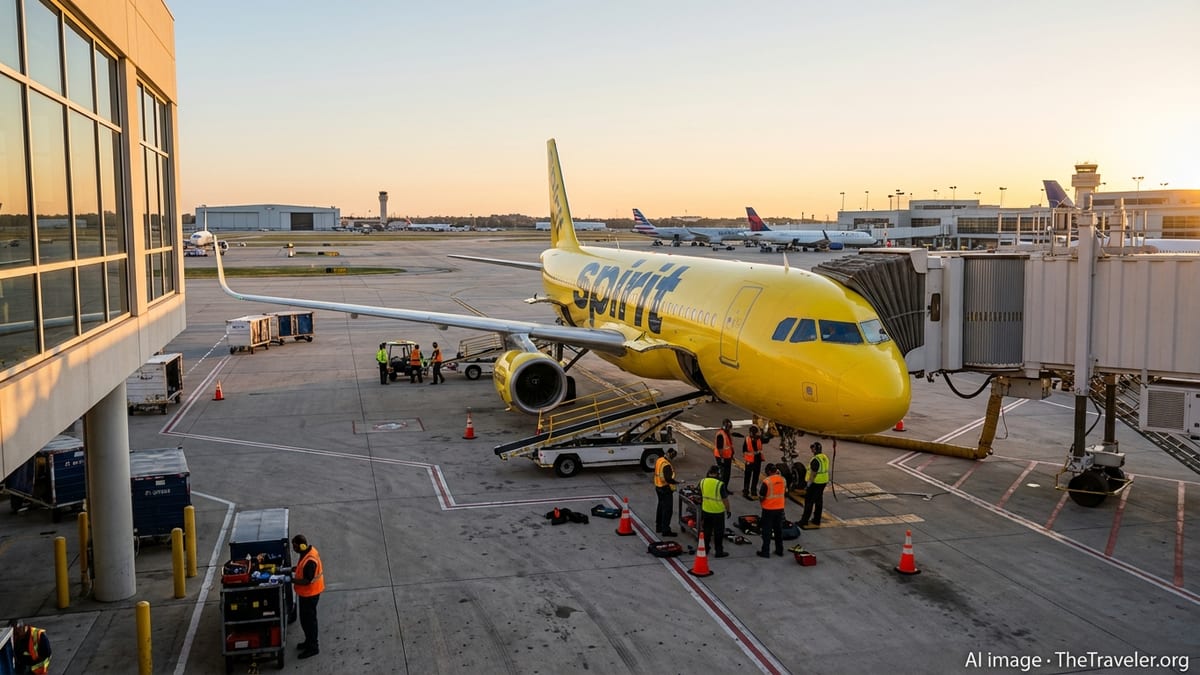
Eight-Year Safety Streak Marks Major Milestone
The Diamond Award of Excellence is the FAA’s highest distinction for aviation maintenance training, reserved for airlines and repair stations where every eligible maintenance technician completes advanced FAA-developed coursework over a full year. Spirit confirmed on February 26 that it once again met the 100 percent participation threshold across its maintenance workforce, extending a run that began in 2018.
For an airline that has built its brand around low fares, the recognition offers a powerful counterpoint to perceptions that budget pricing comes at the expense of safety or professionalism behind the scenes. By FAA design, the award is focused specifically on training, regulatory knowledge, and safety procedures, rather than customer-facing experience, giving it particular weight within the industry.
“Our team’s commitment to continuous learning highlights the priority we place on running a safe and reliable operation for our guests every day,” said John Bendoraitis, Spirit Airlines’ executive vice president and chief operating officer, in the company’s announcement. He credited technicians across the network for the consistency required to maintain the award over nearly a decade.
The carrier’s maintenance teams complete specialized instruction in aircraft systems, federal regulations and current FAA standards, an effort that requires coordinating thousands of course hours across bases and line stations. Spirit’s continued eligibility signals that those programs have remained intact even as the company reshapes its fleet and network.
Training and Compliance at the Core of the Program
The Diamond Award program is designed to push airlines beyond the minimum regulatory bar by tying recognition to organization-wide participation. To qualify, all eligible maintenance technicians must complete a rigorous series of individual awards during the year, covering topics from advanced troubleshooting to human factors and safety management principles.
For Spirit, that means coordinating training across a system that spans the United States, Latin America and the Caribbean, with technicians supporting maintenance on an all-Airbus narrowbody fleet. The airline has emphasized standardization across its operation, citing consistent procedures and documentation as key to both safety and cost control.
The FAA’s focus on recurrent learning is particularly relevant in a period of rapid technical evolution, with new aircraft configurations, updated avionics and evolving regulatory guidance requiring constant refresh. Airlines that maintain Diamond-level participation signal to regulators and partners that they are investing continuously in upskilling critical technical staff.
Spirit’s recognition also comes amid broader industry attention on maintenance staffing and training pipelines, as airlines across North America compete for licensed technicians. Awards tied to training can help carriers position themselves as employers of choice within that talent market.
Safety Recognition Amid Financial Restructuring
The maintenance accolade arrives as Spirit works through a complex financial restructuring under Chapter 11 protection, with the company targeting an exit from bankruptcy in late spring or early summer. Management has said the restructuring will leave the carrier smaller but more cost-efficient, with a streamlined fleet and tighter network focus.
In that context, the Diamond Award provides a narrative counterweight to headlines about reduced capacity, job cuts and aircraft sales. Spirit executives have repeatedly stressed that safety investments and operational integrity remain non-negotiable, even as the business model is recalibrated to deal with higher costs and shifting demand.
The carrier has already significantly reduced its Airbus narrowbody fleet and scaled back operations in several markets as part of cost-cutting measures. Maintaining systemwide compliance with the FAA’s training benchmarks through this transition suggests that the maintenance function has been insulated from the deepest cuts and remains central to the airline’s go-forward strategy.
Industry analysts note that strong safety and reliability credentials can be an asset for an ultra-low-cost carrier seeking to rebuild customer trust after prolonged financial turbulence. Operational performance and maintenance culture often factor into corporate travel policies and leisure travelers’ airline choices, especially when fares are comparable across carriers.
On-Time Performance and External Rankings Support Safety Message
Spirit’s latest Diamond Award follows a string of external validations related to reliability and safety. The carrier was recently ranked third among the 10 largest North American airlines for on-time performance in 2025 by aviation analytics firm Cirium, placing it ahead of several larger legacy competitors.
Consumer-focused rankings have echoed that performance story. In WalletHub’s 2025 Best Airlines report, Spirit was named Best Airline Overall and received top recognition for safety and affordability for the second consecutive year. The study evaluated major U.S. and regional carriers on metrics including delays, cancellations, mishandled baggage, and safety incidents.
Together, these measures allow Spirit to frame the FAA award as part of a broader pattern rather than an isolated accolade. For travelers, the combination of strong on-time performance, recognized maintenance training, and independent safety rankings may help offset lingering concerns tied to the airline’s bare-bones product and history of operational disruptions earlier in the decade.
While such rankings are snapshots and can shift year to year, they provide additional talking points for Spirit as it competes with both full-service and low-cost rivals for price-sensitive travelers across the Americas.
What It Means for Travelers Choosing Spirit
For passengers, the FAA’s Diamond Award does not change the onboard experience or fare structure, but it does speak to the systems and people maintaining the aircraft they board. In practical terms, the award reflects documented training and compliance rather than a separate safety rating, yet industry observers often view it as a useful signal of how seriously an airline treats its maintenance function.
Spirit’s leadership has repeatedly framed safety and reliability as the foundation on which its low-fare model depends. With a simplified fleet and dense route structures, unplanned maintenance issues can quickly ripple through schedules. Investing in technician training and preventative maintenance practices can reduce those disruptions, benefiting travelers through more consistent operations.
As the airline moves toward its planned emergence from Chapter 11 later this year, maintaining its Diamond Award streak may also help reassure customers that core safety programs have not been compromised by cost-cutting. For frequent flyers weighing ultra-low fares against potential inconvenience, a documented record of maintenance training and improving on-time performance may factor increasingly into booking decisions.
Spirit, for its part, is using the award to reinforce a message that, even in a period of intense financial and strategic change, its commitment to maintenance safety remains central to how it plans to compete in the crowded North American market.