

More news on this day
Spirit Airlines is racing to reinvent itself in the face of a deepening financial crisis, juggling back-to-back bankruptcy filings, sweeping fleet reductions and a reset of the credit card deals that help keep its ultra-low-cost model in the air.
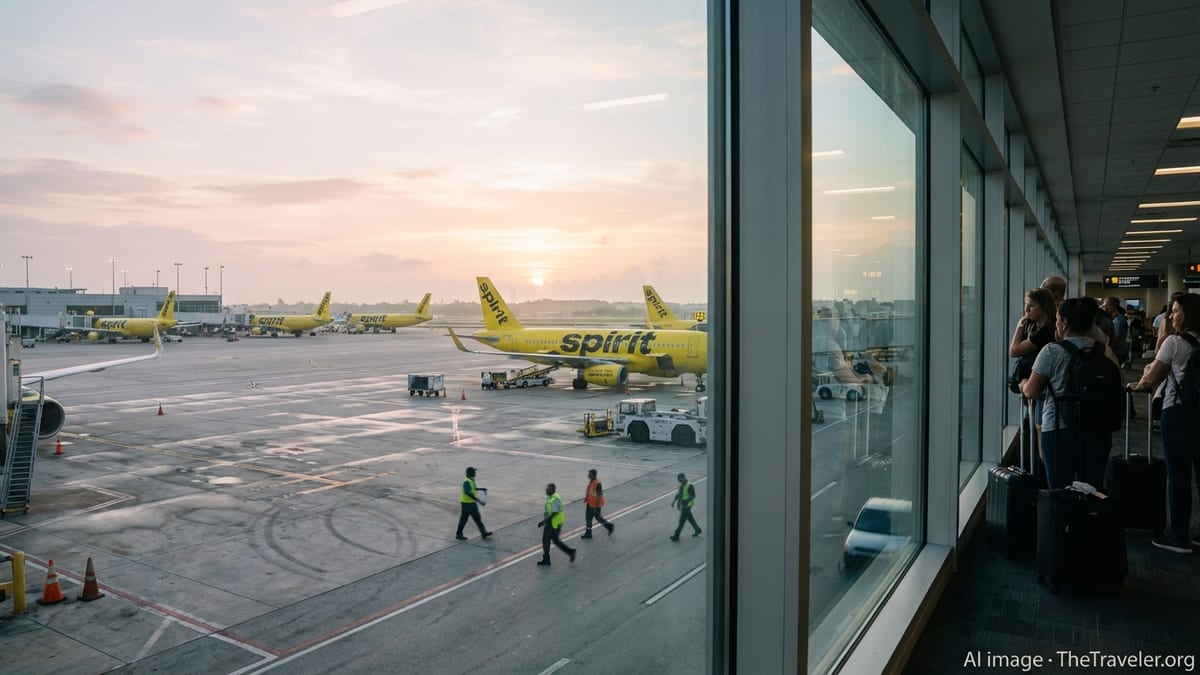
A Carrier Caught in a Relentless Financial Squeeze
Spirit Airlines entered 2026 as one of the most distressed major carriers in the United States, still working through its second Chapter 11 bankruptcy in less than a year and warning investors that survival is not guaranteed. After briefly emerging from court protection in March 2025, the airline was forced back into bankruptcy in late August when cash levels again came under severe strain. Management has described the move as a last chance to resize the business and restore confidence among creditors and travelers.
The reversal capped a bruising period that began when U.S. regulators blocked Spirit’s planned merger with JetBlue in early 2024, cutting off what had been billed as a lifeline transaction. An earlier merger proposal with Frontier had already collapsed, leaving the discount carrier with a heavy debt load, softening demand in its core domestic leisure markets and an aircraft fleet hobbled by engine issues. By the time Spirit returned to bankruptcy court, it was delisted from the New York Stock Exchange and under intense pressure to prove its business could be viable on a standalone basis.
Executives insist that Chapter 11, while painful, gives Spirit room to simplify its network, renegotiate debts and shed uneconomic aircraft. The company has secured hundreds of millions of dollars in debtor-in-possession financing and access to additional cash collateral, allowing it to keep flying while it restructures. Spirit maintains that tickets, travel credits and loyalty points remain valid and that the bankruptcy is designed to remake, not liquidate, the carrier.
Still, with repeated warnings in regulatory filings about its ability to remain a going concern and mounting operational disruptions from staffing and fleet decisions, questions have grown louder about how many cuts the airline can sustain before customers and partners conclude that the risk of booking with Spirit is simply too high.
Chapter 11, Take Two: What This Bankruptcy Really Means
Spirit’s latest Chapter 11 case, filed in August 2025 in the Southern District of New York, is more sweeping than its first trip through the courts in late 2024. This time, management is openly using the process to shrink the airline to a size it believes can earn money, even in a weaker demand environment and with intense fare competition from larger rivals. Court documents describe an ambitious mix of cost cuts, route exits, fleet rationalization and new capital intended to stabilize the balance sheet.
The airline has lined up a debtor-in-possession financing package of up to roughly 475 million dollars from existing bondholders, with an initial tranche available once the court signed off last fall. That facility, together with separate interim access to about 120 million dollars in cash collateral, is designed to support day-to-day operations while Spirit renegotiates with lessors, airports, labor groups and other creditors. It follows an earlier injection of equity and debt relief that accompanied Spirit’s emergence from its first bankruptcy in March 2025, underscoring how quickly conditions deteriorated again.
Spirit argues that virtually every major U.S. carrier has at some point used Chapter 11 to reset its cost base and fleet, and that the stigma of bankruptcy has faded for many travelers. Even so, the airline has taken the unusual step of acknowledging in securities filings that there is substantial doubt about its ability to continue operating beyond the next year if its restructuring falls short. That candor reflects not only high leverage and ongoing operating losses but also the delicate confidence game of any reorganization that plays out in full public view.
In parallel with the court process, Spirit has opened talks with private equity firm Castlelake and other financial players about potential longer-term capital solutions that might reduce the risk of a third bankruptcy. Those discussions, still fluid, highlight the scale of the challenge: any investor support is likely to depend on Spirit convincing stakeholders that this restructuring finally aligns costs, capacity and revenue with the realities of the post-pandemic market.
A Drastic Fleet Pullback Reshapes Spirit’s Network
The centerpiece of Spirit’s turnaround plan is a radical reduction of its Airbus fleet, which stood at more than 200 aircraft as recently as late 2025. The company has sought court approval to reject leases on 87 planes, a move that would cut the fleet by almost half and dramatically shrink capacity. In addition, it has negotiated settlements with key lessors that include cash payments to Spirit in exchange for early lease terminations, freeing the airline from some of its most burdensome contracts.
Alongside the lease rejections, Spirit has pursued outright asset sales. In recent weeks the carrier asked the bankruptcy court to bless a deal to sell 20 Airbus jets for about 533.5 million dollars to an aviation asset manager, opening the door to a competitive auction that could nudge the price higher. Most of those aircraft are not currently flying revenue service, allowing Spirit to unlock cash and reduce debt without immediately disrupting schedules. The company has stressed that its near-term timetable should remain largely stable as the planes are transferred to new owners starting in April 2026.
The restructuring is also prompting a sweeping retreat from marginal airports and routes. Spirit has already won approval to reject a dozen airport leases and nearly 20 ground handling agreements, while planning a capacity cut of roughly 25 percent in some schedules compared with the prior year. Entire cities have been dropped from the network and around 40 underperforming routes suspended, with the airline concentrating its remaining aircraft on core leisure corridors and higher-yield markets.
The fleet shake-up is partly a response to external pressures, including Pratt & Whitney engine problems that have taken dozens of Spirit’s Airbus A320neo and A321neo aircraft out of service for inspections and repairs. With as many as 38 neos grounded and more potentially parked, the airline found itself paying for aircraft it could not fully utilize. By rightsizing the fleet and exiting older, less efficient jets, Spirit hopes to reduce fixed costs, improve utilization of the planes it keeps and eventually return to measured growth from a smaller base after 2026.
Passengers Feel the Turbulence as Operations and Jobs Are Cut
The restructuring has not been confined to balance sheets and courtrooms. Travelers across Spirit’s network have felt the impact in the form of canceled flights, thinner schedules and uncertainty around future routes. Over key holiday and long-weekend periods, Spirit has scrubbed hundreds of flights, citing staffing shortages and fleet availability constraints. Hubs such as Fort Lauderdale, a cornerstone of the carrier’s South Florida presence, have seen particularly acute disruption, with stranded passengers and long lines becoming a familiar scene.
Behind the operational challenges lie deep cuts to Spirit’s workforce. In the autumn of 2025 the airline announced plans to furlough roughly one-third of its flight attendants, around 1,800 people, alongside reductions among pilots and ground staff. Many of those furloughs took effect just as schedule cuts and fleet exits accelerated. More recently, Spirit has begun recalling several hundred of those flight attendants, signaling how finely it is trying to calibrate staffing levels to a moving target of available aircraft and demand.
Labor unions have criticized the company for what they describe as whiplash-inducing decisions, arguing that overly aggressive cuts have degraded reliability and made it harder to win back customers the airline can ill afford to lose. Spirit counters that aligning staffing with a smaller fleet is unavoidable if it is to emerge as a sustainable business. Within the cabin, crews report fuller flights on the remaining routes, but also more tension as travelers vent frustrations over delays, schedule changes and the omnipresent fees that are central to Spirit’s ultra-low base fare model.
For leisure travelers and price-sensitive families, the near-term result is a mixed picture. While deeply discounted fares are still available on many routes, fewer frequencies and the elimination of certain city pairs mean less flexibility and, in some markets, higher prices as the competitive pressure once exerted by Spirit diminishes. Travel industry analysts warn that if Spirit shrinks too far or fails outright, the broader effect across U.S. domestic prices could be significant, especially in smaller cities where it was one of only a few ultra-low-cost options.
Credit Card and Payment Deals Under Fresh Scrutiny
Spirit’s financial crisis is also forcing a closer look at a less visible but crucial pillar of the airline’s economics: its credit card and payment processing relationships. Like many carriers, Spirit relies on co-branded credit cards and advance ticket payments as a vital source of liquidity. Payment processors typically hold back a portion of ticket revenue when a merchant is deemed higher risk, releasing it only as travel is completed. In a bankruptcy, these arrangements can be tightened, raising the cost of doing business.
In earlier phases of its turnaround effort, Spirit moved to extend and modify its revolving credit facility and card processing agreements, pushing out maturities and refining the terms that govern how quickly ticket proceeds flow into its coffers. Those amendments, involving major banks and payment partners, were intended to buy time after the collapse of the JetBlue merger and to reassure markets that processors would continue to handle Spirit transactions. Now, with a second Chapter 11 filing on the books, industry observers say counterparties are likely to demand further protections.
Any shift in these agreements can have outsized effects on Spirit’s cash position. Higher holdbacks or tighter reserve requirements mean less immediate cash from each ticket sold, just as the airline is struggling to fund operations and restructuring costs. At the same time, co-branded credit cards linked to Spirit’s loyalty program remain an important revenue stream, generating fees and selling frequent-flyer points that can be booked as income. Preserving these card partnerships on acceptable terms has become a priority, even as the value proposition of the airline’s loyalty currency is scrutinized by both banks and cardholders in light of ongoing uncertainty.
For travelers, most of the credit card shake-up is happening behind the scenes. Existing cardholders can still earn and redeem points, and bank partners have not signaled any abrupt changes to benefits. But should Spirit’s financial position deteriorate further, card issuers could adjust earning rates, sign-up bonuses or even seek alternative airline partners, shifting the competitive dynamics among U.S. budget carriers’ loyalty offerings.
Customers Weigh Risk, Reward and the Future of Ultra-Low-Cost Travel
All of these developments are testing the loyalty of Spirit’s core customer base, which has long accepted no-frills service and limited flexibility in exchange for low upfront fares. With headlines about repeated bankruptcies, aircraft sales and staffing cuts, some travelers are beginning to question whether the savings justify the perceived risk of disruption. Social media and consumer forums have filled with accounts of missed connections, overnight delays and difficulty securing help from overwhelmed customer service channels.
Spirit is attempting to counter that narrative by emphasizing continuity. The airline has repeatedly assured the public that it plans to keep operating through restructuring, that schedules are being adjusted with an eye to reliability rather than simple volume, and that tickets and loyalty balances remain safe. It is also continuing a longer-running shift toward somewhat more premium offerings, including extra-legroom seating, priority services and onboard enhancements designed to appeal to travelers who may once have flown with full-service competitors.
Whether that repositioning can gain traction while the company is in and out of bankruptcy court remains an open question. Ultra-low-cost carriers thrive on volume and simplicity: dense seating, quick turns, and minimal frills. Upgrading the product while also shrinking the fleet and cutting staff risks blurring the brand in the eyes of consumers who primarily shop by price. At the same time, the broader U.S. market is grappling with overcapacity in certain leisure corridors and slower growth than expected, particularly as household budgets tighten following several years of inflation.
For now, Spirit’s fate will hinge on its ability to execute the painful steps outlined in court filings without alienating the very travelers whose fares fund its turnaround. If the company can stabilize operations on a smaller scale, preserve key card and payment partnerships and convince new investors to back its plan, it could emerge as a leaner, if diminished, player in the domestic leisure space. If not, the retreat of one of America’s most prominent ultra-low-cost brands would mark a major turning point in the economics of U.S. budget air travel.