

More news on this day
Spirit Airlines has entered 2026 battling a perfect storm of financial pressures, from a strained relationship with its credit card processor to a second bankruptcy restructuring that is testing investor confidence and unsettling U.S. travelers who depend on ultra-low fares.
A Low-Cost Pioneer Caught in a New Kind of Storm
For much of the past two decades, Spirit Airlines symbolized the rise of ultra-low-cost flying in the United States, turning bare-bones fares and dense seating into a lucrative niche. That model is now under acute pressure. After years of thin margins and pandemic-era losses, the Florida-based carrier has twice sought refuge in Chapter 11 protection in less than 12 months, emerging briefly in March 2025 before returning to court in August as cash reserves evaporated and merger hopes faded.
The latest restructuring has pushed Spirit into what industry analysts describe as survival mode. The airline has warned of "substantial doubt" about its ability to continue operating over the next year, even as it continues to sell tickets and reassure customers that flights and loyalty points remain valid. The dissonance between public messaging and stark regulatory language has left frequent fliers and credit card partners closely watching each new disclosure.
Spirit’s challenges are unfolding against a broader backdrop of turbulence in U.S. aviation. Domestic leisure demand, which powered the post-pandemic travel rebound, has softened at the same time that airlines added capacity, sparking intense price competition on popular routes. For an ultra-low-cost carrier that relies on filling nearly every seat to make money, even modest fare pressure can be punishing.
Credit Card Tensions Expose a Critical Weak Link
One of the sharpest fault lines in Spirit’s current crisis runs through an often-overlooked part of the airline business: payment processing and co-branded credit cards. In recent filings, Spirit disclosed that a key credit card processor had requested additional collateral to continue handling ticket sales and loyalty transactions, and had tied renewal of its contract to stricter financial conditions. The existing arrangement is reportedly set to expire at the end of 2025, compressing the timeline for a resolution.
Such collateral demands are not just a technical detail. When processors grow uneasy about an airline’s solvency, they can require that more of each ticket sale be held back in reserve in case of a collapse, rather than passed immediately to the carrier. For an airline already short on cash, that effectively siphons away working capital. Spirit has warned that the changes sought by its processor could materially reduce unrestricted cash, tightening an already narrow liquidity runway.
The friction over collateral and contract terms also highlights how fragile the wider financial ecosystem around an airline can become once bankruptcy risk rises. Co-branded credit cards and payment processing deals are lucrative for banks and card networks as long as passengers keep flying. But if a carrier’s collapse looks more likely, partners may scramble to limit exposure, pulling a key source of cash at precisely the wrong moment for the airline.
Bankruptcy Redux: Inside Spirit’s Second Chapter 11 Battle
Spirit’s return to Chapter 11 in August 2025 marked a rare and unsettling moment in modern U.S. aviation, recalling an era when carriers routinely cycled in and out of bankruptcy. The airline had only just completed a court-approved restructuring in early 2025 that converted hundreds of millions of dollars in debt to equity and secured fresh investment, earning a modest credit rating upgrade and a cautiously stable outlook from ratings agencies.
That initial restructuring, however, failed to fix deeper structural problems. As 2025 progressed, Spirit booked steep quarterly losses, warning of a lingering mismatch between its cost base and the fares it could command in a crowded domestic leisure market. A proposed merger with JetBlue was blocked in federal court, and renewed overtures from Frontier failed to produce a viable deal. By late summer, the carrier had little choice but to seek protection again, this time with a sharper focus on shrinking its fleet and network rather than simply reshuffling its balance sheet.
Under the current Chapter 11 process, Spirit has sought debtor-in-possession financing to support day-to-day operations, while asking the court for permission to sell or reject aircraft leases and monetize airport gate rights and real estate. Recent plans include selling a tranche of Airbus jets, many of which are parked or underutilized, to reduce debt and free up cash. The company has also furloughed pilots and announced plans to sideline roughly one-third of its flight attendants, moves that underscore how deeply the restructuring is slicing into its workforce.
Liquidity Squeeze and the Battle to Avoid a Cash Crunch
The central question hanging over Spirit in early 2026 is whether it can shore up liquidity fast enough to satisfy lenders, lessors and processing partners. Bond documents and regulatory filings paint a picture of an airline entangled in high-interest secured notes, revolving credit facilities and minimum liquidity covenants that leave little room for error. Analysts note that some of Spirit’s debt instruments depend on complex valuation assumptions, adding another layer of uncertainty for investors assessing the carrier’s health.
In public statements, Spirit has outlined a multi-pronged plan to raise cash: selling surplus aircraft, entering sale-and-leaseback transactions on engines, disposing of excess airport gates and trimming non-core real estate. The airline is also working to align its schedule more closely with demand, cutting capacity in underperforming markets in hopes of boosting revenue per seat on remaining routes.
The strategy may buy time, but it also risks eroding the very scale that underpins the ultra-low-cost model. Spirit’s latest projections suggest it will remain unprofitable through at least 2026, with a potential return to the black not expected until 2027 at the earliest. That leaves nearly two years during which the airline must continually persuade creditors, lease partners and card processors that its turnaround is credible enough to justify continued support.
Reshaping the Network and Fleet in Survival Mode
Operationally, Spirit has entered 2026 as a smaller, more cautious airline. Court-supervised restructuring has pushed the carrier to pull back from marginal routes, reduce overall capacity by roughly a quarter in key periods and prioritize markets where it can still stimulate demand with ultra-low fares. Industry observers say the new approach looks less like the aggressive growth engine of the 2010s and more like a defensive crouch designed to conserve cash.
Fleet decisions are central to that shift. Spirit has sought approval to reject leases on older or less efficient aircraft while pursuing deals to sell certain jets outright. The airline argues that paring back to a leaner, more standardized fleet will help lower maintenance and fuel costs, even if it means giving up some route flexibility in the near term. At the same time, the sale of aircraft and related assets has become a primary tool for generating quick liquidity.
Passengers are already seeing the effects in the route map. Some secondary and seasonal destinations that once benefited from Spirit’s low-fare stimulus have lost service or seen frequencies cut, particularly where competition has driven fares to unsustainably low levels. The airline insists that the reconfigured network will still connect core leisure destinations and major population centers, but acknowledges that its footprint in 2026 will be noticeably smaller than the peak years before the pandemic.
Passengers, Points and the Psychology of Airline Risk
For travelers, the financial drama unfolding behind the scenes raises practical questions about tickets, travel plans and loyalty balances. Spirit and its advisers have emphasized that flights continue to operate and that customers can still earn and redeem points. Under U.S. bankruptcy law, airlines typically aim to keep operations running to preserve value, and courts have historically allowed loyalty programs to function as normal during reorganization.
Yet the steady drumbeat of warnings, from going-concern language in earnings reports to headlines about asset sales and furloughs, can erode consumer confidence. Some frequent fliers are quietly shifting new bookings and point redemptions to other carriers, not wanting to be caught with stranded credit if the worst-case scenario materializes. Others continue to chase ultra-low fares, betting that protections offered by their credit card issuers and travel insurance will mitigate the risk.
The credit card dimension is especially significant. Co-branded cards are often a major source of cash for airlines, with banks paying upfront for miles that they then distribute to cardholders. Any strain in those relationships, whether through increased collateral demands from processors or renegotiated terms with issuing banks, is felt quickly on the balance sheet. In Spirit’s case, the need to reassure both travelers and financial partners at the same time has made communications unusually delicate.
What Spirit’s Crisis Signals for U.S. Low-Cost Carriers
Spirit’s turbulence is not happening in isolation. Other smaller U.S. airlines, particularly those focused on low-fare leisure routes, have also warned of profit headwinds as capacity outpaces demand and labor and maintenance costs rise. Executives at rival carriers have spoken openly about a recession in affordable air travel, suggesting that some players may need to shrink or exit the market entirely.
The pressures are testing the foundations of the ultra-low-cost model in the United States. That model depends on flying single-class cabins with high seat density, charging fees for extras and keeping unit costs far below those of network carriers. As wages rise across the industry and fuel and maintenance expenses remain elevated, the gap between the cost structures of low-cost and legacy airlines has narrowed. Spirit’s back-to-back restructurings highlight how little cushion remains when that gap erodes.
For travelers, the implications could be mixed. In the short term, financial stress at carriers like Spirit has translated into aggressive fare sales as airlines try to fill seats and generate cash. Over the longer run, however, a shakeout among ultra-low-cost players could reduce competition in certain markets, potentially pushing prices higher and limiting options for budget-conscious flyers. Regulators, who previously blocked consolidation attempts involving Spirit on competition grounds, may face renewed questions about whether their decisions have inadvertently prolonged instability rather than protecting consumers.
Uncertain Skies Ahead as 2026 Unfolds
As 2026 progresses, the trajectory of Spirit’s restructuring will be watched closely by investors, competitors and millions of U.S. travelers. Court decisions on asset sales, aircraft transactions and labor agreements will shape the carrier’s cost base and operational footprint. Negotiations with credit card partners and payment processors, meanwhile, could prove decisive in determining how much cash Spirit has to navigate seasonal swings in demand.
The airline’s own forecasts point to a difficult year ahead, with losses expected to continue even as management targets a return to profitability in 2027. Achieving that outcome will require not only disciplined cost cutting but also a convincing strategy to rebuild revenue, whether through more targeted network planning, refined fare bundles or modest upgrades aimed at attracting higher-spending passengers without undermining the low-cost proposition.
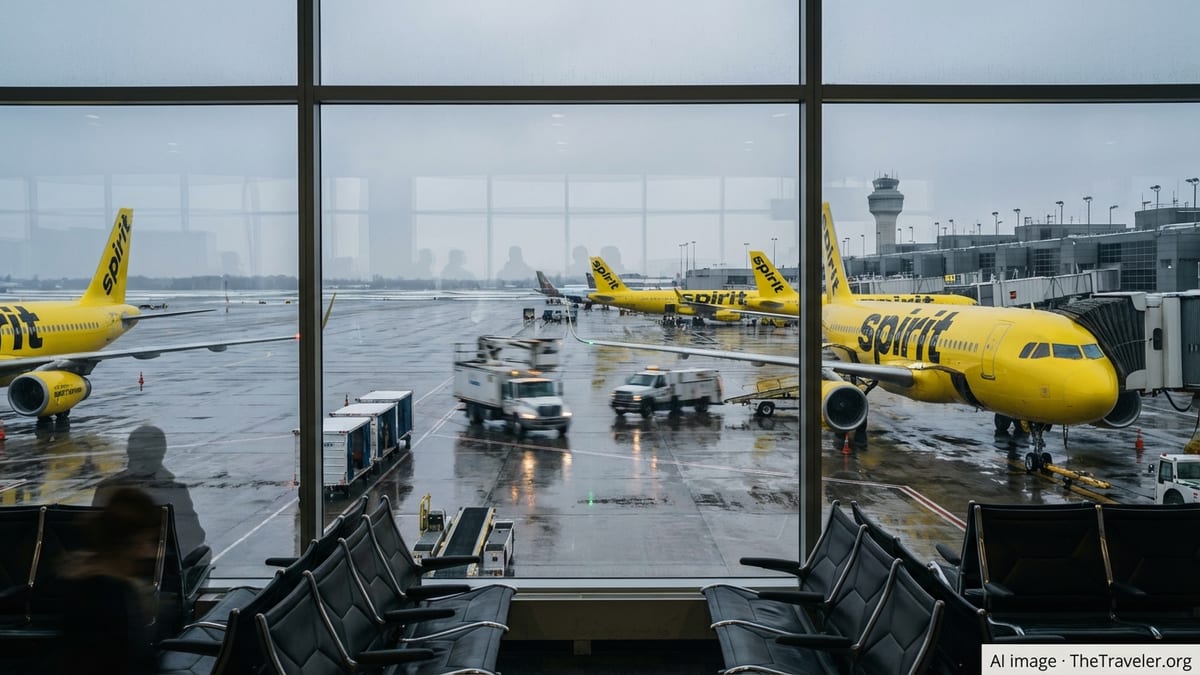
For now, Spirit remains airborne but fragile, an emblem of the financial storm buffeting parts of U.S. aviation. Its fight to stabilize operations, renegotiate critical credit card and processing deals and persuade travelers to keep booking seats will help determine whether the bright yellow jets remain a familiar sight in American skies, or become a cautionary tale about the limits of the ultra-low-cost revolution.