

More news on this day
A Spirit Airlines flight from Newark Liberty International Airport to Detroit was forced to make an urgent diversion to Rochester, New York, after a reported pressurisation indication problem triggered an in-flight emergency alert and prompted a precautionary landing.
Get the latest news straight to your inbox!
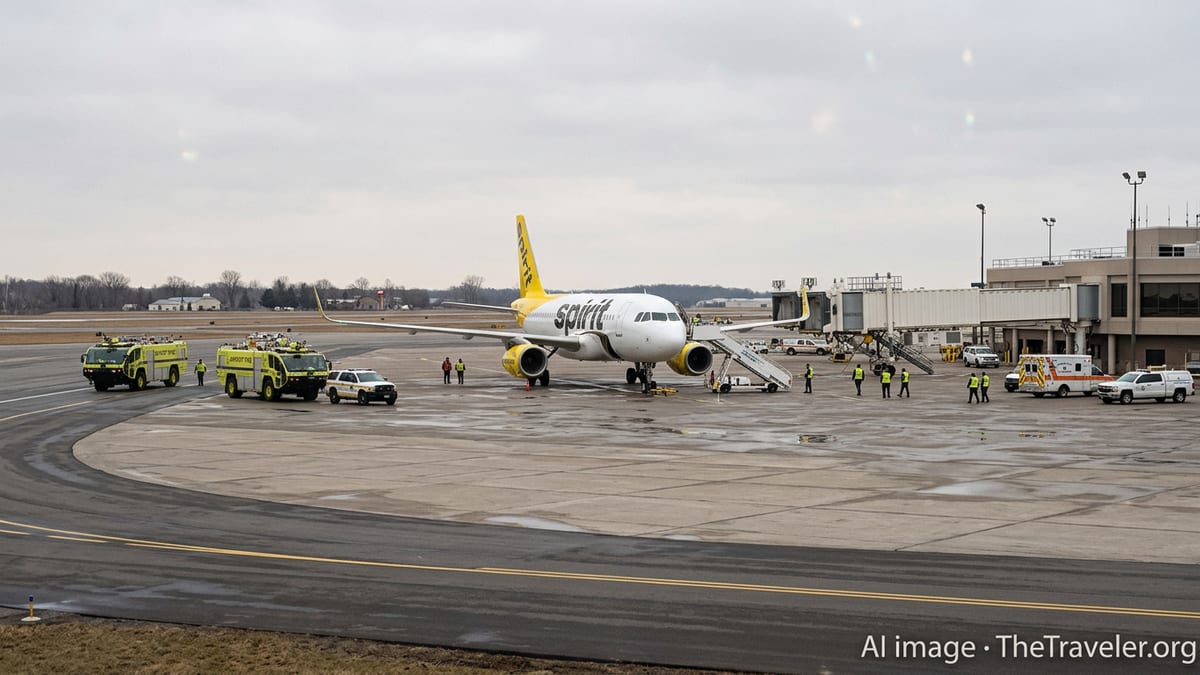
Emergency Diversion After Pressurisation Alert
Publicly available flight tracking data and local coverage indicate that Spirit Airlines flight NK1001, operating from Newark to Detroit, declared an in-flight emergency on Saturday and diverted to Greater Rochester International Airport. The Airbus aircraft transmitted a 7700 squawk code, the general aviation transponder signal used to denote an emergency, before altering course toward Rochester.
Reports indicate that the crew received an abnormal indication related to cabin pressurisation during the climb phase, leading to the decision to discontinue the planned route. While there are no indications of a rapid decompression, any potential pressurisation irregularity at altitude is treated conservatively in commercial aviation because of its possible impact on passenger safety and crew workload.
According to publicly available information, the aircraft descended and landed safely in Rochester, where it was met by airport emergency services as a standard precaution for declared inflight emergencies. Passengers disembarked normally, and there were no immediate reports of injuries.
What Is Known About the Onboard Situation
Early passenger accounts shared on social platforms suggest that those on board were informed of a mechanical issue and later learned that the cabin pressure system was not registering properly. A faulty indication does not necessarily mean an actual loss of pressurisation, but flight crews are trained to treat such alerts seriously because confirmation in real time can be complex.
In typical pressurisation-related incidents, crews may stop a climb, level off, or descend to a lower altitude where supplemental oxygen would not be required, while preparing for a possible diversion. Available tracking data for NK1001 show a relatively prompt descent toward Rochester consistent with a precautionary response to an abnormal system indication rather than a prolonged cruise at higher altitudes.
Published information to date does not indicate the need for emergency oxygen mask deployment or an emergency evacuation after landing. The aircraft appears to have taxied to a gate under its own power, where passengers waited for updates on their continued travel to Detroit.
Impact on Passengers and Flight Operations
Travelers on NK1001 experienced significant disruption as the diversion left them unexpectedly in Rochester instead of Detroit. Passenger comments posted online describe uncertainty at the airport while awaiting information on rebooking options or replacement transport. Some travelers reported considering ground transport to complete the final leg of their journey.
A diversion of this nature typically creates a complex logistical situation for an airline, particularly on a busy weekend travel day. Crews may reach duty-time limits, and the aircraft itself often requires detailed inspections before it can return to service. This can affect not only the diverted flight but also later rotations scheduled for the same aircraft and crew.
At Rochester, airport operations continued with minimal visible disruption beyond the heightened emergency response for the Spirit flight’s arrival. For passengers, however, the unscheduled stop translated into missed connections, delays reaching Detroit, and the challenge of rearranging plans on short notice.
Pressurisation Issues and Safety Protocols
Pressurisation systems on modern commercial jets are designed with multiple levels of redundancy, including automatic controls, manual override capability, and warning systems that alert pilots to abnormal conditions. When an indication suggests the system may not be functioning as expected, crews follow established checklists that can include donning oxygen masks, initiating a controlled descent, and diverting to the nearest suitable airport.
Incidents involving pressurisation indications are not uncommon in global commercial aviation, and the overwhelming majority conclude with uneventful landings. Industry safety analyses note that pilots are trained to act quickly and conservatively, even when a warning later proves to be related to a sensor fault or minor technical irregularity rather than a structural problem.
In the case of NK1001, initial information suggests that the crew’s response aligned with these standard protocols. An emergency declaration, descent, and diversion to an airport with appropriate runway length and emergency services coverage are consistent with industry best practice when there is any question about cabin pressure integrity at altitude.
Next Steps for the Aircraft and Airline
Following an event of this kind, the aircraft involved typically undergoes a detailed inspection by maintenance personnel, focusing on pressurisation controls, sensors, valves, and structural seals associated with the fuselage and door systems. Diagnostic checks are generally completed before the aircraft is cleared to fly passengers again.
For Spirit Airlines, the diversion of NK1001 adds to operational pressures at a time when many carriers continue to manage tight schedules and lean spare capacity. The airline is expected to evaluate the sequence of events, including maintenance records, cockpit procedures, and communication with passengers, as part of standard internal review processes that follow an emergency diversion.
Regulatory authorities may review data from the flight, including cockpit voice and flight data recordings, depending on the severity and classification of the incident. Such reviews typically focus on verifying that established safety procedures were followed and assessing whether any technical or procedural changes are warranted to reduce the likelihood or impact of similar events in the future.