

More news on this day
Spirit Airlines is charting an early summer exit from Chapter 11 protection after reaching a preliminary restructuring deal with key creditors, setting the stage for a smaller, leaner carrier that aims to keep ultra-low fares while sharply cutting fleet and financing costs.
Creditor Deal Sets Timeline for Emergence
The parent company, Spirit Aviation Holdings, announced that it has reached an agreement in principle on the key terms of a restructuring support agreement with its debtor-in-possession lenders and secured noteholders. Executives say the pact provides the financial backing needed to complete the carrier’s second reorganization in less than a year and emerge from Chapter 11 in late spring or early summer 2026.
Under the framework presented to a U.S. bankruptcy court, Spirit expects to cut its combined debt and lease obligations from about 7.4 billion dollars before its August 2025 filing to roughly 2.1 billion dollars upon emergence. The plan would also convert a substantial portion of existing obligations into equity and inject new capital, giving the airline a meaningfully lighter balance sheet as it tries to rebuild investor confidence.
Chief executive Dave Davis has characterized the new agreement as a true restructuring, in contrast with the carrier’s earlier Chapter 11 process that it exited in March 2025. That first effort focused heavily on raising liquidity and swapping debt for equity, but left much of Spirit’s cost base and capacity structure intact, forcing a return to court when losses continued to mount.
Through the current proceedings, Spirit has continued operating flights and honoring tickets, credits and loyalty points. The airline insists that customers will see little disruption during the transition, even as it quietly pulls back in weaker markets and prepares to fly a much smaller fleet in time for the 2026 peak summer season.
A Smaller All-Airbus Fleet at the Center of the Plan
Fleet restructuring sits at the heart of Spirit’s turnaround strategy. The carrier, which operates an all-Airbus narrowbody fleet, has already retired or sold dozens of aircraft and petitioned the court to approve the sale of additional jets. From a pre-bankruptcy peak of more than 210 aircraft, its operating fleet is projected to fall to under 120 early this year and could drop to the mid-90s if all contemplated disposals proceed.
By shedding older and less efficient aircraft and exiting expensive lease agreements, Spirit aims to reduce annual fleet-related costs by more than 550 million dollars, a cut of roughly two thirds from pre-filing levels according to figures shared with creditors. Management argues that a tighter, newer fleet will not only be cheaper to finance and maintain, but will also allow the airline to concentrate capacity where demand is strongest rather than chasing growth across marginal routes.
The downsizing will not be permanent, at least on paper. Spirit’s current projections anticipate modest aircraft additions beginning in 2027, with a more meaningful step-up in deliveries and growth in 2028 once the new cost structure is fully in place. For now, though, the focus is firmly on rationalizing the operation, maximizing utilization of remaining aircraft and ceasing flying that does not clear the airline’s revised profitability thresholds.
Fleet cuts are closely tied to staffing changes. Since re-entering Chapter 11 in August 2025, the airline has furloughed flight attendants and pilots and trimmed ground operations, aligning headcount with a smaller operation. Union leaders have described the latest deal as a necessary reset, though they remain wary of the pace of growth and job restoration after the airline exits court protection.
Network Retrenchment and a New Revenue Playbook
Spirit’s restructuring is also reshaping its route map. Over the past several months the airline has suspended service to more than a dozen destinations, sharply curtailing flying from secondary cities and scaling back off-peak frequencies. Capacity this month is down by nearly one quarter from a year earlier, a striking reversal for a carrier long known for rapid network expansion.
The carrier now plans to concentrate on high-density leisure and visiting-friends-and-relatives routes from core airports such as Fort Lauderdale, Orlando, the New York metropolitan area and Detroit. Schedules are being redesigned to emphasize peak travel days and times, while trimming underperforming off-peak flying that drags down unit revenues and aircraft utilization.
At the same time, Spirit is refining its product and pricing mix in an effort to boost revenue without abandoning its low-fare reputation. Building on premium bundles introduced last year, the airline intends to expand sales of extra-legroom seating in a premium economy-style section and grow its Spirit First bundle built around the Big Front Seat. These higher-yield offerings are meant to complement, rather than replace, the bare-bones base fares that made the brand synonymous with cheap tickets.
Executives and analysts describe the approach as a shift toward a premium low-cost model. Ancillary revenue from seat assignments, bags and in-flight upgrades has long been central to Spirit’s economics. The refreshed strategy adds more distinct tiers of comfort and flexibility, aiming to capture additional spending from travelers who still want a bargain but are willing to pay a bit more for space and convenience.
From Financial Freefall to Test of the ULCC Model
Spirit’s push for an early summer exit from Chapter 11 is unfolding against the backdrop of years of financial strain and strategic setbacks. The airline has racked up multi-billion-dollar losses since the onset of the pandemic, faced surging operating costs and saw a proposed merger with JetBlue blocked on antitrust grounds, cutting off a potential lifeline and forcing it down the standalone restructuring path.
Low-cost rivals have also come under pressure, as legacy airlines roll out their own stripped-down basic economy fares that target price-sensitive travelers while leveraging larger networks and premium cabins. For Spirit, whose brand is tightly linked to ultra-low fares and unbundled service, that competition has compressed margins and made it harder to fill planes profitably without significant discounting.
Industry observers say the current restructuring will serve as a high-profile test of whether a pure ultra-low-cost carrier can thrive as an independent player in the United States market. If Spirit can meaningfully reduce its fixed costs, right-size its fleet and persuade customers to trade up into premium bundles, it could re-emerge as a more resilient niche carrier. If not, future consolidation pressures and renewed financial stress could once again put its independence in question.
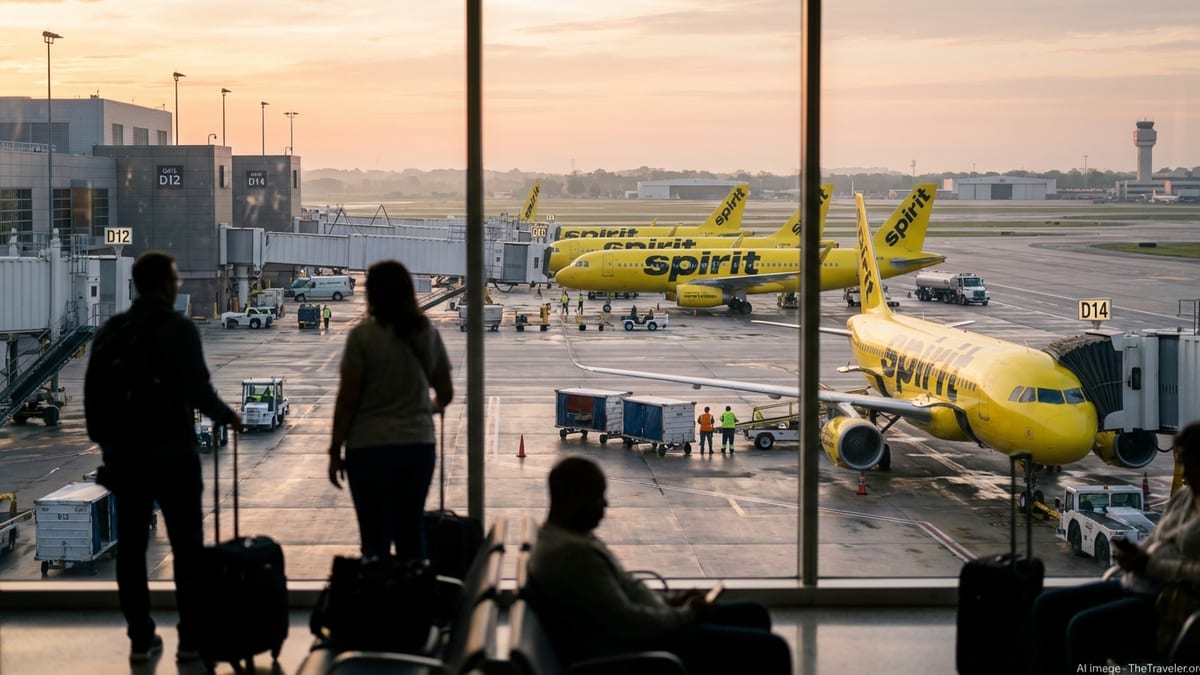
For travelers, the outcome matters well beyond the airline’s signature yellow jets. Spirit holds a notable share of domestic seats in several leisure-heavy markets, and its rock-bottom pricing has often acted as a check on fares across competing airlines. A leaner Spirit that survives could continue to play that role, even with fewer aircraft, while a failure of the restructuring could ripple through ticket prices and route options across the country.
What an Early Summer Exit Means for Travelers
For now, Spirit is emphasizing stability for customers as it moves through the final phases of its court-supervised overhaul. Tickets, vouchers and loyalty points remain valid, and the airline continues to sell future travel through and beyond the expected exit window. Schedules are being updated gradually as fleet and network decisions are finalized, and the carrier advises passengers to monitor itineraries closely for time changes or airport shifts.
If the plan stays on track, by early summer travelers should begin to see the outlines of what Spirit executives describe as a new Spirit. That will likely mean fewer city pairs overall but denser schedules on key sun and city routes, more opportunities to purchase extra-legroom or Big Front Seat options, and potentially more disciplined operational performance as a smaller fleet operates at higher utilization.
Airfares in some former Spirit markets could drift higher as capacity disappears, especially where competitors have been slow to backfill routes. In core markets, however, the airline’s determined focus on remaining a low-fare leader suggests that price-sensitive travelers will still find aggressive deals, albeit with a more pronounced difference between the cheapest bare fare and the carrier’s growing menu of paid extras.
As bankruptcy judges, creditors and regulators weigh the details of Spirit’s restructuring blueprint in the coming weeks, passengers will be watching for a simpler answer: whether the bright yellow planes remain a fixture at U.S. airports well beyond the 2026 summer travel season. The airline’s early summer exit target is as much a signal of survival as it is a milestone in one of the most closely watched aviation turnarounds in recent years.