

More news on this day
A historic Borders estate once known only to architectural historians and local walkers is set to return to the tourism spotlight, as plans emerge to reimagine Scotland’s former Spottiswoode House grounds as an eco-conscious, wellness-led retreat aimed at global travellers.
Get the latest news straight to your inbox!
From Demolished Mansion to Destination Estate
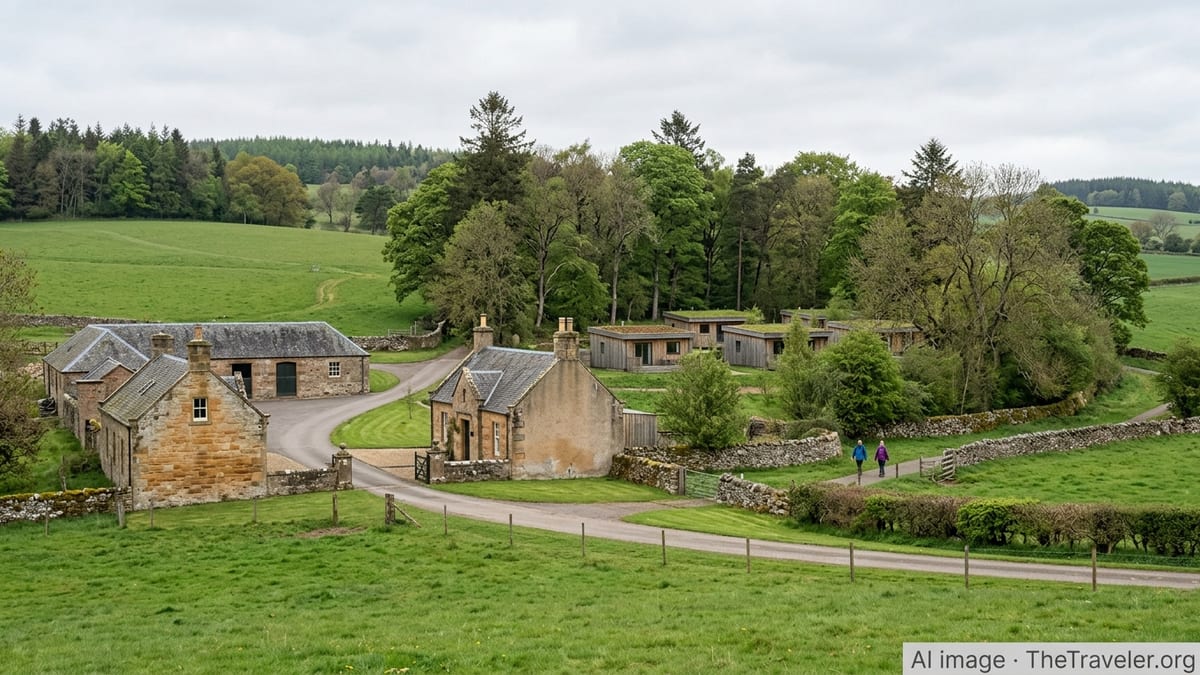
The original Spottiswoode House, a 19th-century country mansion near Westruther in the Scottish Borders, was long regarded as a lost house of Scotland after its demolition in 1939, with only lodge houses, stables, kennels and garden structures surviving in the landscape. Publicly available records describe a cycle of building, alteration and eventual clearance that left the main house absent, even as its designed landscape and estate buildings remained part of the local fabric.
Today, interest in the estate has shifted from archival curiosity to contemporary opportunity. Planning and heritage documents highlight a network of listed outbuildings, clock lodges, stables and dovecots that continue to define the character of Spottiswoode, creating an architectural framework that can be adapted for new uses while retaining the site’s historic identity. This layered setting is now being positioned as the foundation for a new tourism-focused chapter.
Against a broader backdrop of rural diversification across the Scottish Borders, the Spottiswoode estate is being framed as a test case for how dormant historic landscapes can be brought back into active use. The proposed revamp concentrates on sensitive reuse of remaining structures and careful infill within the designed landscape, moving away from a single grand house towards a dispersed collection of low-impact accommodation and shared amenities.
Eco-Friendly Vision in a Historic Landscape
The emerging vision for Spottiswoode is centred on low-carbon building standards, landscape restoration and a strong emphasis on nature-based experiences. Publicly accessible planning and policy material for the wider area points to an expectation that any large-scale tourism development must demonstrate robust environmental credentials, including renewable energy integration, sustainable drainage, biodiversity enhancement and responsible water use.
In practical terms, that is expected to translate into accommodation clusters designed to minimise visual impact, with materials and massing that echo the surviving stone buildings while meeting modern performance targets. Concepts referenced in regional guidance include ground-source or air-source heat pumps serving groups of units, solar arrays discreetly sited away from key views, and high-insulation fabric-first construction that reduces ongoing energy demand.
Landscape proposals around the estate are anticipated to prioritise habitat creation and connectivity, building on the existing pattern of woodlands, shelter belts and field margins. Tree planting, meadow restoration and the careful management of historic avenues and boundaries are likely to feature, positioning the estate as a model for regenerative approaches that support both tourism and biodiversity.
Wellness-Focused Retreat for Global Travellers
The Spottiswoode project is also aligned with the rapid growth of wellness tourism, a segment that has seen visitors seek out quiet, rural settings for rest, restoration and connection with nature. Industry analysis across Scotland points to rising demand for experiences that combine gentle outdoor activity, mindful practices and locally sourced food, rather than traditional resort-style packages.
Within this context, Spottiswoode is being positioned as a low-density retreat environment rather than a large resort complex. Plans outlined in publicly available concept material for comparable estates suggest a mix of accommodation types, from reworked estate cottages and converted stable ranges to contemporary timber-built lodges. These would be centred around shared wellness spaces such as yoga and movement studios, small treatment rooms, thermal experiences and contemplative outdoor areas.
The surrounding countryside, with rolling farmland, wooded ridges and long views towards the Lammermuir Hills, provides a natural setting for walking, cycling, forest bathing and guided nature activities. The intention is to create an itinerary in which time on-site is balanced with curated excursions across the Scottish Borders, integrating local culture, food and heritage into a broader wellness narrative.
Boost for Scottish Borders Tourism Economy
The redevelopment of Spottiswoode aligns with long-term ambitions to diversify and strengthen the visitor economy in the south of Scotland. Economic strategy documents for the region highlight the need for higher-value overnight stays, extended shoulder-season visitation and a broader spread of tourism beyond the traditional honeypot towns and coastal destinations.
By focusing on eco-certified accommodation and wellness-led experiences, the Spottiswoode project has the potential to attract international visitors who typically stay longer and spend more per trip, particularly those travelling from European hubs and North America. The estate’s relative proximity to Edinburgh and Newcastle, combined with improving transport links into the Borders, is expected to support short-break and multi-centre itineraries that pair city stays with rural retreat time.
Local business networks and regional development bodies have consistently argued that projects of this scale can generate benefits beyond the estate itself. These include new employment opportunities in hospitality, outdoor guiding, wellness services and land management, as well as additional demand for local producers, artisan makers and cultural attractions. At the same time, policy frameworks stress the importance of safeguarding community interests, housing affordability and environmental quality as tourism grows.
Balancing Heritage, Community and Growth
One of the defining tests for the Spottiswoode transformation will be the extent to which it can balance visitor expectations with the sensitivities of a historic landscape and a rural community. Heritage listings and conservation guidance emphasise the national importance of surviving estate structures, from stables and kennels to clock lodges and garden features, and indicate that any alteration or adaptive reuse must be carefully justified and designed.
Engagement processes around development in the area consistently underline concerns such as road capacity, visual impact, lighting, noise and access to outdoor space for local residents. The Spottiswoode project is expected to respond with traffic management plans, dark-sky friendly lighting strategies and public or community-accessible walking routes that integrate with existing paths, while ensuring that core retreat spaces retain a sense of seclusion.
If executed in line with these expectations, Spottiswoode could emerge as a reference point for how historic Scottish estates can evolve in the era of climate-conscious and wellness-oriented travel. For now, it stands as one of the most closely watched rural regeneration stories in the Borders, reflecting a shift in Scottish tourism towards slower, more sustainable and experience-rich journeys.