

More news on this day
Spring break travel across the United States has been thrown into disarray in March 2026, as powerful storms, brief ground stops and lingering operational strains combine to cancel hundreds of flights and delay thousands more at major hubs from Chicago and Atlanta to New York and Washington, D.C.
Get the latest news straight to your inbox!
Severe Weather Systems Hammer Major US Hubs
A series of potent late-winter systems sweeping across the Midwest, South and East Coast in mid-March has emerged as the primary driver of the latest disruption. Published coverage indicates that a large storm complex between March 13 and 17 brought blizzard conditions to parts of the Upper Midwest, damaging winds and tornadoes across the South and Mid-Atlantic, and hazardous conditions extending into key aviation corridors.
According to aviation tracking data cited in recent reports, airlines canceled more than 1,100 US flights on March 17 alone, while delays stretched into the thousands as carriers attempted to recover from earlier storms. Hartsfield-Jackson Atlanta International Airport, consistently the world’s busiest passenger hub, registered more than 230 cancellations and roughly 770 delays in a single day as thunderstorms and high winds repeatedly disrupted operations.
New York-area airports and Chicago O’Hare have also been among the hardest hit, with lines of thunderstorms, low ceilings and crosswinds triggering rolling ground stops and ground delay programs. Publicly available flight-tracking dashboards show that on multiple days in March, these hubs ranked near the top of national disruption tables, creating knock-on delays across the wider network as aircraft and crews fell out of position.
For travelers, the result has been packed terminals, extended waits on the tarmac and missed connections during one of the busiest leisure travel periods of the year. Social media posts and passenger accounts shared on forums describe families sleeping in airport concourses, scrambling for rental cars and enduring multi-hour queues at rebooking counters as storms moved east.
Spring Break Demand Collides With System Strain
The timing of the latest weather events has magnified their impact. March is traditionally one of the peak months for spring break travel, and 2026 is no exception. Airlines have scheduled robust capacity into sunny destinations in Florida, the Caribbean and the Mountain West, while major hubs such as Atlanta, Dallas-Fort Worth, Houston, Denver and Chicago are handling heavy connecting traffic.
Analysts writing in industry publications note that the US air system is operating near capacity on many peak days, leaving little room to absorb cascading delays. When storms force ground stops at hubs like O’Hare or Atlanta, the ripple effects fan out quickly through secondary airports as crews and aircraft rotate through the network. Even short disruptions early in the day can evolve into nationwide schedule problems by evening.
Passenger chatter on airline-focused forums reflects this dynamic. Travelers describe relatively minor initial delays turning into missed connections and overnight stays as subsequent flights lose their crews to mandatory duty limits. Several posts highlight how a single canceled leg during the March storms led to entire family trips being shortened or abandoned, underscoring how tightly scheduled operations have become.
Travel specialists commenting in recent coverage suggest that the overlapping pressures of high seasonal demand, limited slack in airline schedules, and persistent staffing challenges in some parts of the aviation system are making spring 2026 particularly fragile for US air travel, even when compared with other busy years.
Targeted Ground Stops and Technical Glitches Add to Chaos
While weather has been the primary catalyst, a series of targeted operational disruptions has added fresh complications for passengers this month. On March 10, a brief nationwide ground stop for JetBlue flights requested by the carrier due to an internal IT issue led to paused departures across its network for around 40 minutes. Publicly available information shows that even this short outage caused knock-on delays into the morning schedule at key JetBlue airports.
In a separate incident on March 13, four major airports serving the Washington, D.C., Baltimore and Richmond regions temporarily halted flights because of a strong chemical smell at a nearby air traffic control facility. Reports indicate that the resulting ground stop, which affected Ronald Reagan Washington National, Washington Dulles International, Baltimore-Washington International and Richmond International, pushed delays at those airports to roughly two hours on average for a period on Friday evening.
Earlier in March, a severe weather outbreak linked to thunderstorms, snow and ice on March 7 triggered hundreds of cancellations and more than 5,000 delays nationwide, according to aviation news outlets and flight-tracking data. Chicago O’Hare and Atlanta again figured prominently among the worst affected, with Federal Aviation Administration ground stops and ground delay programs briefly slowing the entire system.
Together, these localized events have compounded the broader strain caused by the larger storm systems, catching many passengers off guard. Travelers who had already rebooked once due to weather in one region sometimes encountered fresh disruption at their connection point because of a tech glitch or a localized airspace issue elsewhere.
Government Capacity Measures and Structural Pressures
The spring turmoil is also unfolding against a backdrop of broader efforts by regulators to shore up reliability at busy airports. Aviation industry briefings in early March highlighted plans by the Federal Aviation Administration to cap or reduce scheduled departures at Chicago O’Hare for the upcoming summer season, citing concerns about overscheduling by major carriers at the shared hub.
At the same time, the national aviation system is still contending with the aftereffects of earlier staffing shortages among air traffic controllers and security screeners, which became visible during previous federal funding standoffs and shutdowns. While conditions have improved compared with late 2025, some major coastal and hub airports remain sensitive to surges in traffic or weather-related rerouting, and can quickly experience backups if staffing and schedule peaks collide.
Industry analyses suggest that these constraints help explain why seemingly routine late-winter storms in 2026 are producing such widespread consequences. With many hubs already running close to their maximum sustainable throughput, any reduction in arrival or departure rates to maintain safety margins can translate rapidly into gate shortages, congested taxiways and queues on the runway.
Observers also point to increasing operational complexity, including more point-to-point flying and intensive banked hub schedules, which can heighten vulnerability when a key node such as O’Hare, Atlanta, New York or Denver experiences even short-lived disruption.
What Travelers Are Experiencing and How to Respond
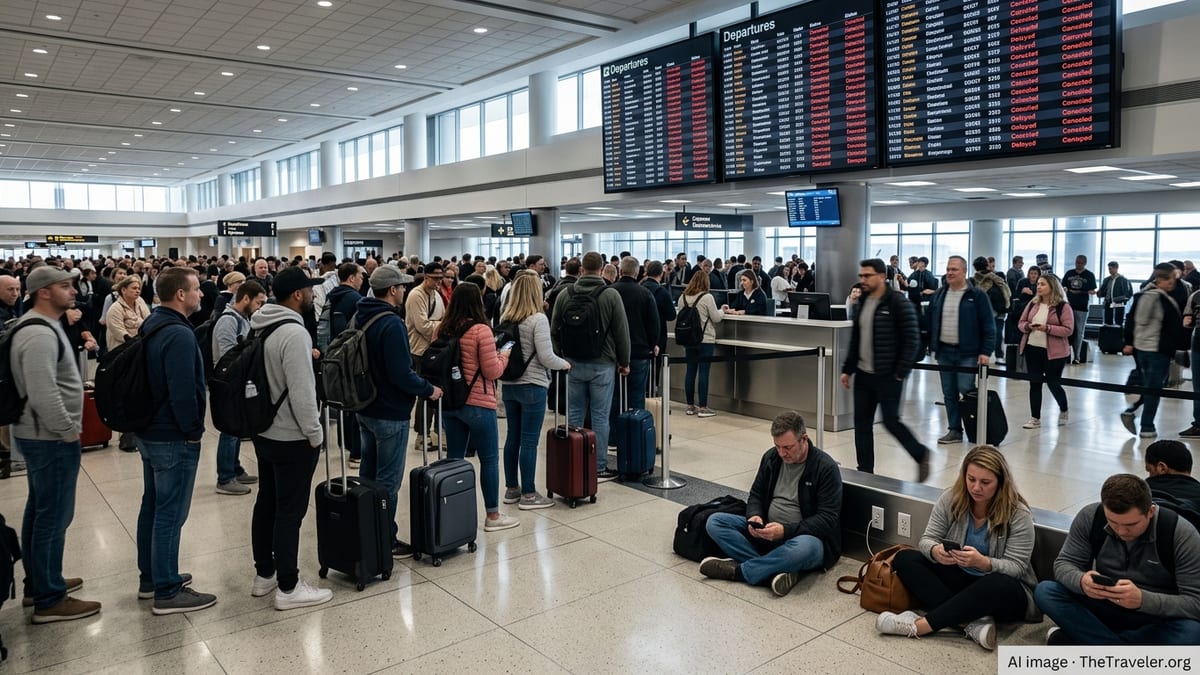
For passengers on the ground, the March 2026 disruption has been felt most acutely at check-in counters, security lines and boarding gates. Photos and descriptions shared publicly from Atlanta, Chicago, New York and Washington terminals depict departure boards filled with red “canceled” and “delayed” notices, along with crowds of travelers in tightly packed queues.
Recent posts from frequent flyers suggest that same-day rebooking has become more difficult on popular routes, with limited spare seats available on alternative flights during peak spring break weeks. Some passengers describe being re-routed through multiple hubs or shifted to partner airlines, often extending travel times by many hours or turning a nonstop journey into two or three segments.
Consumer advocates quoted in travel coverage are urging passengers to build more flexibility into their plans during this period. Recommendations include leaving additional connection time when routing through weather-prone hubs, traveling with carry-on luggage where possible to ease rebooking, and monitoring flight status closely from 24 hours before departure, particularly during active storm systems.
While airlines are working through backlogs from the latest round of storms and localized ground stops, operational specialists caution that spring weather volatility typically continues into April. With high demand expected to persist, travelers heading to or through major US hubs in the coming weeks are being advised to prepare for the possibility of continued delays, schedule changes and crowded airport terminals.