

More news on this day
Spring break 2026 is colliding with one of the most volatile travel environments in recent years, as security tensions in the Middle East, civil unrest in parts of Mexico, and ongoing disruptions to Mediterranean routes trigger flight cancellations, shifting advisories, and growing uncertainty for travelers planning warm-weather escapes.
Get the latest news straight to your inbox!
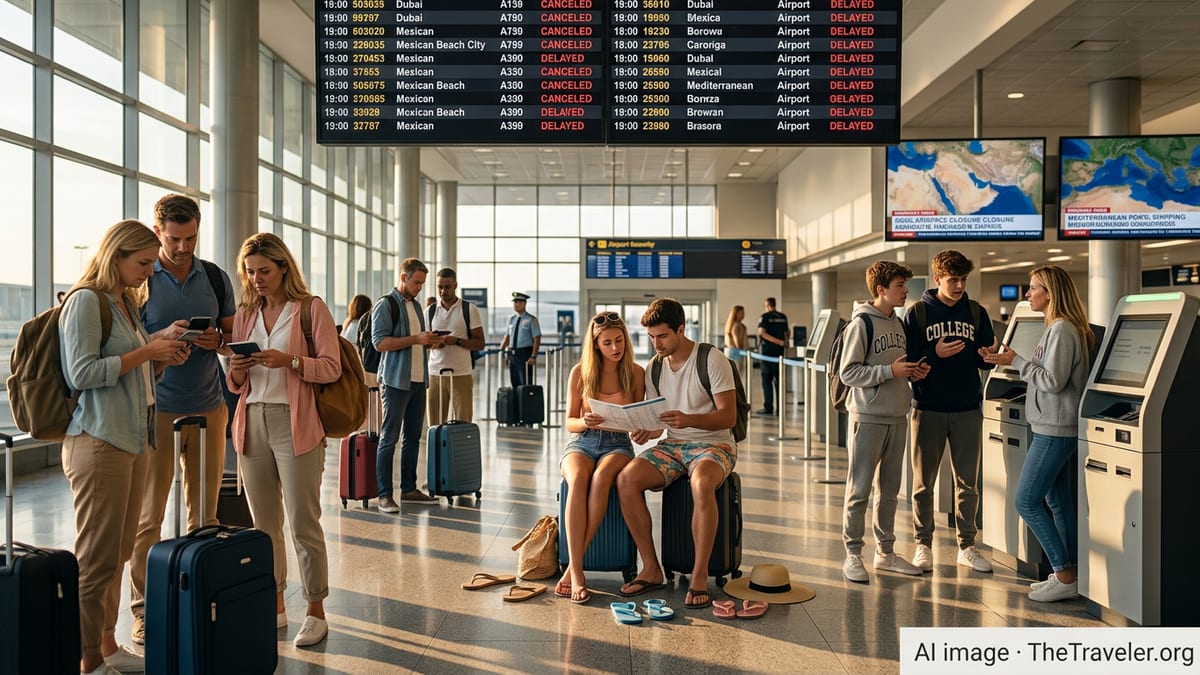
Middle East Airspace Disruptions Put Dubai Trips in Doubt
Dubai, long marketed as a reliably stable escape for spring holidaymakers, has been thrust into the center of the 2026 Iran war and wider Gulf crisis. Since late February, Iranian missile and drone attacks targeting the United Arab Emirates and surrounding states have led to repeated airspace closures and emergency interceptions around Dubai and Abu Dhabi. Publicly available advisories from aviation and maritime security firms in early March describe large portions of Gulf airspace as effectively shut or heavily restricted, causing cascading flight disruptions just as spring break demand peaks.
Client alerts from global travel management and shipping companies in early March indicate that airlines serving the UAE suspended or sharply curtailed schedules for several days as military activity intensified, with some carriers halting new bookings to and from Dubai and other Gulf hubs. Although a limited number of flights have since resumed, reports point to rolling cancellations, last-minute schedule changes, and crowded alternative routes via Oman and other regional gateways.
Travel-focused risk bulletins and embassy security messages issued in early to mid March emphasize that conditions remain highly fluid. Several governments now strongly discourage nonessential travel to the UAE, and some are advising travelers already in the country to be prepared for shelter-in-place instructions, disruptions to airport access, and difficulties securing outbound seats on short notice.
For would-be spring breakers, the practical effect is that Dubai can no longer be treated as a low-risk, high-reliability hub. Travelers face a meaningful chance of last-minute cancellations or diversions if military activity escalates again, and many may find that even confirmed tickets offer limited certainty.
Mexico Spring Break Hotspots Grapple With Security Alerts and Waivers
Popular Mexican beach destinations, long central to the North American spring break circuit, are facing their own turbulence. Security alerts circulated in late February and March highlight ongoing security operations and civil unrest in parts of the country, including western states that feed major resort markets. Publicly available travel waivers from at least one major airline reference “civil unrest” in Jalisco and extend flexible rebooking options for trips through the end of March, signaling that carriers anticipate continued instability through the heart of the spring break calendar.
Reports from expatriate and traveler communities in Mexico, echoing official security notices, describe increased checkpoints, sporadic roadblocks, and law-enforcement operations in certain regions. While major resort corridors remain operational, these developments heighten the risk of localized disruptions: delayed airport transfers, temporarily restricted highways, or advisories against nighttime road travel between inland cities and coastal resorts.
Public travel advisories from several governments continue to differentiate between tourist zones and higher-risk states, but the tone has hardened in recent weeks. Travelers are being urged to monitor local news, remain aware of security operations near their destinations, and consider flexible bookings that allow for last-minute changes if violence or unrest flares closer to resort areas.
For students and families who booked early, the result is a patchwork of risk: some all-inclusive resorts are operating close to normal, while others are fielding questions about whether travelers can reroute to alternate airports or qualify for change-fee waivers. Those still planning last-minute trips are facing a more complex decision set than before, with safety, logistics, and insurance considerations competing with price and party atmosphere.
Mediterranean Routes Strained by Multi-Chokepoint Shipping Crisis
The Mediterranean, often seen as a safer counterweight to more volatile regions, is not insulated from the broader 2026 crisis. Although most European coastal cities remain open to visitors, the combined impact of the Hormuz blockade, renewed attacks on Red Sea shipping lanes, and rerouted vessels around Africa is straining supply chains and timetables for cruise and ferry operations that feed into Mediterranean itineraries.
Maritime and logistics analyses published in recent weeks describe an unprecedented “multi-chokepoint” disruption, with Gulf, Red Sea, and Suez Canal routes simultaneously affected. This has pushed freight and fuel costs higher, cut schedule reliability, and forced shipping companies to rework routes at short notice. While container traffic is the primary focus, knock-on effects are reaching passenger services too, from repositioning cruises to itineraries that rely on timely transits through affected corridors.
Industry briefings suggest some cruise lines have already altered or canceled spring sailings that would have linked the Gulf or Red Sea with Mediterranean ports, opting instead for truncated routes or alternative embarkation cities. Travelers may see changes in port calls, extended days at sea, or late-notice itinerary swaps as operators adapt to evolving security assessments and insurance restrictions on high-risk waters.
For travelers viewing Mediterranean trips as a fallback to higher-risk destinations, the primary concern is less physical security in European ports and more logistical uncertainty. Longer transit times, higher operating costs, and congested alternative routes can translate into higher fares, last-minute changes, or trimmed services, especially for shoulder-season sailings around March and April.
Rising Costs, Insurance Complications, and Booking Headaches
Beyond direct safety concerns, the current crisis is reshaping the economics of spring travel. With the Strait of Hormuz effectively blocked and Red Sea shipping threatened again, analysts tracking the 2026 Iran war have highlighted rising energy and transport costs that ripple into airfares, cruise pricing, and even on-the-ground expenses at resort destinations. Higher fuel costs, longer flight routings around closed airspace, and maritime detours around Africa are all adding to operators’ bottom lines.
For travelers, this shows up as surcharges, fewer discounted seats, and tighter capacity on seemingly unrelated routes. Carriers reallocating aircraft away from high-risk Gulf routes may temporarily boost options in some markets, but in many cases the result is reduced flexibility and fewer backup options when weather or security incidents cause disruption elsewhere.
Insurance and refund rules are another pressure point. Many standard travel insurance policies restrict coverage for war or terrorism-related events, and cancellation protections may apply only when an official advisory reaches a specific threshold or a carrier cancels a service outright. Spring breakers who booked nonrefundable fares without reading the fine print may find themselves caught between heightened risk and limited recourse if they decide to walk away from a trip voluntarily.
Publicly available guidance from travel risk consultants emphasizes the importance of checking both airline waivers and insurance terms before departure, documenting any disruptions, and keeping receipts for unexpected costs such as extra hotel nights or alternative transport routes if flights are canceled or rerouted at short notice.
How Travelers Can Navigate Spring Break 2026 Safely
With conditions changing rapidly, experts in travel risk management and consular security consistently highlight preparation and flexibility as the best defenses against disruption. Travelers are urged to monitor destination-specific advisories daily, including any new security alerts issued during their trip dates, and to treat embassy and consular notices as early indicators of shifting risk, even before formal advisory levels change.
Practical steps include booking fully refundable or changeable fares where possible, choosing accommodations with flexible cancellation policies, and favoring itineraries that allow alternate routing if one hub is suddenly affected by a closure or incident. For the Middle East in particular, travelers are being advised to build in longer connection times and to have a contingency plan that avoids overreliance on a single high-risk hub such as Dubai.
For those still set on spring break in Mexico or Mediterranean destinations, public safety guidance points to familiar precautions that take on new urgency: avoiding nonessential travel after dark between airports and resorts, registering travel plans with a consular service where available, and maintaining a low profile in areas with visible security operations. In coastal Europe, where physical risks remain comparatively lower, the primary advice is to prepare for delays, schedule changes, and temporary shortages tied to the wider shipping and energy crisis.
As spring break 2026 unfolds, the headline is not that travel has stopped, but that it has become far less predictable. Travelers who approach their plans with a newsroom’s eye on fast-moving developments, and a willingness to pivot when the situation demands it, are best positioned to salvage safe and memorable trips from an unusually turbulent season.