

More news on this day
Spring break flyers are being hit from both sides this week, as a grinding partial U.S. government shutdown and a fast‑escalating war with Iran converge to disrupt flight networks, fuel global delays and drive ticket prices sharply higher at the very moment millions of Americans head for vacation.
Get the latest news straight to your inbox!
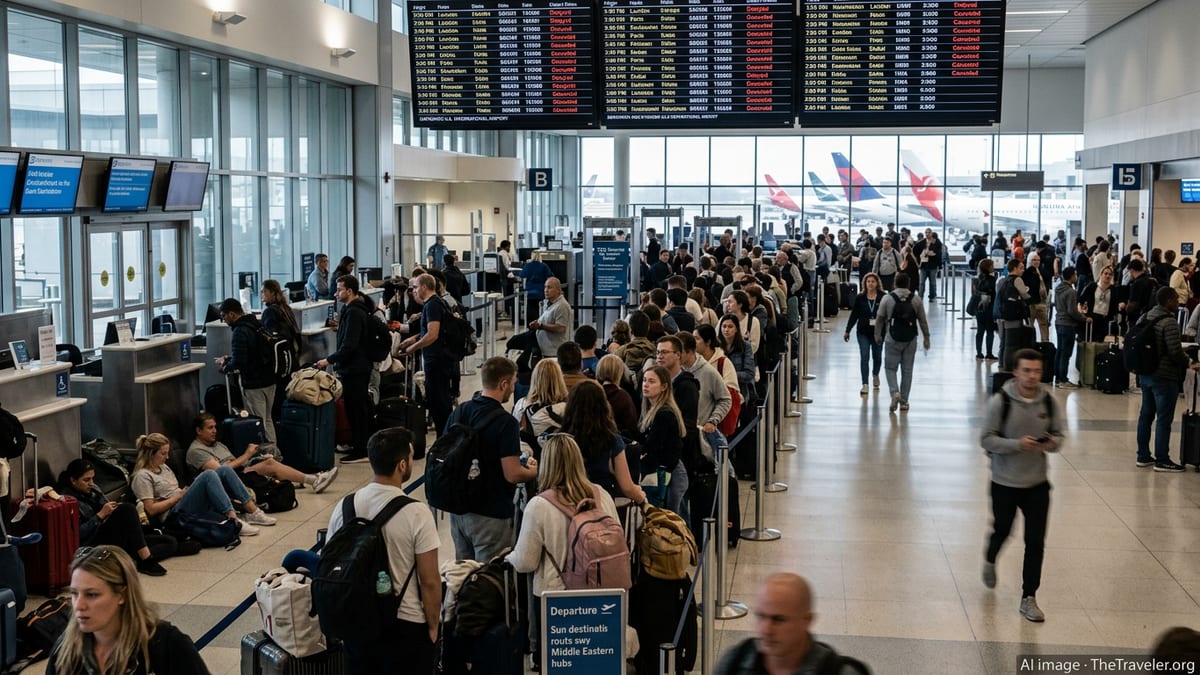
Shutdown Chokes TSA Just as Spring Break Peaks
At airports across the United States, security lines have snaked into parking garages and baggage halls as the partial federal shutdown enters its second week and the spring break rush accelerates. With Transportation Security Administration officers working without pay, callouts have increased and checkpoints have been consolidated, creating waits of two to four hours at some of the country’s busiest terminals since the weekend of March 8.
In Houston, social media posts from Hobby Airport urged passengers first to arrive two hours early, then three to four, and eventually up to five hours ahead of departure as staffing shortages worsened. Similar warnings have gone out from airports in Florida, Dallas, Jackson and other popular spring break gateways, where passenger volumes are surging and screening capacity is simultaneously being squeezed.
Industry groups say the timing could hardly be worse. Airlines expect to carry roughly 171 million passengers between March and April for spring holidays, according to recent trade projections, meaning even modest staffing shortfalls can quickly cascade into missed flights, missed connections and gate hold delays. While the Federal Aviation Administration remains funded and air traffic controllers are not directly affected in this shutdown, ground‑side bottlenecks at security are increasingly spilling over into the rest of the system.
Travelers at some airports have reported being held at the gate while late‑arriving passengers race from overwhelmed checkpoints, forcing airlines to juggle departure times and rebook stranded customers. At other facilities, airlines have begun advising passengers to move to later flights preemptively if they cannot reach the airport far in advance, adding strain to already crowded schedules.
Iran Conflict Closes Key Airspace and Cancels Thousands of Flights
Compounding the domestic turmoil is the rapidly intensifying conflict centered on Iran, which erupted on February 28 with coordinated U.S. and Israeli strikes and has since drawn in multiple states across the Gulf. A patchwork of airspace closures and restrictions in Iran, Iraq, Israel, Jordan, Kuwait, Qatar, Bahrain and the United Arab Emirates has forced airlines to cancel or reroute thousands of flights a day, severing some of the world’s most important long‑haul corridors.
Hubs such as Dubai, Abu Dhabi and Doha, normally among the busiest connecting points linking Europe, Asia, Africa and North America, have been operating at sharply reduced capacity or intermittently suspending passenger services amid missile and drone attacks and shifting security directives. Industry data from the first days of March showed more than 19,000 flights scheduled over the wider Middle East on one day, with roughly 3,400 of them canceled outright and many others delayed or diverted to secondary airports.
The ripple effects are being felt far beyond the region. European and Asian carriers that once overflew Iran and neighboring states on polar‑like arcs between Europe and South or East Asia are being forced into lengthy detours over Central Asia or southern maritime routes. Those diversions add hundreds of miles to typical journeys, increasing fuel burn, tightening crew duty margins and narrowing the buffer airlines rely on to recover from routine operational hiccups.
For U.S. travelers, the most visible impact is on international itineraries that connect through Gulf super‑hubs or via affected Middle East cities. Students heading to study abroad programs, families traveling to safaris or Indian Ocean resorts, and business travelers bound for major Asian and African capitals have all reported sudden cancellations or rebookings that stretch journeys by many hours and in some cases strand passengers in transit cities with scarce hotel availability.
Fares Spike as Capacity Shrinks and Detours Add Costs
With both the shutdown and the Iran conflict squeezing capacity simultaneously, airfares on many popular spring break and long‑haul routes have climbed sharply over the past week. On U.S. domestic leisure routes into Florida, Texas and mountain destinations, airlines say fuller planes and reduced schedule flexibility leave them little room to absorb disruptions, prompting the dynamic pricing systems that set most fares to ratchet higher.
Across the Atlantic and Pacific, rerouted flights around closed Middle East airspace are adding significant operating costs, particularly for widebody jets flying between Europe and South or East Asia and between North America and the Indian subcontinent. Longer routings can push aircraft close to maximum range, requiring technical fuel stops or passenger and cargo weight limits. Those constraints reduce the number of revenue seats available on each departure, a factor that quickly feeds into higher ticket prices for remaining inventory.
Some carriers have introduced limited fare caps or flexible rebooking policies for travelers whose itineraries touch conflict zones, but those measures are tightly targeted. For many spring break travelers booking at the last minute or trying to rebook disrupted trips, the practical reality is a far smaller pool of available seats at higher prices, especially on the busiest weekend departure days later in March.
Travel advisors report a surge in calls from clients shocked by the cost of switching from itineraries routed via Gulf hubs to those using European or direct North American connections. In several markets, premium‑cabin fares on the few nonstop alternatives that bypass the Middle East have doubled compared with early February, while some economy tickets now carry multiple connections and overnight layovers that travelers were not expecting when they first planned their vacations.
Airlines, Airports and Travelers Scramble to Adapt
U.S. airports are attempting to blunt the impact of the shutdown by redeploying staff, opening additional overflow queuing areas and pushing real‑time updates through social media and terminal signage. A handful of facilities that already use private contractors for security screening, such as San Francisco International, have so far avoided the worst of the delays, drawing new attention to little‑known federal programs that allow outsourcing under Transportation Security Administration oversight.
Airlines, meanwhile, are tightening their day‑of‑travel playbooks. Carriers are proactively waiving same‑day change fees on select routes affected by security bottlenecks and international detours, and some are encouraging customers with flexibility to move their flights away from peak weekend dates. Operations centers are also adjusting crew rotations to account for longer flying times around the Middle East, trying to minimize the number of flights that must be canceled outright for lack of rested crews.
Travelers themselves are left to shoulder much of the burden. Consumer advocates are advising spring breakers to arrive at the airport at least three hours before domestic departures and four hours before international flights, build generous buffers between connections and carry essentials like medication and a change of clothes in hand luggage in case of unexpected overnight delays. For those whose flights are canceled due to security‑driven airspace closures, rebooking options may be limited, particularly during the busiest travel days between now and the end of March.
Behind the scenes, government and industry officials are watching nervously for signs that the combination of a prolonged shutdown and a deepening Middle East conflict could trigger more systemic congestion. So far, Europe’s air traffic network has managed to absorb the extra complexity from detours without replicating the acute gridlock seen after previous crises, but experts warn that as spring and summer traffic builds, the margin for error will shrink.
Outlook: A Volatile Start to the 2026 Travel High Season
With no immediate political breakthrough in Washington and little sign of a near‑term ceasefire between Iran and its adversaries, aviation analysts say the conditions that have produced this week’s turbulence are unlikely to ease quickly. Each additional day of unpaid work heightens the risk that more U.S. security officers will call in sick or seek other jobs, while every new volley of missiles or drones around the Gulf forces airlines to revisit their risk calculations and flight plans.
For now, most carriers insist that safety margins remain robust and that the majority of scheduled flights are still operating, if more slowly and at higher cost. But they also acknowledge that the resilience of the global aviation system depends on a complex web of interlocking parts, from airport security checkpoints and radar stations to refueling stops and crew bases, many of which are now under unusual strain.
The result for travelers heading into the heart of the spring break season is an environment defined by uncertainty. Routes that looked straightforward when vacations were booked in January now involve last‑minute schedule changes, new connection points and longer total travel times. As the shutdown drags on and the Iran conflict continues to reshape airspace across a vast region, passengers, airlines and airports alike are being forced into constant, costly improvisation just to keep people moving.