

More news on this day
Millions of spring break travelers across the United States are facing marathon security lines, missed connections and overnight airport stays, as a partial federal government shutdown and severe weather collide with one of the busiest travel periods of the year.
Get the latest news straight to your inbox!
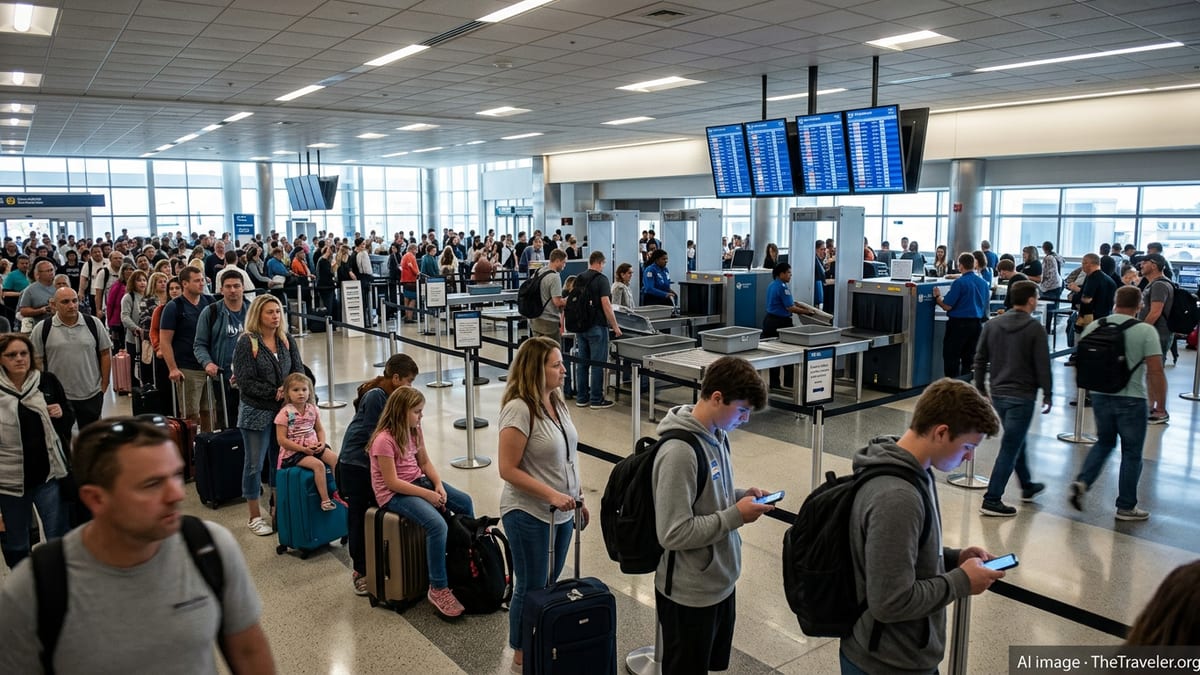
Perfect Storm of Shutdown, Weather and Record Crowds
Reports from major airports indicate that security bottlenecks that began emerging in early March have intensified in recent days, coinciding with peak spring break departures. A partial shutdown of the U.S. government that began on February 14 has left roughly 50,000 Transportation Security Administration officers working without regular pay, while storms sweeping across the Midwest and East Coast are canceling and delaying thousands of flights. Together, these pressures are rippling through airports nationwide just as passenger volumes climb to seasonal highs.
Coverage from national and local outlets shows that the effect is uneven but widespread. Some hubs, including Dallas Fort Worth and certain mid-sized airports, have so far managed to keep security wait times close to normal through schedule adjustments and contingency planning. Others, particularly those already stretched by rapid growth or special events, are recording early morning lines snaking out of terminals and into parking areas as travelers compete for limited staffing and screening lanes.
Travel industry data and airport projections suggest that tens of millions of passengers are expected to pass through U.S. checkpoints from early to late March, with airports in Texas, Florida, Colorado and the Southeast handling some of the largest spring break surges. Publicly available information indicates that many of these facilities were already operating near capacity, leaving little margin when federal staffing and weather falter at the same time.
Hours-long Waits and Missed Flights in Key Hotspots
In Austin, Houston and New Orleans, images and traveler accounts shared in local coverage and on social platforms depict security queues stretching far beyond the usual checkpoint areas. At Austin Bergstrom International Airport, early morning flyers at the start of spring break reported spending up to three hours inching through general screening, with outdoor lines forming before 5 a.m. and some passengers missing flights despite arriving several hours before departure.
Houston’s Hobby Airport has emerged as another flashpoint. Local reporting describes travelers encountering waits measured in hours, with the airport’s own passenger forecasts showing more than two million spring break flyers expected across the city’s two commercial airports. Staffing shortages linked to the ongoing shutdown have reduced the number of open lanes at peak times, amplifying the impact of already heavy leisure demand.
Elsewhere in the South and along the Gulf Coast, from New Orleans to busy hubs in Atlanta and Charlotte, publicly shared wait time data and traveler reports point to significant slowdowns at certain times of day. While not every airport is seeing extreme disruption, the combination of early morning departure banks, unpaid federal staff and strong leisure demand has made predictability elusive. In several cities, airport operators have begun publicly advising passengers to arrive three hours before domestic flights and even earlier for international departures.
Uneven Impact: Some Airports Buck the Trend
Despite the headline-grabbing scenes of passengers stuck in serpentine lines, not all airports are experiencing the same level of chaos. Information from airport authorities and local outlets indicates that several large and mid-sized facilities have, at least for now, avoided severe checkpoint backups. Dallas Fort Worth International Airport, which expects nearly 4.7 million spring break travelers between March 5 and March 24, has reported relatively stable security operations so far, aided by schedule planning and infrastructure built to handle heavy traffic.
Other airports, including facilities in Richmond and certain smaller regional markets, also appear to be managing the crisis more smoothly. Travelers describe normal or only modestly extended waits at some checkpoints, even as national averages creep higher. These pockets of relative calm underscore how local staffing decisions, terminal design, time-of-day patterns and the mix of business versus leisure travelers can shape the on-the-ground experience.
However, even airports that have avoided the worst of the current disruption are preparing for possible spillover effects. Publicly available planning documents and recent board presentations from several airport authorities reference concerns about recurring funding lapses and the need for long-term strategies to protect aviation staffing during future shutdowns. Industry observers note that if the federal impasse drags on, more airports could see security operations strained as fatigue and absenteeism grow among unpaid workers.
Passengers Scramble as Delays Cascade Through the System
For travelers caught in the logjams, the practical consequences can be severe. Accounts collected in recent days describe families with children sleeping on airport floors after missed connections, college students rebooked days later when seats prove scarce, and business travelers forced to abandon carefully planned itineraries. With storms in the Midwest and along the East Coast canceling or delaying thousands of flights, many passengers who do make it through long security lines are finding that their aircraft are still waiting for crew, maintenance or weather clearances.
Published coverage highlights how tightly coupled the aviation system has become. When security lanes slow, passengers arrive at gates later, complicating boarding and producing missed departure windows. When storms roll through busy hubs, aircraft and crews are left out of position, forcing widespread schedule changes. With spring break demand so strong, the usual options to rebook on later flights or different routes are limited, making every delay more likely to result in an overnight stay or multi-leg detour.
Travel forums and airline communications show that some carriers are temporarily waiving change fees or issuing travel advisories for certain cities and dates, encouraging customers to rebook outside of peak hours or travel days. Yet for many families locked into school holidays and pre-booked accommodations, flexibility is limited, leaving them to navigate security backlogs and rolling flight disruptions with few alternatives.
How Travelers Are Adapting in a Shifting Landscape
As frustration grows, many travelers are rapidly rethinking their airport strategies. Publicly available advice from airports, airlines and travel experts now overwhelmingly emphasizes earlier arrivals, with some recommending that passengers planning to check bags or travel during the first morning departure bank build in an additional hour beyond traditional guidance. Others are steering travelers toward mid-day or late evening flights, when security lines in some cities appear less acute.
Use of trusted traveler programs and mobile tools is also under scrutiny. A recent resumption of the Global Entry program, after a brief suspension tied to the shutdown, has renewed interest in expedited screening and passport control options. At the same time, reports indicate that staffing patterns are making the availability of dedicated lanes, such as TSA PreCheck, less predictable at certain airports and times, occasionally forcing enrolled travelers into standard lines when specialized checkpoints are shuttered.
For now, aviation analysts suggest that the situation may remain volatile throughout March, with three distinct waves of spring break travel still to move through the system. If funding for homeland security operations is restored and severe weather abates, pressure on security checkpoints and flight schedules could ease. Until then, millions of travelers heading for beaches, ski slopes and family reunions are confronting a far different kind of spring break experience, one defined by uncertainty, patience and the hope that they make it to the gate before the boarding door closes.