

More news on this day
As orange trees burst into blossom and daytime temperatures settle into the low 70s Fahrenheit, Seville is sliding into one of its busiest springs in years, with Holy Week processions, the Feria de Abril fair and a wave of new travel trends drawing visitors from across Europe and beyond.
Get the latest news straight to your inbox!
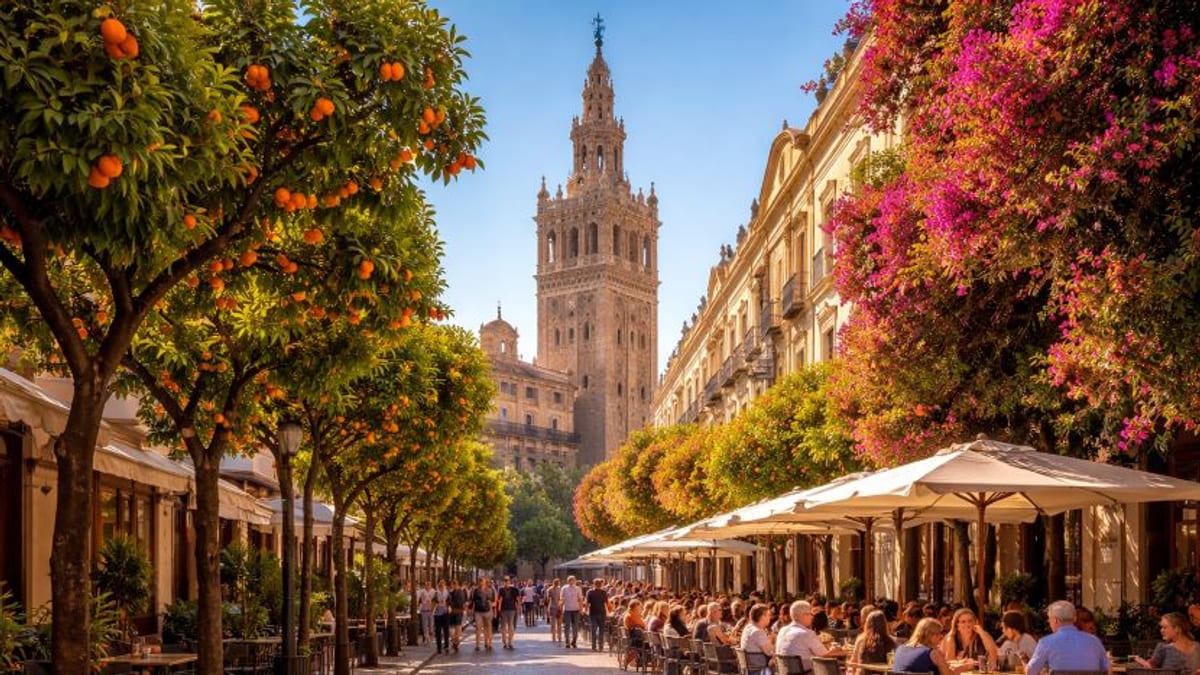
Image by Travel And Tour World
Ideal Spring Weather Lifts Seville’s 2026 Travel Season
Publicly available climate data shows that late March and April in Seville typically bring highs around 22 to 25 degrees Celsius, or the low to mid-70s Fahrenheit, with cool evenings and relatively low rainfall compared with winter. That pattern is repeating in 2026, creating near-ideal conditions for walking the historic center, exploring the Guadalquivir riverfront or lingering on café terraces as the city’s orange and jacaranda trees come into bloom.
Travel publications tracking demand in Spain report that Seville continues to rank among the most searched urban destinations for spring breaks, driven in part by travelers seeking warm weather without the peak summer heat further ahead. Airlines and rail operators have increased capacity on Madrid and Barcelona routes into Seville around Easter and late April, reflecting expectations of heavier passenger flows tied to the city’s major festivals.
Tourism analysts also point to a shift in how visitors plan their days in Seville during spring. With afternoon temperatures already climbing toward summer levels on some days, more travelers are concentrating sightseeing and guided visits into morning and evening slots, keeping the hottest hours for long lunches or siesta-time breaks. This pattern is visible across much of southern Spain but is especially pronounced in Seville, where festival activities often stretch late into the night.
City information channels continue to highlight basic sun protection and hydration for spring visitors, noting that strong sunlight can surprise travelers who associate March and April with cooler conditions in northern Europe or North America. Light layers, comfortable walking shoes and a flexible schedule that leaves room for crowds and processions are being emphasized as the most practical packing advice for 2026.
Semana Santa 2026: Early Easter Brings Intense Crowds
According to coverage from Spanish media and specialist Holy Week guides, Seville’s Semana Santa in 2026 begins on Palm Sunday, March 29, and runs through Easter Sunday on April 5. The city’s historic brotherhoods are once again scheduled to move their elaborate processions along routes that converge on the official ceremonial route between La Campana and Seville Cathedral, with daytime and overnight processions expected throughout the week.
Reports indicate that accommodation demand has spiked sharply for the nights between March 29 and April 5, with many central hotels and apartments either fully booked or quoting premium prices months in advance. Travel forums and booking platforms show some visitors shifting to outlying neighborhoods or nearby towns connected by commuter rail in order to avoid the highest rates and secure more flexible cancellation terms.
Local coverage in Andalusian outlets details road closures, diversions and crowd-control measures across the historic center during processions, advising residents and visitors to factor in additional walking time and to avoid attempting to cross the official procession route at the last minute. Public information campaigns emphasize that streets can become heavily congested on key nights, especially Maundy Thursday and Good Friday, when many processions move through the center.
Despite the logistical challenges, travel media continue to rank Semana Santa in Seville among Europe’s most striking urban spectacles, citing the combination of candlelit processions, brass bands, incense and centuries-old wooden floats. For 2026, visitor guides are recommending that first-time travelers balance time in major viewing spots with quieter corners of the route, where it may be easier to appreciate the atmosphere without the densest crowds.
Feria de Abril 2026: Six Days of Color After Holy Week
Once the solemnity of Holy Week passes, attention in Seville turns to the Feria de Abril, the city’s emblematic spring fair. Official municipal documentation updated in March 2026 confirms that this year’s feria will run from Tuesday, April 21, through Sunday, April 26, at the Real de la Feria grounds in the Los Remedios district on the southwest bank of the Guadalquivir.
Guides produced by tourism offices and travel publishers describe a vast temporary city of striped casetas, or marquee tents, illuminated gateways and lantern-strung streets. During the day, horse-drawn carriages and riders in traditional dress move through the fairground; at night, visitors crowd into casetas for food, music and dancing, while the adjacent funfair, known locally as Calle del Infierno, operates late into the evening.
Recent coverage notes renewed attention to safety, accessibility and environmental measures around the feria site. Organizers have gradually expanded public casetas open to all, in addition to the many private tents run by families, companies and associations, allowing more international visitors to experience the social side of the fair. Publicly available information also points to reinforced public transport links and late-night bus services connecting the Real de la Feria with key neighborhoods during the six days of festivities.
With the Copa del Rey football final now scheduled for April 18 at Seville’s Estadio de La Cartuja, national sports and news outlets have underlined how the city’s calendar in April 2026 stacks a major sporting event directly ahead of the feria dates. Travel commentators suggest that this concentration of large-scale gatherings could lengthen the busy period for hotels and hospitality businesses, effectively turning the second half of April into a continuous high season.
Beyond the Big Fairs: Culture, Food and Neighborhood Life
While Semana Santa and Feria de Abril dominate headlines, cultural guides are highlighting a broader range of experiences for visitors arriving in Seville this spring. Museum programs, photography exhibitions and contemporary art spaces are using the seasonal surge in foot traffic to promote new shows, including initiatives that spread Semana Santa imagery across galleries and public spaces in the weeks surrounding Holy Week.
Gastronomy writers point to the city’s tapas bars and traditional taverns as another draw in spring, when seasonal products such as artichokes, broad beans and local seafood appear more frequently on menus. Many establishments in central districts like Santa Cruz, Arenal and Triana extend opening hours or add terrace seating to capture the evening crowds spilling out from processions and pre-feria social gatherings.
Neighborhood-level coverage from Andalusian outlets shows how districts beyond the postcard center are also benefiting from the spring influx. Triana, across the river from the cathedral, continues to attract visitors interested in ceramics workshops and flamenco heritage, while less touristed areas in the Macarena and Alameda zones are seeing renewed interest from travelers looking for independent venues, live music and smaller-scale Semana Santa rituals.
Travel analysts note that this diversification of visitor flows is in line with broader tourism strategies aimed at distributing footfall more evenly across the city and throughout the shoulder seasons. For spring 2026, Seville appears to be balancing the magnetic pull of its flagship festivals with a push to showcase contemporary culture, everyday neighborhood life and a culinary scene that extends well beyond the fairground.
New Visitor Trends and the Role of Technology
Industry reports linked to the Tourism Innovation Summit, which takes place in Seville later in the year, indicate that travelers in 2026 are increasingly relying on digital tools to tailor their city breaks. In Seville’s case, this is visible in the widespread use of mobile apps and real-time maps to track procession timings, identify less crowded viewing points and navigate transport disruptions during Holy Week and the feria.
Data from travel platforms and social media monitoring compiled in tourism studies show that short-form video, particularly on Instagram and TikTok, now plays a central role in shaping expectations about Seville in spring. Clips of late-night flamenco at the feria, candlelit floats during Semana Santa and sunset views from the Setas de Sevilla structure are among the most widely shared visual motifs, helping to drive interest among younger visitors.
At the same time, local initiatives are emphasizing sustainability and responsible tourism, encouraging visitors to consider public transport, respect residential quiet hours outside core festival zones and support locally owned businesses. City-facing communications stress that Seville’s appeal in spring is not limited to spectacle: quieter moments in parks, lesser-known churches and neighborhood markets remain part of what many travelers describe in reviews as the season’s main charm.
Taken together, the combination of mild weather, tightly packed cultural events and evolving visitor behavior suggests that Seville’s 2026 spring season will be both one of the busiest and one of the most carefully managed in recent years. For travelers prepared to plan ahead and be flexible on timings and locations, the city is poised to deliver an especially vivid snapshot of southern Spain in full seasonal transition.