

More news on this day
Sri Lanka is introducing a new QR-based verification layer across key tourism touchpoints at the same time its visitor profile is shifting, with emerging markets and visa policy reforms reshaping how travelers arrive, move and spend across the island.
Get the latest news straight to your inbox!
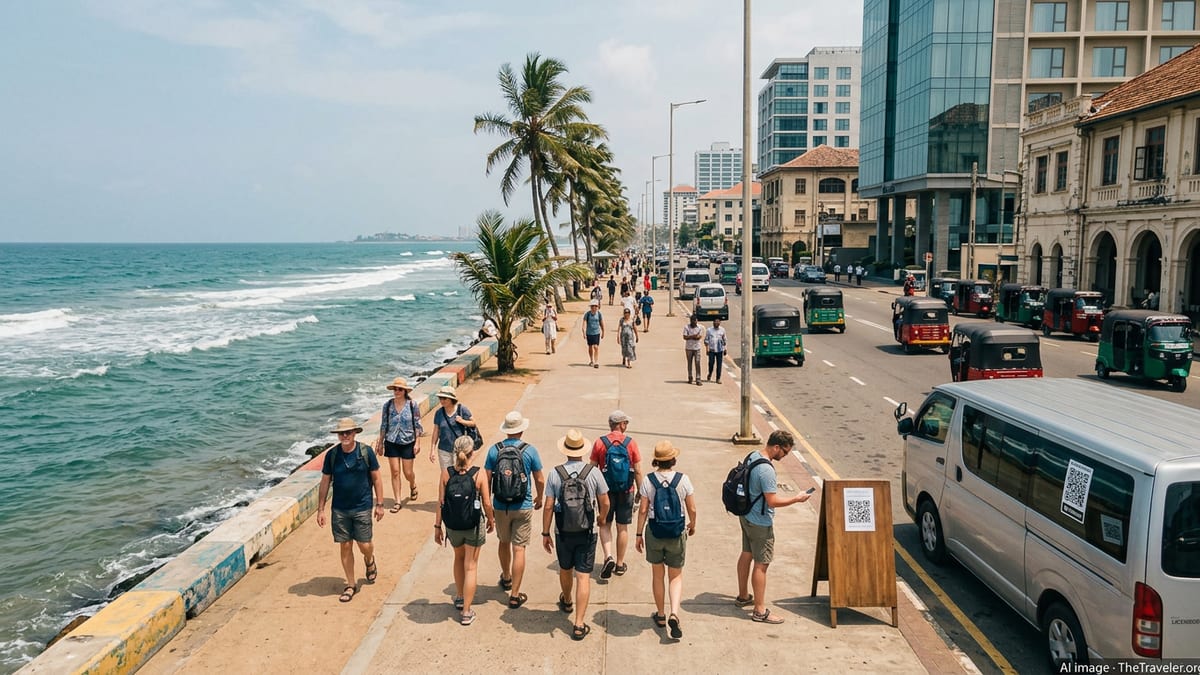
New QR Verification Layer Targets Safer, More Transparent Travel
Publicly available information from recent government circulars and industry briefings indicates that Sri Lanka is rolling out an expanded QR-based verification framework across the tourism chain, designed to confirm the authenticity of services and documents that visitors commonly use. Building on the country’s existing national QR infrastructure in payments and public services, the new measures aim to give travelers a simple way to verify that an operator, document or transaction is genuine by scanning a code with a mobile device.
Early details suggest that the system is being linked to official registries maintained by tourism authorities, transport regulators and local government agencies. When a QR code is scanned, travelers are expected to see core registration data, validity periods and contact details, providing a quick cross-check against fraudulent or unlicensed providers. Industry analysts describe this as a response to the growth of informal operators and third-party intermediaries that have proliferated alongside Sri Lanka’s tourism rebound.
The QR initiative appears to be most advanced in three areas that directly affect visitors: licensed accommodation, registered tour and transport providers, and key permits such as electronic travel authorizations and tourism-related passes. Sector observers report that the system is being piloted in major gateways including Colombo, Negombo, Galle and Kandy, with plans to expand to popular nature and cultural sites if the digital checks prove reliable and widely adopted.
For travelers, the rollout is expected to mean more visible codes on vehicles, storefronts, booking confirmations and documents, all linked back to centralized databases. While full implementation timelines have not been formally consolidated in a single public roadmap, the direction of policy points clearly toward using QR verification to standardize identity checks, support consumer protection and strengthen data collection on how visitors move through the destination.
Digital Oversight of Guides, Transport and Documents
Tourism stakeholders note that one of the more significant elements of the new framework is its application to service providers who interact most closely with visitors, particularly tourist guides and transport operators. According to sector coverage and official statistical reports, authorities are increasingly tying license renewals and registrations to digital identifiers that can be represented as QR codes, allowing travelers to verify credentials at the curbside or during a tour.
In practical terms, this means that a licensed driver, guide or excursion operator can be linked to a unique digital record containing their registration number, category, validity dates and any geographic or activity limitations. When scanned, the QR reference is intended to display that information in real time from official systems rather than relying solely on printed cards or physical stickers, which have historically been vulnerable to forgery or misuse.
The same logic is being applied to selected travel documents and processes. Publicly available guidance on Sri Lanka’s electronic travel authorization regime shows that digital applications already produce reference numbers and machine-readable confirmations, and industry commentary indicates that QR-based verification is being considered or layered in where it can simplify airport checks and reduce paperwork. This would align with broader regional moves to rely on scannable codes for arrival cards, payment receipts and attraction tickets, particularly in high-volume destinations.
Travel advisors point out that the success of such systems depends on two factors: reliable back-end databases and strong traveler awareness. As Sri Lanka’s tourism institutions refine their digital platforms, the QR approach is being viewed as a way to bridge the gap between on-the-ground experiences and centralized oversight, creating a traceable link between the services visitors buy and the regulatory structures that govern them.
Record Arrivals and a Rebalanced Global Market Mix
The expansion of QR verification comes as Sri Lanka’s visitor numbers reach new highs after several years of volatility. According to aggregated tourism data compiled by international economic platforms and official statistical releases, the country welcomed about 2.36 million international arrivals in 2025, surpassing its previous 2018 peak and confirming a full numeric recovery in volume terms.
At the same time, the composition of those arrivals has shifted. Recent breakdowns show India firmly in the lead as Sri Lanka’s largest source market, contributing more than half a million visitors in 2025 and accounting for a substantial share of total arrivals. The United Kingdom, Russia, Germany and China have emerged as the next most significant contributors, with each market sending well over 100,000 travelers in the latest full year of data.
Monthly tourism reports for late 2025 indicate that India often provided close to one quarter of all visitors in peak months, while Russia, Germany and China moved dynamically between second and fifth place depending on season and air connectivity. This reflects broader global trends in outbound travel, with strong pent-up demand from Europe and Russia for winter sun destinations, alongside a gradual normalization of travel from China as outbound capacity rebuilds.
For Sri Lanka, this new mix has practical implications. The growing importance of short-haul and regional markets such as India means that travelers often take shorter, more frequent trips, with different spending patterns from traditional long-haul visitors from Western Europe or Australia. At the same time, the presence of multiple large source markets reduces dependence on any single region, but also requires more tailored marketing, language support and product development across the island’s coastal, cultural and nature-focused attractions.
Visa Reforms, QR Checks and the Competition for High-Value Visitors
Visa policy has become a key instrument in Sri Lanka’s tourism strategy, intersecting closely with digital verification efforts. Published coverage of recent policy changes describes how authorities have experimented with fee waivers for selected nationalities and streamlined entry processes in order to attract more visitors and lengthen stays. In 2025, a wider group of countries reportedly benefited from reduced or removed visa fees, a move that coincided with rising arrival numbers from India, parts of Europe and several Asian neighbors.
As Sri Lanka fine-tunes its e-visa and electronic travel authorization platforms, QR-based checks are being positioned as a way to keep these systems user-friendly while guarding against fraud and unofficial intermediaries. Travel forums and consumer advisories have repeatedly highlighted the proliferation of unofficial application sites that charge high service fees or mimic government portals. Against that backdrop, a verifiable QR link between an application, its payment record and a traveler’s passport data can help ensure that border officials and airlines are working with authentic documentation.
These measures are unfolding in a region where competition for high-value visitors is intense. Neighboring destinations, including the Maldives and Thailand, continue to invest in digital arrival systems, flexible visa options and targeted marketing to specific segments such as wellness, diving or long-stay remote workers. Analysts following Sri Lanka’s tourism performance suggest that the country’s combination of eased entry, enhanced verification and diversified source markets is intended to position the island as a reliable, mid-priced destination with reduced friction at key points in the journey.
However, the focus is not only on raw arrival numbers. Economic commentary indicates that despite record or near-record visitor volumes, tourism receipts have not yet fully matched the revenue levels of the late 2010s. This has prompted discussion about how to attract travelers who stay longer and spend more, including those drawn to heritage, wildlife, wellness and responsible travel experiences, rather than relying primarily on price-sensitive segments.
What the New System Means for Travelers and the Industry
For travelers considering Sri Lanka in the coming seasons, the evolution of QR verification and market dynamics will likely be most visible in day-to-day touchpoints rather than in dramatic policy announcements. Visitors can expect to encounter QR codes when booking licensed accommodation, hiring vehicles, entering major attractions or confirming the legitimacy of guides and intermediaries. In many cases, scanning these codes will act as a quick reassurance that services are officially recorded and operating under current permits.
From an industry perspective, the digitalization push is both an opportunity and an adjustment. Registered businesses that comply with regulations stand to benefit from clearer differentiation and easier marketing, while operators in informal or semi-formal segments may face new pressures to regularize their status in order to maintain access to online distribution channels and partnerships. Over time, more granular data from QR-linked systems could help planners understand visitor flows by region, season and activity, shaping investments in transport, infrastructure and conservation.
Observers also note that the combination of strong Indian demand, resilient European interest and a gradual return of Chinese travelers puts Sri Lanka at a crossroads. Choices made now about pricing, product development and regulatory oversight, including how QR verification is implemented, will influence whether the country remains primarily a volume-driven destination or moves toward a more balanced model that emphasizes experience quality and yield per visitor.
As the 2026 travel year unfolds, the interplay between digital verification, evolving visa policies and shifting global source markets will be central to Sri Lanka’s tourism narrative. Travelers, businesses and policymakers will be watching closely to see whether the new QR system and regional market tailwinds can translate into a more secure, diversified and sustainable tourism economy for the island.