

More news on this day
As Sri Lanka’s hill country recovers from weeks of torrential rain and landslides linked to Cyclone Ditwah, the historic city of Kandy and its surrounding highlands have become the focus of a widening safety and tourism crisis, forcing authorities, residents and would-be visitors to reassess how and when to travel through one of the island’s most iconic regions.
From Cyclone Ditwah to a Hill Country Emergency
The current landslide emergency in and around Kandy did not erupt overnight. It is the latest and most visible chapter in a season of extreme weather that began in late November 2025, when Cyclone Ditwah swept across Sri Lanka bringing intense, localized downpours to the central highlands. Meteorological services reported more than 180 millimetres of rain in parts of Kandy within a single day, saturating fragile slopes and setting the stage for slope failures in the weeks that followed.
Those early deluges triggered red alerts across multiple central districts, as the Disaster Management Centre warned of rising landslide risk in Kandy, Nuwara Eliya, Badulla and Kegalle. Villages long accustomed to heavy monsoon rain found themselves facing a different order of threat, with rockfalls and earth slips threatening homes, roadside eateries and key intercity roads that knit the hill country together. Kandy, a UNESCO-listed cultural capital normally defined by its tranquil lake and temple, suddenly became a case study in hill city vulnerability.
While the storm itself passed within days, the damage unfolded more slowly. Weeks of unstable weather and saturated ground culminated in a succession of landslides across central Sri Lanka, killing hundreds nationwide and destroying thousands of homes. Kandy District emerged among the hardest hit, recording some of the country’s highest death tolls alongside extensive damage to hillside settlements and rural roads that host homestays, guesthouses and tea tourism operations.
By mid December, authorities reported that more than a million people across Sri Lanka had been affected by storm-related floods and landslides, with Kandy accounting for a disproportionate share of fatalities and housing losses. The hill capital’s reputation as a safe, serene stop on the classic cultural circuit was abruptly overshadowed by images of collapsed slopes, evacuated neighbourhoods and search and rescue teams picking through debris.
Kadugannawa Landslide Highlights Route Vulnerability
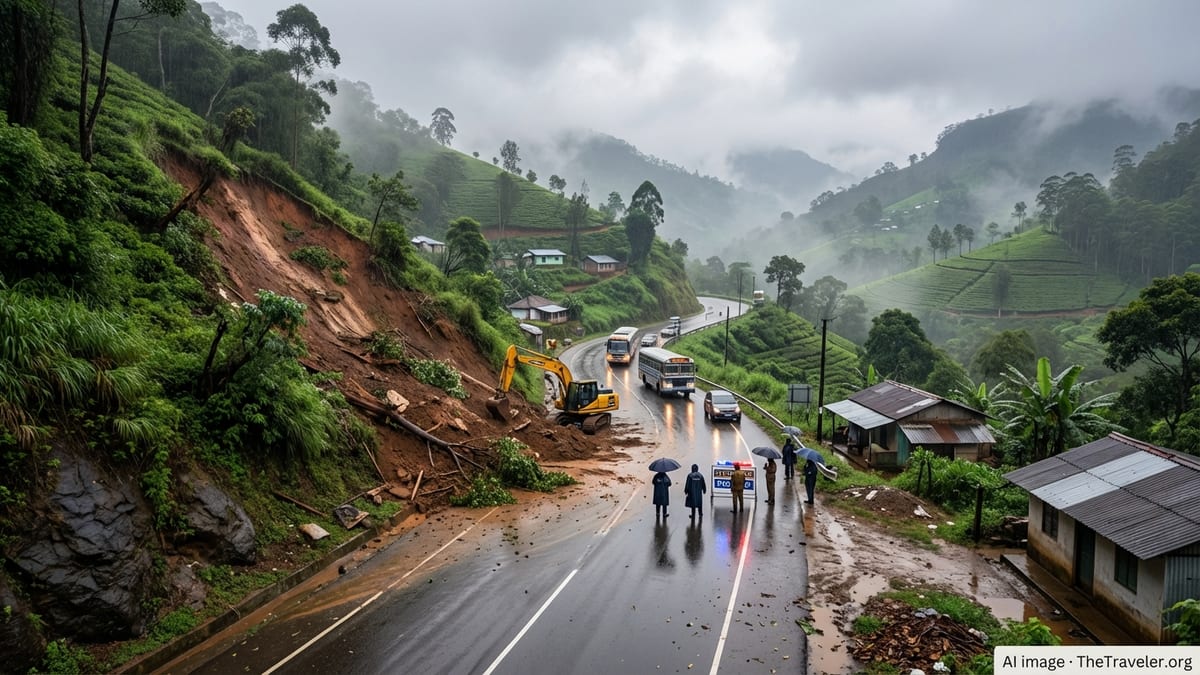
Nowhere have the risks to travellers been more stark than along the Colombo Kandy A1 highway, the main artery feeding visitors into the central highlands. In late November, a massive earth slip near Kadugannawa, west of Kandy, sent boulders and mud crashing onto a roadside home and a popular eatery, killing six people in the early hours of the morning and injuring several others. The incident unfolded on a stretch of road that is a well-loved waypoint for long distance buses, tour coaches and self drive travellers.
Emergency crews spent hours digging through the rubble, while police quickly ordered the closure of the Ganethenna junction to Kadugannawa section of the highway. Authorities urged motorists to avoid non essential travel and warned residents in nearby hillside communities that further evacuations could follow if rain continued. For many Sri Lankans, the tragedy revived memories of earlier landslide incidents on the same route, underlining how even nationally significant corridors remain exposed when heavy rain combines with unstable slopes.
For visitors, the Kadugannawa landslide served as a blunt reminder that risk in the hill country is not limited to remote trekking trails or rural plantations. Key tourism gateways themselves can be compromised, turning a three hour transfer from Colombo into a multi hour, multi route detour or, in the worst cases, stranding travellers until debris is cleared. Local tour operators reported rerouting some guests via alternative highways and rail where available, while others delayed departures, monitoring updates from the Disaster Management Centre and police.
Experts in slope management have long flagged the need for stricter controls on hillside construction, drainage and vegetation removal along the A1 and other mountain roads. The latest landslide has renewed calls for more investment in rock netting, early warning systems and controlled traffic during high risk weather windows, measures that could reduce the likelihood of sudden, deadly failures on routes that carry thousands of residents and tourists each day.
Kandy District Counts the Human and Economic Cost
Beyond headline grabbing incidents on major roads, the wider toll in Kandy District has been severe. Official situation reports in December detailed hundreds of deaths linked to landslides and flooding across Sri Lanka, with Kandy recording the single highest number of confirmed fatalities. More than two thousand houses in the district were reported as completely destroyed, while many more sustained partial damage from collapsing slopes, falling boulders and erosion triggered by unrelenting rain.
Entire hillside communities have been uprooted. Tens of thousands of people have been forced into temporary shelters and safety centres, often set up in schools and public buildings away from known risk zones. For families whose livelihoods depend on tea smallholdings, roadside stalls or village guesthouses, the landslides have meant the loss of both home and income in a single event. Local authorities, supported by the military and volunteer groups, continue to manage relief distributions, but reconstruction in steep, geologically complex terrain will be a long term effort.
The damage radiates beyond housing. Rural roads that link villages to Kandy city have been cut in multiple places, affecting school runs, hospital access and market supply chains. Landslides have undermined sections of minor roads that many independent travellers use to reach tea estates, homestays and lesser known viewpoints around the city. Repair crews are working under challenging conditions to stabilise embankments and restore single lane access, but full rehabilitation of some routes may take months.
Economically, the disaster has arrived at a delicate moment. Tourism is widely viewed as a critical engine of Sri Lanka’s post crisis recovery, and Kandy sits at the heart of the country’s most visited circuit. Every cancelled room night in a family run guesthouse, every postponed tour departure and every shuttered roadside café compounds the shock for small businesses that only recently emerged from the pandemic and economic turmoil. Local tourism associations in the Kandy region are now lobbying for targeted grants, soft loans and technical support to help operators rebuild more safely on the slopes.
Travel Conditions: What Visitors Need to Know Now
For international travellers with upcoming trips, the key question is whether it is still safe and practical to include Kandy and the surrounding hill country in their plans. The short answer is that the region remains accessible in most cases, but conditions can change quickly during heavy rain and it is essential to travel with up to date information, flexible routing and a focus on safety over sightseeing. Authorities have stressed that visitors currently in the country are not the primary victims of the crisis, but they can be affected by disrupted transport and services.
Road access into Kandy has largely been restored, with at least one primary route open between the capital and the hill city. However, sections of the A1 near Kadugannawa and other hillside approaches have previously been subject to temporary closures due to clearance work or ongoing slope assessments. Travellers should expect possible delays, detours and occasional nighttime restrictions while engineers stabilise high risk sections. Reputable local drivers, who receive live updates via government advisories and media, are better placed than self drive visitors to navigate rapidly changing conditions.
Within the wider hill country, some minor roads to tea estates and remote guesthouses remain under review or partially blocked. Rail operations on the main line through the central highlands have been operating on limited segments when weather allows, providing an alternative to road travel on certain stretches but not a complete substitute for overland transfers. Domestic flights to and from nearby airstrips are largely unaffected but can be impacted by low cloud and rain. It is sensible for travellers to reconfirm every internal transfer 24 to 48 hours before travel and to build in buffer time between connections.
Visitors who prioritize safety are advised to avoid travelling during or immediately after intense rainfall, particularly overnight, and to reconsider stays in isolated hillside properties that can be difficult to access or evacuate in an emergency. Insurance policies that explicitly cover trip disruption due to natural disasters offer an additional layer of reassurance, especially for travellers planning complex multi stop itineraries through the central highlands in the coming months.
Government Response and Criticism Over Risk Messaging
The Sri Lankan government, together with the Disaster Management Centre, military and police, has mounted a large scale response to the landslides, focusing on evacuations from high risk zones, search and rescue, and the provision of emergency shelter, food and medical care. Hundreds of safety centres have been opened nationwide, with significant concentrations in central districts such as Kandy, Nuwara Eliya and Badulla. Officials have issued tiered landslide alerts and evacuation orders as rainfall thresholds are crossed, urging residents on vulnerable slopes to move to safer ground.
Yet even as technical agencies raised the alarm, aspects of the public communication strategy have come under scrutiny. Some government and tourism sector statements during the height of Cyclone Ditwah emphasized that transport networks were operating normally and that major destinations were functioning as usual, even as the Disaster Management Centre was reporting road closures and issuing red level landslide warnings in the same districts. Critics, including local commentators and civil society groups, argue that such mixed messaging may have understated risks for both residents and visitors at crucial moments.
Officials in charge of tourism promotion counter that their priority was to prevent exaggerated or outdated reports from discouraging visits to parts of the country that remained unaffected and safe, particularly coastal and cultural destinations far from the worst hit highlands. They stress that no major incidents involving tour groups have been reported and that coordination between tourism bodies and disaster agencies has improved since the first days of the storm. Updated advisories now more clearly differentiate between localized high risk areas and the broader network of open, functioning tourism zones.
The ongoing challenge is to strike a balance between protecting human life and sustaining an industry vital to Sri Lanka’s economic recovery. The Kandy landslide crisis has underscored that in an era of more volatile weather patterns, transparent, location specific risk information is essential. That includes candid guidance on which roads, valleys and slopes are off limits at any given time, even during peak tourism months, and a willingness to prioritize temporary closures over the temptation to keep every route open for business.
Tourism Industry Resilience and Rerouted Dreams
Despite the disruption and distress caused by the landslides, Sri Lanka’s tourism sector has moved quickly to adapt. Large hotels in and around Kandy, as well as many established guesthouses, report that they remain open with only minor interruptions to services. Some operators temporarily shifted guests to alternative properties on safer ground or adjusted itineraries to emphasize low risk urban and cultural experiences over long rural drives. The famed Temple of the Tooth, Kandy Lake and central city attractions have continued to receive visitors, even as outlying hillside communities focus on recovery.
Nationally, tourism arrivals have proven remarkably resilient in the wake of Cyclone Ditwah, with industry leaders noting only a modest dip in bookings during the height of the crisis. Many visitors already in the country chose to continue their journeys with modified routes, often combining the south and west coasts or the Cultural Triangle with limited time in the highlands, carefully planned around weather forecasts and official updates. Domestic travellers, who form an important market for Kandy’s hotels and restaurants, have also begun to return as roads reopen.
Tours that previously relied on the classic Colombo Kandy Nuwara Eliya loop are increasingly being redesigned. Some planners now route travellers into the hill country via alternative highways, or spread overnight stays between Kandy and lower risk foothill towns, reducing exposure to steep, landslide prone corridors. Others recommend travelling into the highlands by rail where feasible, turning an operational constraint into a scenic experience while avoiding some of the most vulnerable road sections.
For many would be visitors, the crisis has shifted the dream of misty tea hills and cool Kandy evenings rather than destroyed it. Instead of abandoning plans entirely, travellers are being encouraged to think seasonally and geographically, favouring periods of more stable weather and being prepared to swap a night in a remote tea bungalow for an extra day exploring Kandy’s cultural heart if conditions demand it.
Community Recovery, Climate Risk and the Future of Hill Country Travel
On the ground in Kandy District, the long road to recovery is only beginning. Local authorities, non governmental organizations and community groups are working to relocate the most exposed households away from high risk slopes, sometimes to new settlements entirely. Engineers are conducting detailed assessments of failure zones, while environmental experts push for reforestation, terracing and better water management to reduce the likelihood of repeat landslides in years to come.
For tourism, the crisis has reopened vital debates about where and how to build. Small guesthouses and homestays that once saw hillside perches as an asset are now re evaluating their locations and designs, paying closer attention to official hazard maps and building codes. Responsible tourism advocates argue that future development in the hill country must incorporate climate projections, not just historical weather patterns, recognizing that intense, short lived downpours linked to a warming climate can destabilize slopes that seemed safe a generation ago.
Travellers themselves have a role in shaping this future. By choosing operators that prioritize safety and environmental stewardship, visitors can support a shift towards more resilient forms of hill country tourism. That may mean favouring properties built on stable ground with proper drainage, backing community initiatives that restore forests and watershed health, or accepting that certain picturesque but precarious viewpoints and tracks are better left off the itinerary.
For now, Kandy remains both a cherished gateway to Sri Lanka’s interior and a powerful symbol of the country’s exposure to landslide risk. The recent crisis has not closed the door on travel dreams in the hill country, but it has made clear that those dreams must be pursued with open eyes, flexible plans and a deeper respect for the steep, rain carved landscapes that make this region so compelling in the first place.