

More news on this day
Regional and low-cost carriers including PSA Airlines, Piedmont, Endeavor Air, Frontier and Republic have canceled 44 flights and delayed more than 700 others at Charlotte Douglas International Airport, disrupting some of the busiest short-haul routes in the Southeast and snarling travel to key destinations such as Wilmington, Cincinnati, Savannah, Nashville and New York.
Get the latest news straight to your inbox!
Ground Operations Struggle as Delays Cascade Through Network
The wave of disruptions at Charlotte Douglas unfolded as staffing constraints in air traffic control and across ground operations left the airport struggling to keep pace with a tightly banked schedule of departures and arrivals. As delays stacked up early in the day, carriers began scrubbing select flights and holding others at origin, creating a cascading effect across the regional network.
PSA Airlines, Piedmont and Endeavor Air, which operate many of American and Delta’s regional connections, were among the hardest hit, with their tightly timed turnarounds particularly vulnerable to even brief slowdowns. Frontier and Republic, both running smaller but strategically important schedules from Charlotte, also reported a sharp uptick in late departures as aircraft and crews fell out of position.
By mid-afternoon, Charlotte Douglas had become one of the most disrupted major U.S. hubs, with rolling delays affecting both inbound and outbound traffic. While some mainline operations continued to move, passengers booked on regional spokes felt the brunt, facing last-minute gate changes, creeping departure times and, in many cases, outright cancellations.
Airport officials said teams were working with the Federal Aviation Administration and airline partners to meter departures and arrivals, but acknowledged that recovery would take time given the volume of flights and the knock-on effects across the broader system.
Key Routes to Wilmington, Savannah, Nashville and New York Hit Hard
The operational strain was most visible on high-frequency short-haul routes that funnel passengers through Charlotte to the broader national and international network. Flights to Wilmington on the North Carolina coast, Savannah along the Georgia shoreline, and inland business markets like Nashville and Cincinnati all reported clusters of delays and select cancellations.
These routes rely heavily on regional jets operated by carriers such as PSA, Piedmont, Republic and Endeavor under major airline brands. With aircraft cycling through Charlotte multiple times a day, any disruption at the hub ripples rapidly along the route, leading to aircraft and crews being out of place for subsequent departures.
New York routes were also among those affected, with service to major airports in the region experiencing rolling delays as congestion at Charlotte pushed departure times back. For many travelers, this meant missed connections onward to Europe, the Caribbean and the West Coast, compounding the local disruption with long-haul itinerary breakdowns.
Smaller markets that depend on one or two daily frequencies from Charlotte saw some of the most acute impacts. When a single regional flight is canceled, travelers can be left with limited same-day alternatives, forcing rebookings through other hubs or overnight stays at already crowded airport hotels.
Passengers Face Missed Connections, Long Lines and Limited Options
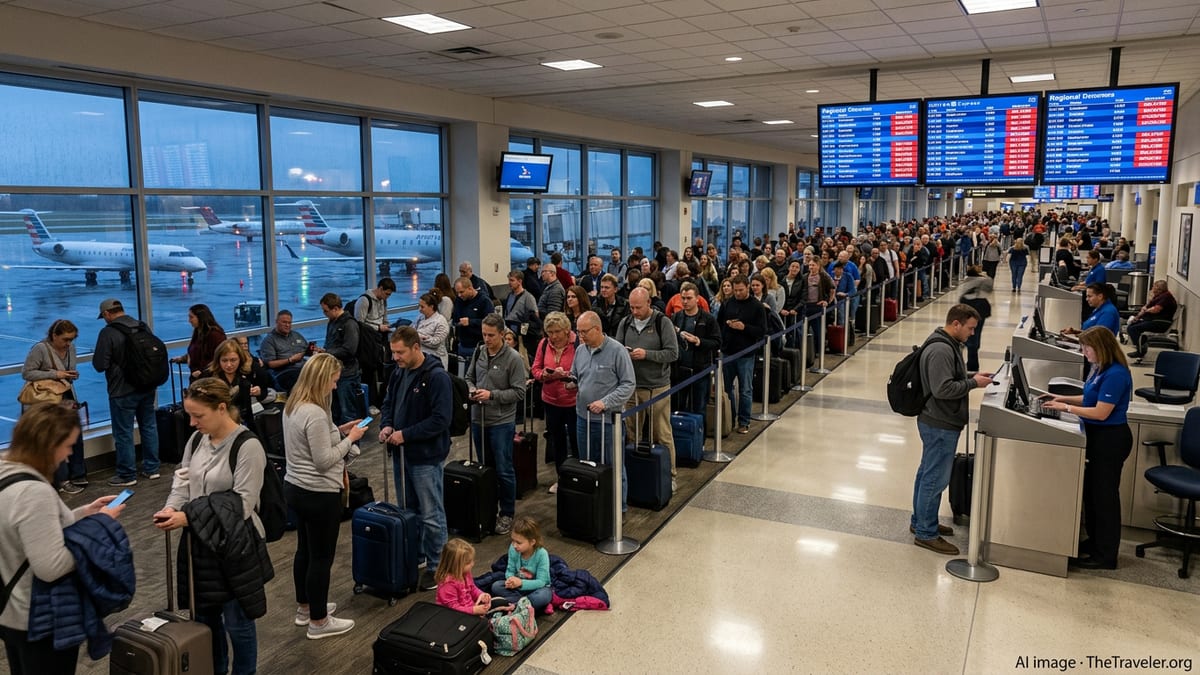
Inside the terminal, the operational challenges translated into long queues at customer service counters, busy rebooking desks and crowded gate areas, particularly at the ends of the regional concourses where PSA, Piedmont, Republic and similar carriers tend to operate. Travelers reported departure times moving in repeated short increments, often stretching modest delays into hours-long waits.
Families heading to leisure destinations such as the beaches near Wilmington and Savannah found themselves competing for scarce open seats on later departures. Business travelers bound for hubs like New York and Nashville scrambled to preserve tight schedules, with some opting to reroute through alternate airports when options from Charlotte became too constrained.
Airport staff urged passengers to remain in close contact with their airlines via mobile apps and text alerts, noting that gate changes and departure times were shifting rapidly as operations teams attempted to squeeze in delayed flights where possible. Self-service kiosks and digital tools handled part of the surge, but many travelers still sought in-person assistance to navigate complex, multi-leg itineraries.
Food courts, rest zones and power outlets around the terminal quickly filled as the delays wore on. Travelers who had planned brief layovers found themselves camping out for large portions of the day as they waited for aircraft and crews to reset.
Airlines Work to Recover Schedules and Protect Crews
For PSA, Piedmont, Endeavor, Frontier and Republic, the immediate priority shifted from running the full published schedule to preserving safety margins for crews and aircraft while gradually restoring reliability. Airline planners began proactively canceling select frequencies to create breathing room, allowing remaining flights to operate closer to schedule and reducing the risk of last-minute disruptions caused by crew time-out rules.
Regional carriers face particular complexity in this kind of event because their aircraft are often scheduled on tight rotations, with minimal slack built into the day. A delay on a single leg from, for example, Savannah to Charlotte can cascade into late departures to Cincinnati, then Nashville, and onward to smaller spoke cities, affecting dozens or even hundreds of passengers over the course of the day.
Low-cost operators such as Frontier confronted similar challenges with point-to-point services that depend on precise aircraft utilization. With many flights sold to capacity, the ability to re-accommodate passengers onto alternative departures was limited, increasing the likelihood of travelers being shifted onto flights the following day or rerouted via other hubs.
Industry analysts noted that staffing shortfalls at key points in the system, from air traffic control to ground handling, can magnify routine operational hiccups into large-scale disruption, particularly at growth-focused hubs like Charlotte Douglas where flight volumes and passenger demand have surged in recent years.
What Travelers Through Charlotte Should Expect Next
With schedules heavily disrupted, airlines warned that residual delays could persist into subsequent days as aircraft and crews are repositioned and maintenance windows are recalibrated. Even after the most acute phase passes, travelers can expect tighter connections, fuller flights and limited flexibility on popular routes from Charlotte, especially during early morning and late afternoon peak banks.
Passengers with upcoming trips involving PSA, Piedmont, Endeavor Air, Frontier or Republic-operated segments were advised to monitor their reservations closely, build extra time into itineraries that rely on connections in Charlotte and consider earlier departures where possible. Same-day changes may be limited once flights begin to go out near or at capacity as airlines work through the backlog.
Airport officials reiterated longstanding guidance that travelers arrive well ahead of departure, particularly during busy travel periods when security wait times and check-in lines can fluctuate rapidly. With Charlotte Douglas serving as a critical connecting node for the Carolinas and surrounding states, even modest operational constraints can translate into long, stressful days for passengers across the region.
For now, the focus at the airport and among its airline partners is on stabilizing the operation, moving stranded passengers to their destinations and restoring traveler confidence after another day in which Charlotte’s status as a major U.S. hub came with heavy consequences for those relying on its regional and low-cost carriers.