

More news on this day
Travelers heading to Japan this year are finding that one of the country’s most talked-about stays is not a traditional ryokan or a luxury tower, but a resort-style hotel chain where dinosaur robots handle check-in and sweeping bay views sit just beyond the lobby doors.
Get the latest news straight to your inbox!
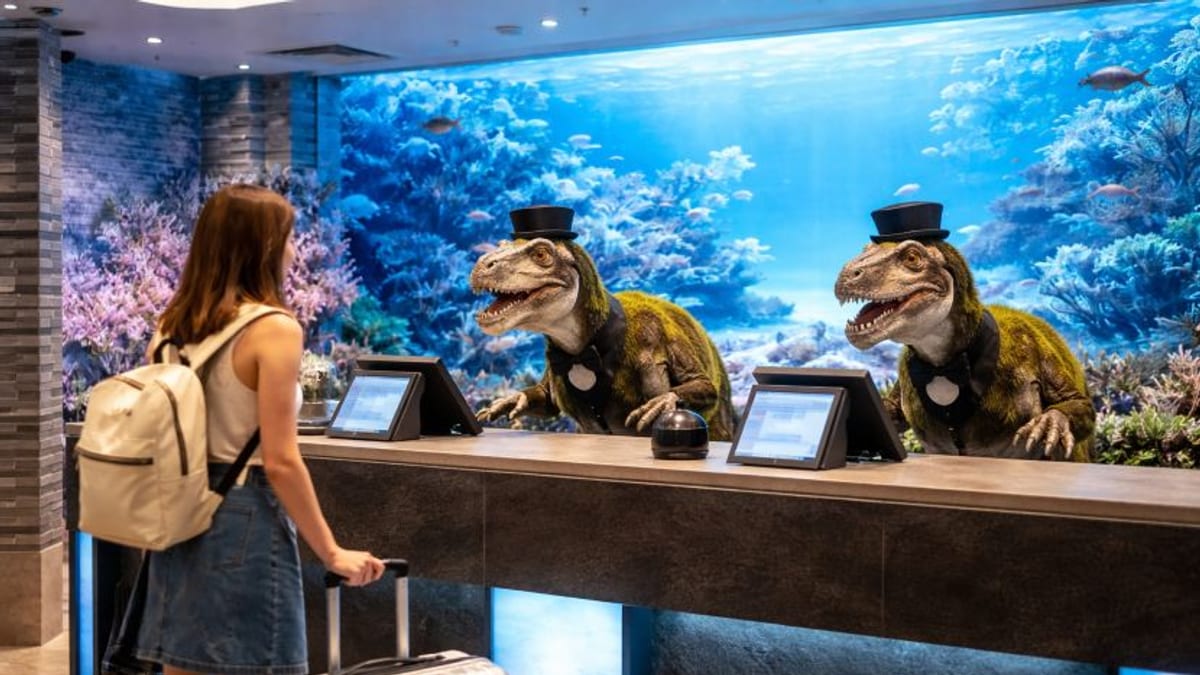
Image by International Hotels News, Hotel Industry & Hospitality News
A Resort Stay Where Robots Run the Front Desk
Henn Na, which translates loosely as “strange,” has evolved from a curiosity in Nagasaki Prefecture into a full resort-ready brand, with locations positioned near major leisure hubs and coastal scenery. Publicly available information shows that the chain, managed by HIS Group affiliates, now operates dozens of properties across Japan, marketed around automation, playful robotics, and compact but functional rooms.
The original concept hotel opened inside Huis Ten Bosch, a theme park in Sasebo modeled on a Dutch waterfront town, pairing its canals and bay views with a lobby staffed by multilingual androids and robotic helpers. Published coverage describes reception counters where motion-sensitive robots offer greetings while guests complete check-in on touchscreens, with minimal human staff in public view. The idea was to demonstrate how far hospitality automation could realistically go.
Over time, reports indicate that Henn Na has reduced the number of robots in daily operation after encountering practical issues, but the core hook remains intact. For resort travelers, that means check-in sequences that feel closer to an attraction than a transaction, automated cloakrooms that store luggage, and delivery robots in some properties that ferry amenities through the corridors.
Industry analyses note that the brand has also diversified into “Premier” and “Express” tiers, signaling a shift from pure experiment toward a more conventional resort product that still puts robotics and technology at the center of its identity.
Dinosaur Robots and Theme Park Proximity in Maihama
One of the most eye-catching Henn Na properties for international visitors is Henn Na Hotel Maihama Tokyo Bay, located in Urayasu, Chiba Prefecture, within easy reach of Tokyo Disney Resort. The official hotel information highlights dinosaur robots at the front desk, where animatronic velociraptors in bellhop-style uniforms move and speak as they “assist” with check-in at self-service kiosks.
According to the hotel’s own descriptions, the property operates a free shuttle linking guests with nearby Maihama Station, the gateway rail stop for the resort area. From there, guests can connect to the monorail loop serving Tokyo Disneyland and Tokyo DisneySea, turning the robot-manned hotel into an offbeat base for multi-day park visits while still offering access to Tokyo’s wider rail network.
Room details published by the hotel emphasize practical touches for families and parkgoers, including separate bath and toilet areas and compact layouts tailored for short stays. Every room is equipped with a small communication robot, such as RoBoHoN, that can answer simple questions, act as an alarm, and control certain in-room functions, extending the sense that the entire stay is framed around interaction with machines.
For travelers weighing options around Tokyo Bay, this positioning places Henn Na Hotel Maihama among a cluster of resort-focused properties, but with a distinctly different flavor. Instead of Disney theming or conventional business-hotel decor, guests encounter dinosaur animatronics, digital signage, and lighting that underline the hotel’s identity as a tech-centric attraction in its own right.
Scenic Settings from Omura Bay to Urban Waterfronts
While the robot receptionists tend to grab attention, Henn Na’s resort appeal is closely tied to its locations. Reports from the inaugural Nagasaki property describe views across Omura Bay from within the Huis Ten Bosch grounds, where wooded hills and water channels form a backdrop to the European-style streetscape. Guests staying at the hotel can step directly from a robotics-focused check-in area into canal-side promenades and nighttime illuminations.
Other properties in the chain lean on urban waterfronts and transport-accessible districts rather than remote experimentation sites. Official materials point to hotels in Tokyo’s bayside zones, as well as in cities such as Osaka and Fukuoka, where the emphasis is on combining modern skyline views with easy access to shopping, dining, and entertainment.
This mix means that the “strange hotel” experience does not require sacrificing scenery. Travelers can wake to glimpses of coastal Japan, walk along rivers or harbors, and then return to a lobby where concierges are machines, not people. For many international visitors, that juxtaposition has become part of the draw, pairing expectations of Japanese landscape beauty with an almost science-fiction interior.
Travel guides and booking platforms increasingly frame Henn Na as a midrange option for guests who value proximity to attractions and public transport as much as the novelty factor. Scenic outlooks, on-site baths in selected locations, and nighttime lighting displays at connected theme parks all contribute to its positioning as a resort-style stay, not just a technology demonstration.
What Staying at a Robot Resort Is Really Like
Travel features from outlets such as Wired and other international publications paint a nuanced picture of the guest experience at Henn Na properties. After the initial surprise of robot dinosaurs at reception, the day-to-day stay reportedly feels closer to a streamlined business or resort hotel, with compact rooms, touch-panel controls, and modest public spaces designed for efficiency rather than luxury.
Published first-hand accounts note that some robots are more theatrical than functional, handling greetings and simple instructions while human staff remain available behind the scenes for troubleshooting. At certain locations, guestroom robots can control lights, answer basic queries, or provide weather and transport information, though their capabilities may be limited compared with smartphone assistants.
For families and younger travelers, especially those visiting nearby theme parks, these limitations matter less than the atmosphere. Children often focus on the dinosaur robots and delivery machines moving through corridors, while adults appreciate practical elements such as luggage storage systems, self-service kiosks that reduce queues, and contactless room access.
There are trade-offs. Some reports mention that high automation can feel impersonal compared with a traditional Japanese inn, where staff interaction and hospitality rituals are central to the experience. Guests seeking tatami rooms, kaiseki dinners, and hot-spring rituals may view Henn Na as a secondary or novelty stay alongside more classic accommodations.
Planning a Stay: Who Henn Na Resorts Suit Best
According to travel industry commentary, Henn Na hotels tend to appeal most to tech-curious travelers, theme park visitors, and repeat visitors to Japan who want something different from standard city business hotels. The chain’s focus on automation, compact layouts, and efficient transport access generally aligns with midpriced itineraries rather than ultra-budget or top-tier luxury trips.
Families heading for multi-day visits to Tokyo Disney Resort, for example, may see Henn Na Hotel Maihama as a way to fold an extra “attraction” into their accommodation choice, thanks to the on-site dinosaur robots and in-room devices. In Nagasaki, the Huis Ten Bosch location functions similarly, effectively extending the theme park experience into the overnight stay.
For solo travelers and couples, particularly those interested in robotics, artificial intelligence, or future-of-work debates, a night at Henn Na can serve as a case study in how far automation has permeated front-line hospitality. Observing the division of tasks between robots and humans, and how guests respond in the lobby and corridors, has become part of the narrative many visitors share afterward.
As Japan continues to refine tourism offerings after its border reopening, hotels like Henn Na illustrate a willingness to experiment with what a “resort” stay can look like. For visitors willing to trade some traditional warmth of service for a front-row seat to the country’s fascination with robotics, the promise of robot dinosaurs and scenic views may be reason enough to book.