

More news on this day
A recent theft of jet engine components in Spain, reportedly re-routed from a destruction facility despite being classified as non airworthy, has prompted a new wave of aviation safety checks and renewed concern over the integrity of global aircraft parts supply chains.
Get the latest news straight to your inbox!
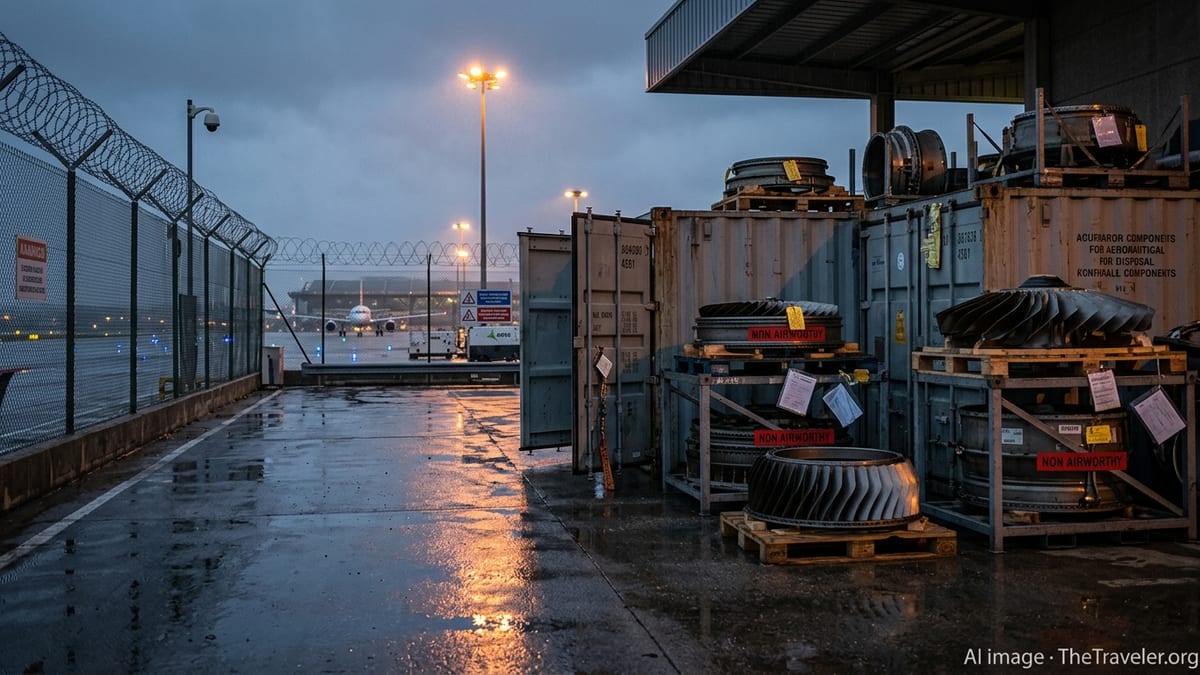
A Heist in Spain Raises Fresh Red Flags
According to aviation industry coverage, Spain’s national aviation authorities informed the European Union Aviation Safety Agency that a consignment of non airworthy turbofan engine parts, earmarked for disposal, was fraudulently redirected in late January 2026. The shipment reportedly involved multiple containers of components that had been formally declared unsuitable for use on commercial aircraft.
The parts were believed to be en route from a Spanish logistics provider to a facility where they would have been dismantled or scrapped. Instead, they were allegedly intercepted and diverted to an unknown third party, raising fears that the components could re-enter the global marketplace with falsified paperwork.
Early information suggests that the stolen items include components for widely used turbofan engine families rather than complete engines. While non airworthy parts are common in the supply chain as engines are overhauled and retired, they are usually tightly tracked and ultimately destroyed. Their disappearance at this stage is viewed by safety specialists as a serious breach in the disposal process.
Reports indicate that Spanish law enforcement bodies and aviation regulators are tracing the route of the missing containers and reviewing security protocols around the handling and scrapping of high-value aeronautical parts.
EASA Alerts Airlines and Maintenance Providers
Following notification from Spain, the European Union Aviation Safety Agency issued a safety information notice urging airlines, lessors, maintenance organizations, and parts distributors to verify that they have not acquired any of the referenced components. The alert, highlighted by trade publications, emphasizes the possibility that the stolen items could be offered for sale with forged airworthiness documentation.
The advisory calls on organizations to conduct targeted reviews of their purchasing records and inventories, cross-checking part numbers and serial numbers against lists provided by regulators and original equipment manufacturers. Any suspect parts are to be quarantined and traced back through their documentation chain.
This latest notification builds on a series of EASA communications over the past two years addressing suspected unapproved parts and falsified certification documents. Regulators in Europe and elsewhere have been refining procedures that require operators to quickly identify potentially compromised components and remove them before further operation.
Industry analysts describe the new Spanish case as particularly troubling because the components were already categorized as non airworthy before the theft, which suggests that any future appearance on the market would be deliberate misuse rather than paperwork error.
Fraud Cases Add Pressure to a Stretched Supply Chain
The Spanish theft comes against a backdrop of high-profile cases involving unapproved and fraudulently documented engine parts entering commercial fleets. Investigations into an independent UK-based distributor that supplied CFM56 engine components with falsified certificates prompted extensive inspections across airlines in 2023 and 2024, as reported by multiple international outlets.
Separate coverage has detailed concerns about counterfeit or mis-certified raw materials, including titanium, making their way into aircraft production. These cases have reinforced regulator messages that documentation alone cannot be taken at face value when safety-critical hardware is involved.
At the same time, global aviation remains under pressure from post-pandemic travel demand, supply chain bottlenecks, and long lead times for new engines and spares. Maintenance repair and overhaul providers have reported tight availability of certain components, particularly for popular single-aisle aircraft, which creates fertile ground for opportunistic suppliers offering hard-to-find parts.
Analysts note that while there is no indication so far that the Spanish stolen parts have been installed on aircraft, the incident heightens concern that bad actors may exploit shortages by pushing illicit components into legitimate supply chains.
Global Audits and Traceability Checks Intensify
In response to the latest alert, airlines and maintenance organizations are reported to be expanding internal audits focused on engine components, with particular scrutiny on parts acquired from third-party brokers or outside long-standing contractual channels. Review teams are examining the authenticity of airworthiness tags, accompanying shop reports, and the continuity of trace records from original manufacturers through any intermediaries.
Some oversight bodies had already issued broad guidance on suspected unapproved parts, recommending that operators verify the origin of certificates such as EASA Form 1 or FAA 8130-3 directly with the organizations named on those documents. The Spanish case is expected to accelerate adoption of those practices, turning what had been best practice into standard procedure for high-value engine pieces.
Industry specialists point out that many carriers now use digital tracking tools to follow components across their life cycle, but gaps remain when parts are bought or sold on the secondary market. The theft of a shipment already marked for destruction illustrates a different weak point, at the end of the life cycle, where robust security and documentation controls are equally critical.
For the moment, publicly available information indicates that regulators are treating the incident as a targeted criminal act rather than a systemic failure; however, the ongoing audits may reveal additional vulnerabilities in how obsolete engine parts are handled and documented worldwide.
What Travelers Should Know About the Safety Impact
Aviation safety experts emphasize that commercial aircraft systems are designed with multiple defensive layers intended to catch faulty or unapproved parts before they pose a hazard in flight. Engine overhauls are tightly regulated, and airlines typically rely on approved repair facilities that face their own stringent oversight and record-keeping requirements.
Reports from industry bodies indicate that, in previous cases involving falsified documents, affected parts were generally discovered during routine maintenance rather than after in-service failures. That track record, while not eliminating the risk, offers some reassurance that existing inspection regimes are capable of detecting anomalies.
Nonetheless, passenger advocates argue that repeated discoveries of stolen, counterfeit, or mis-certified components should prompt a wider conversation about investment in digital traceability, stronger penalties for fraudulent suppliers, and greater transparency around safety notices that involve parts used across multiple fleets.
As the investigation into the Spanish theft continues, airlines and regulators worldwide are expected to maintain heightened vigilance, particularly around turbofan engine parts moving through brokers and surplus channels. For travelers, the impact is more likely to appear in the form of precautionary maintenance, potential schedule adjustments, and continued headlines about the airworthiness of the hardware that keeps global aviation in motion.